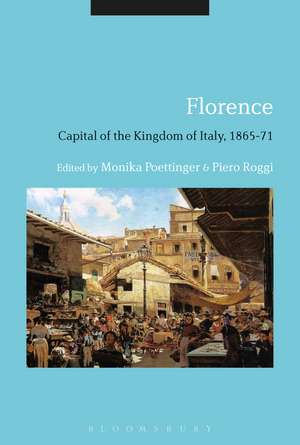
Florence
Editat de Monika Poettinger, Piero Roggien Limba Engleză Hardback – 28 dec 2017
Covering various aspects of politics, economics, culture and society, this book examines the impact that the short-lived experience of becoming the political and administrative centre of the Kingdom of Italy had on the Tuscan city, both immediately and in the years that followed. It reflects upon the urbanising changes that affected the appearance of the city and the introduction of various economic and cultural innovations. The volume also analyses the crisis caused by the eventual relocation of the capital to Rome and the subsequent bankruptcy of the communality which hampered Florence on the long road to modernity.
Florence: Capital of the Kingdom of Italy, 1865-71 is a fascinating study for all students and scholars of modern Italian history.
Preț: 799.59 lei
Preț vechi: 1206.81 lei
-34%
Puncte Express: 1199
Preț estimativ în valută:
141.35€ • 165.48$ • 123.44£
141.35€ • 165.48$ • 123.44£
Carte tipărită la comandă
Livrare economică 06-20 martie
Specificații
ISBN-13: 9781350013988
ISBN-10: 1350013986
Pagini: 376
Ilustrații: 32 bw illus
Dimensiuni: 161 x 240 x 25 mm
Greutate: 0.73 kg
Editura: Continnuum-3pl
Locul publicării:London, United Kingdom
ISBN-10: 1350013986
Pagini: 376
Ilustrații: 32 bw illus
Dimensiuni: 161 x 240 x 25 mm
Greutate: 0.73 kg
Editura: Continnuum-3pl
Locul publicării:London, United Kingdom
V-ar putea interesa
-
 Harry's WarHarry Drinkwater-21%Preț: 91.40 lei115.72 lei
 -
 Clausewitz: His Life and WorkDonald Stoker-25%Preț: 136.34 lei180.85 lei
 -
 The Kremlin ConspiracyDouglas BoydPreț: 93.15 lei
 -
 Spain: The Centre of the World 1519-1682Robert Goodwin-34%Preț: 78.49 lei118.58 lei
 -
 The FlaneurEdmund White-35%Preț: 48.54 lei74.55 lei
 -
 Silent Night: The Remarkable Christmas Truce Of 1914Stanley WeintraubPreț: 75.15 lei
 -
 The British and the Balkans: Forming Images of Foreign Lands, 1900-1950Dr Eugene MichailPreț: 263.92 lei
 -
 Colonial Food in Interwar ParisLauren Janes-34%Preț: 795.76 lei1204.44 lei
 -
 The Strange Death of Europe: Immigration, Identity, IslamDouglas Murray-26%Preț: 99.15 lei133.41 lei
 -
 Russian History through the Senses: From 1700 to the PresentProfessor Matthew P. Romaniello-18%Preț: 186.51 lei226.26 lei
 -
 The Myth of the Andalusian ParadiseDario Fernandez-MoreraPreț: 187.58 lei
 -
 Hidden AberdeenshireFiona-Jane Brown-17%Preț: 58.57 lei70.98 lei
Cuprins
List of Illustrations
List of Maps
List of Tables
List of Contributors
Introduction: Florence, Capital of the Kingdom of Italy, Monika Poettinger (Bocconi University, Italy)
Part I: Culture and Politics
1. A New Capital for Italy: Politics and Culture, Cosimo Ceccuti (University of Florence, Italy)
2. A Capital of Culture, Sergio Caruso (University of Florence, Italy)
3. Bettino Ricasoli: Economic Policy or House Management?, Piero Roggi (University of Florence, Italy)
4. Bettino Ricasoli and the Sunset of Moderate Hegemony, Daniele Bronzuoli (University of Siena, Italy)
5. Activist Literary Culture in Florence (1865-1871), Gino Tellini (University of Florence, Italy)
6. Science and Florence's Ruling Class - Fabio Bertini (University of Florence, Italy)
7. The Technical Institute of Florence at the Paris Universal Exhibition of 1867, Paolo Brenni, Laura Faustini, Elena Mechi (Science and Technology Foundation, Italy)
Part II: A Stroll Around Florence Capital of Italy
8. Popular Life in the Streets of Florence, Zeffiro Ciuffoletti and Maria Grazia Proli (University of Florence, Italy)
9. A Stroll around Florence: Places of Power, Places of Pleasure, Maria Carla Monaco (Independent Scholar, Italy)
Part III: Economy and Society
10. An Economy Stuck at the Crossroads to Modernity, Andrea Giuntini (University of Modena and Reggio Emilia, Italy)
11. Florentine, Italian and Foreign Entrepreneurs in the Urban Renovation of Florence, Daniela Manetti (University of Pisa, Italy)
12. Enterprises and Entrepreneurs in Tuscany, Monika Poettinger (Bocconi University, Italy)
13. Food Availability and Consumption Patterns in Florence and Tuscany after Italy's Unification, Francesco Ammannati (Bocconi University, Italy)
14. Banks and Capitalists in Florence in the Decades after Unification, Marco Cini (University of Pisa, Italy) and Simone Fagioli (Italian Association of Archivists, Italy)
15. Straw Hats: The Invisible Work of Women behind the International Image of Florence, Monica Pacini (University of Florence, Italy)
Bibliography
Index
List of Maps
List of Tables
List of Contributors
Introduction: Florence, Capital of the Kingdom of Italy, Monika Poettinger (Bocconi University, Italy)
Part I: Culture and Politics
1. A New Capital for Italy: Politics and Culture, Cosimo Ceccuti (University of Florence, Italy)
2. A Capital of Culture, Sergio Caruso (University of Florence, Italy)
3. Bettino Ricasoli: Economic Policy or House Management?, Piero Roggi (University of Florence, Italy)
4. Bettino Ricasoli and the Sunset of Moderate Hegemony, Daniele Bronzuoli (University of Siena, Italy)
5. Activist Literary Culture in Florence (1865-1871), Gino Tellini (University of Florence, Italy)
6. Science and Florence's Ruling Class - Fabio Bertini (University of Florence, Italy)
7. The Technical Institute of Florence at the Paris Universal Exhibition of 1867, Paolo Brenni, Laura Faustini, Elena Mechi (Science and Technology Foundation, Italy)
Part II: A Stroll Around Florence Capital of Italy
8. Popular Life in the Streets of Florence, Zeffiro Ciuffoletti and Maria Grazia Proli (University of Florence, Italy)
9. A Stroll around Florence: Places of Power, Places of Pleasure, Maria Carla Monaco (Independent Scholar, Italy)
Part III: Economy and Society
10. An Economy Stuck at the Crossroads to Modernity, Andrea Giuntini (University of Modena and Reggio Emilia, Italy)
11. Florentine, Italian and Foreign Entrepreneurs in the Urban Renovation of Florence, Daniela Manetti (University of Pisa, Italy)
12. Enterprises and Entrepreneurs in Tuscany, Monika Poettinger (Bocconi University, Italy)
13. Food Availability and Consumption Patterns in Florence and Tuscany after Italy's Unification, Francesco Ammannati (Bocconi University, Italy)
14. Banks and Capitalists in Florence in the Decades after Unification, Marco Cini (University of Pisa, Italy) and Simone Fagioli (Italian Association of Archivists, Italy)
15. Straw Hats: The Invisible Work of Women behind the International Image of Florence, Monica Pacini (University of Florence, Italy)
Bibliography
Index
Recenzii
A fascinating account of Florentine life in the nineteenth century, and a snapshot of the city when it was the capital of Italy, this series of essays shows the city in all its delightful complexity, poised between tradition and modernity, political conservatism and cultural innovation. For lovers of Florence seeking to know more about the history of the modern city, and the material realities behind its Renaissance facade, this book is a must-read.
This book provides a comprehensive history of Florence between 1865 and 1871. An encompassing introduction by one of the editors and 15 contributions show the profound and long-lasting changes resulting from the establishment of Florence as temporary capital of Italy. Readers will learn a lot from this illuminating text and its rich illustrations.
This book provides a comprehensive history of Florence between 1865 and 1871. An encompassing introduction by one of the editors and 15 contributions show the profound and long-lasting changes resulting from the establishment of Florence as temporary capital of Italy. Readers will learn a lot from this illuminating text and its rich illustrations.