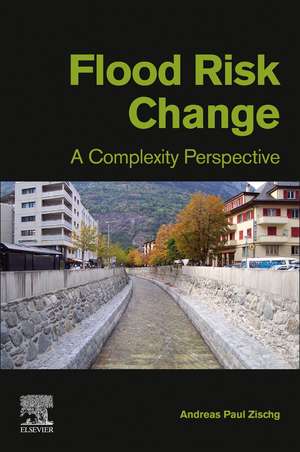
Flood Risk Change: A Complexity Perspective
Autor Andreas Paul Zischgen Limba Engleză Paperback – 2 sep 2022
Researchers studying flood risk, environmental engineering, disaster risk reduction, and land use, as well as those in industry and responsible for policy, will find this an invaluable resource.
- Comprehensive overview of key drivers of change, including both natural drivers and socioeconomic drivers
- Presents different modeling frameworks and setups for considering complexity in flood risk analysis and management
- Includes both theoretical research and practical applications as told through case studies
Preț: 723.04 lei
Preț vechi: 1048.45 lei
-31%
Puncte Express: 1085
Carte tipărită la comandă
Livrare economică 01-15 decembrie
Livrare prin curier în România Termenul estimat este afișat lângă disponibilitate.
Transport gratuit pentru acest produs Plată online sau ramburs, în funcție de opțiunile comenzii.
Retur gratuit în 14 zile Comandă securizată și suport în română.
Specificații
ISBN-13: 9780128220115
ISBN-10: 0128220112
Pagini: 314
Dimensiuni: 152 x 229 x 19 mm
Greutate: 0.42 kg
Editura: ELSEVIER SCIENCE
ISBN-10: 0128220112
Pagini: 314
Dimensiuni: 152 x 229 x 19 mm
Greutate: 0.42 kg
Editura: ELSEVIER SCIENCE
Cuprins
1. Key drivers of flood risk change2. Disentangling drivers of change3. Rivers and floodplains as complex adaptive systems?4. Modelling spatio-temporal dynamics of flood risk change 5. Confronting complexity in flood risk management
Notă biografică
Andreas Paul Zischg is a geographer by training and has worked for many years in flood risk research and flood risk management. He was a consultant for public authorities responsible for water resources management, flood risk management, land use planning, and environmental protection and has built experience in adapting disciplinary government practices to the complex challenges of our times, e.g. by developing transdisciplinary and participative planning processes, adaptive management approaches, and by introducing participatory modelling framework in decision making processes. In these years, he acknowledged the urgent need for methods that enable us to consider, confront, and tackle the complexity inherent in solving current problems. Currently, he is a senior scientist at the University of Bern, Switzerland. His research focuses on the development of coupled component modelling frameworks for analysing and modelling complex processes and changes that are shaping flood risks in the Anthropocene.