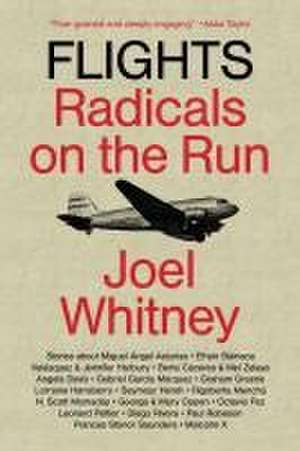
Flights
Autor Joel Whitneyen Limba Engleză Paperback – 21 mai 2024
Suntem de părere că volumul Flights reprezintă o extensie necesară a literaturii dedicate disidenței politice, aducând în prim-plan mecanismele prin care aparatul de stat a forțat exilul unor figuri culturale emblematice. Față de abordările biografice clasice, Joel Whitney propune o structură de tip portret de grup, legând experiențele individuale de o cronologie a supravegherii și cenzurii care se extinde de la începutul Războiului Rece până în prezentul marcat de cazul lui Julian Assange. Ne-a atras atenția modul în care autorul integrează noi profiluri ale unor activiști precum Malcolm X sau Angela Davis, transformând „fuga” dintr-un act de supraviețuire într-un gest de rezistență creativă. Această lucrare continuă cercetarea începută de autor în Finks, unde a explorat influența politicului asupra presei americane. Dacă în lucrarea anterioară accentul cădea pe instituții, în Flights accentul se mută pe individul aflat în conflict direct cu puterea. Cititorii familiarizați cu Memoirs de Pablo Neruda vor aprecia aici perspectiva externă, documentată riguros, asupra perioadei în care poetul a fost urmărit de autorități, completând detaliile intime cu un context politic global. De asemenea, spre deosebire de Unexpected Routes, care se concentrează pe refugiații celui de-al Doilea Război Mondial, Flights oferă o analiză mai largă, incluzând lupta împotriva fascismului, dar și a politicilor de supraveghere moderne. Ritmul este alert, susținut de detalii factuale despre viața clandestină, oferind o perspectivă lucidă asupra prețului plătit pentru libertatea de exprimare în secolul american.
Preț: 130.23 lei
Carte disponibilă
Livrare economică 07-21 septembrie
Livrare express 21-27 august pentru 31.37 lei
Specificații
ISBN-10: 1682194310
Pagini: 390
Dimensiuni: 138 x 206 x 23 mm
Greutate: 0.46 kg
Editura: OR Books
De ce să citești această carte
Această carte este esențială pentru cei interesați de istoria politică și drepturile omului. Cititorul câștigă o înțelegere profundă a modului în care supravegherea de stat a modelat cultura secolului XX. Joel Whitney oferă un argument solid împotriva cenzurii, demonstrând prin exemplele unor genii precum Gabriel García Márquez că exilul, deși traumatic, a fost adesea singura cale pentru a păstra integritatea intelectuală în fața opresiunii.
Descriere scurtă
In 1949, the poet Pablo Neruda escaped anti-communist Chile on horseback. Scrambling across Andean rivers disguised as an ornithologist named Antonio Ruiz, he had days before served as an elected senator in the Chilean legislature. Now he was on the run from enforcers of the Truman doctrine, hiding in safehouses while a police dragnet closed in on him. During his flight, his masterpiece, Canto General, was printed as samizdat, in secret, with a false dust jacket affixed.
A year later, poets George and Mary Oppen crossed into the Sonoran Desert, fleeing F.B.I. agents who surveilled their house in the L.A. suburbs. The Oppens spent most of the 1950s as political refugees in Mexico City, exiled from the United States for their relief work with the Communist Party, to stop evictions during the Great Depression. Before Neruda would win the Nobel Prize in literature and George Oppen would add the Pulitzer Prize in poetry to his World War II Purple Heart, they were refugees from anti-communism.
What did these refugees feel as they fled their homelands and friends? Wanted for a crime she did not commit, Professor Angela Davis went on the run twenty years after the Oppens, describing the struggle against panic in her nightly safehouse transfers: “Living as a fugitive means resisting hysteria, distinguishing between the creations of a frightened imagination and the real signs that the enemy is near.” In her quest “to elude him, outsmart him,” she recalled, “Thousands of my ancestors had waited, as I had…for nightfall to cover their steps…”
With new profiles of Lorraine Hansberry, Malcolm X, Paul Robeson, Diego Rivera, Angela Davis, Gabriel García Márquez, Graham Greene, Miguel Ángel Asturias, Octavio Paz, Frances Stonor Saunders, Guatemalan guerrilla fighter Everado and his American wife, Jennifer Harbury, Nobel Peace laureate Rigoberta Menchú, deposed Honduran President Mel Zelaya and murdered Lenca environmentalist Berta Cáceres, these artists and activists took imaginative and other flight from American oppressors and their allies, from the Truman through the Trump presidencies.
At once a group portrait of these geniuses of creative escape, Flights is also a prehistory (and indictment) of American mass surveillance culminating in Snowden’s revelations, of torture culminating in Abu Ghraib, of censorship culminating in the incarceration of journalist Julian Assange, of fascism culminating in January 6, and of political murder culminating in the Bush-Obama-Trump air assassination program.