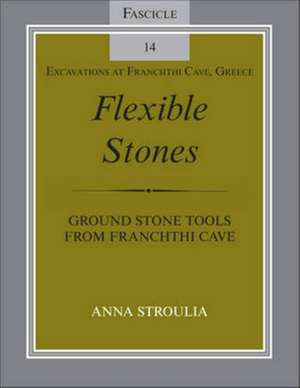
Flexible Stones
Autor Anna Strouliaen Limba Engleză Paperback – 30 mar 2010
Preț: 340.87 lei
Puncte Express: 511
Carte tipărită la comandă
Livrare economică 26 decembrie 26 - 09 ianuarie 27
Livrare prin curier în România Termenul estimat este afișat lângă disponibilitate.
Transport gratuit de la 400.00 lei Plată online sau ramburs, în funcție de opțiunile comenzii.
Retur gratuit în 14 zile Comandă securizată și suport în română.
Specificații
ISBN-13: 9780253221780
ISBN-10: 0253221781
Pagini: 242
Ilustrații: 30 b&w illustrations 2 maps
Dimensiuni: 216 x 280 x 13 mm
Greutate: 0.62 kg
Editura: Indiana University Press
ISBN-10: 0253221781
Pagini: 242
Ilustrații: 30 b&w illustrations 2 maps
Dimensiuni: 216 x 280 x 13 mm
Greutate: 0.62 kg
Editura: Indiana University Press
V-ar putea interesa
-
 Death and Dying in the Neolithic Near EastKarina Croucher-30%Preț: 1132.29 lei1615.95 lei
-
 King of the CrocodyliansDavid R SchwimmerPreț: 314.95 lei
-
 The Body in HistoryJohn RobbPreț: 361.85 lei
-
 Prehistoric Rock ArtPaul G Bahn-21%Preț: 226.47 lei285.85 lei
-
 The Comparative Archaeology of Complex SocietiesMichael E. SmithPreț: 285.94 lei
-
 The Archaeology of ChinaLi LiuPreț: 370.82 lei
-
 Becoming HumanIain MorleyPreț: 363.89 lei
-
 Organizing Bronze Age SocietiesTimothy EarlePreț: 315.65 lei
-
 Space and Sculpture in the Classic Maya CityAlexander Parmington-14%Preț: 751.58 lei873.93 lei
-
 From Chiefdom to State in Early IrelandD. Blair Gibson-14%Preț: 749.49 lei871.51 lei
-
 The Archaeology of Power and Politics in EurasiaCharles W Hartley-28%Preț: 617.10 lei853.89 lei
-
 Stone Tools and Fossil BonesManuel Domínguez Rodrigo-14%Preț: 865.87 lei1006.83 lei
-
 Reassessing Paleolithic SubsistenceEugène Morin-31%Preț: 632.41 lei915.01 lei
-
 -14%Preț: 843.67 lei981.01 lei
Cuprins
Acknowledgments
Chapter One Introduction
Introduction to the site and assemblage
Classification
Describing the material
Why not a ground stone tool stratigraphy?
Tool names
Structure of the study
Abbreviations used in the text
Chapter Two The Pre-Neolithic Material
Introduction
The Palaeolithic period
The Mesolithic period
Lower Mesolithic
Upper Mesolithic
Final Mesolithic
Possible Pre-Neolithic specimens
Chapter Three The Neolithic Material (1)
Introduction to the Neolithic period
Passive tools
Introduction
1. Passive open tools (Popen)
Introduction
Raw material
Aspects of manufacture
Technomorphological characteristics
Aspects of use
Discussion
2. Passive tools with cavity (Pcav)
3. Passive miscellanea (Pmisc)
Chapter Four The Neolithic Material (2)
Active tools
Introduction
1. Active cutting edge tools (Acut)
Introduction
Raw material
Aspects of manufacture
Technomorphological characteristics
Aspects of use
Epilogue
2. Active discoidal tools (Adisc)
Introduction
Raw material and manufacture
Technomorphological characteristics
Aspects of use
3. Active rectangular tools (Arect)
Introduction
Raw material and manufacture
Technomorphological characteristics
Aspects of use
4. Active square or circular tools (Asquare-circ)
Introduction
Raw material and manufacture
Technomorphological characteristics
Aspects of use
5. Active tools used with ends (Aend)
Introduction
Raw material and manufacture
Technomorphological characteristics
Aspects of use
6. Active globular tools (Aglobe)
6.1 Active globular tools with stains (Aglobe-stain)
Introduction
Raw material and manufacture
Technomorphological characteristics
Aspects of use
6.2 Active globular tools without stains (Aglobe-nostain)
Introduction
Raw material and manufacture
Technomorphological characteristics
Aspects of use
7. Active miscellanea (Amisc)
Introduction
7.1 Active miscellanea 1 (Amisc-1)
7.2 Active miscellanea 2 (Amisc-2)
Epilogue
Chapter Five Summary and Conclusions
Raw material
Manufacture
Use and discard
Chronological distribution
Spatial Distribution
References
Appendixes
Appendix A
Appendix B
Appendix C
Figures
Index
Plates (CD-ROM)
Recenzii
"[This series makes] an exceptional contribution to the hitherto very inadequate knowledge of this period in Greece." Antiquity
Notă biografică
Anna Stroulia is an archaeologist and social anthropologist who teaches at the University of Southern Indiana. She is author (with Susan Buck Sutton) of the forthcoming Archaeology in Situ: Sites, Archaeology and Communities in Greece.
Descriere
Understanding the ground stone tools of Greeces famed Franchthi Cave