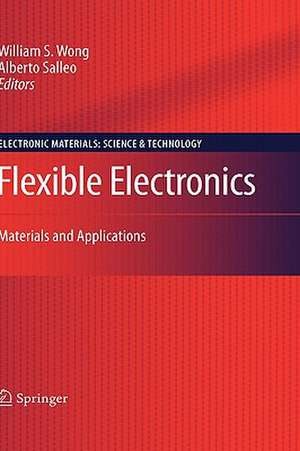
Flexible Electronics
Editat de William S Wong, Alberto Salleoen Limba Engleză Hardback – 28 apr 2009
Resursele tehnice și datele experimentale centralizate în acest volum oferă o fundamentare riguroasă pentru inginerii care proiectează noua generație de dispozitive portabile și senzori integrați. Găsim în această carte o analiză exhaustivă a avantajelor oferite de electronica flexibilă — de la robustețe și greutate redusă, până la factori de formă neconvenționali — care depășesc limitările substraturilor rigide clasice. Structura volumului urmărește o progresie logică, pornind de la fundamentul teoretic al mecanicii filmelor subțiri și alinierea straturilor, continuând cu procesarea la temperaturi joase a materialelor convenționale pe folii de plastic și culminând cu metode inovatoare de imprimare și procesare roll-to-roll. Reținem atenția deosebită acordată fizicii dispozitivelor, unde sunt explicate relațiile dintre structura polimerilor semiconducători și proprietățile tranzistorilor cu efect de câmp. Complementar lui Introduction to Flexible Electronics, care se concentrează pe aspectele fundamentale de manual, lucrarea editată de William S Wong și Alberto Salleo pune accent pe reperele de performanță (benchmarks) și pe identificarea proceselor specifice de fabricație pentru aplicații industriale precum celulele solare cu heterojoncțiune sau sistemele micro-electro-mecanice (MEMS). Prin integrarea unor studii detaliate despre nanotuburile de carbon utilizate ca conductori transparenți și despre electronica pe bază de oxizi metalici de tranziție, volumul reușește să acopere decalajul dintre cercetarea de laborator și implementarea pe scară largă. Abordarea este esențialmente tehnică, oferind soluții pentru provocările legate de curbura substratului și stabilitatea electronică în condiții de stres mecanic.
Preț: 1215.21 lei
Preț vechi: 1481.96 lei
-18%
Carte tipărită la comandă
Livrare economică 05-19 decembrie
Specificații
ISBN-10: 0387743626
Pagini: 462
Ilustrații: XVIII, 462 p. 245 illus.
Dimensiuni: 161 x 241 x 30 mm
Greutate: 0.93 kg
Ediția:2009 edition
Editura: Springer Us
Locul publicării:New York, NY, United States
V-ar putea interesa
-
 Concepts in Organic ElectronicsStephen R. Forrest-9%Preț: 352.46 lei386.06 lei
 -
 Organic Electronics: Foundations to ApplicationsStephen R. Forrest-31%Preț: 991.69 lei1432.51 lei
 -
 -11%Preț: 668.13 lei750.70 lei
 -
 Introduction to Microfabrication 2eSami Franssila-19%Preț: 493.30 lei609.01 lei
 -
 -23%Preț: 1262.27 lei1639.31 lei
 -
 Thin Film TransistorsYue Kuo-24%Preț: 1840.50 lei2421.72 lei
 -
 Molecular & Organic Electronics DevicesD K Aswal-26%Preț: 1554.07 lei2113.72 lei
 -
 -30%Preț: 97.81 lei139.80 lei
 -
 -14%Preț: 1320.28 lei1535.21 lei
 -
 Electrical Memory Materials and DevicesWen-Chang Chen-14%Preț: 1239.15 lei1440.87 lei
 -
 Preț: 311.21 lei
 -
 Preț: 411.30 lei
 -
 -14%Preț: 997.82 lei1160.26 lei
 -
 -14%Preț: 883.53 lei1027.36 lei
 -
 Flexible Electronics for Electric VehiclesSanjeet Dwivedi-24%Preț: 1167.59 lei1536.30 lei
 -
 Flexible OLEDsMitsuhiro KodenPreț: 413.73 lei
 -
 Flexible ElectronicsYongan Huang-24%Preț: 1065.59 lei1402.09 lei
Public țintă
ResearchDe ce să citești această carte
Recomandăm acest volum cercetătorilor și inginerilor din industria semiconductorilor care doresc să treacă de la designul rigid la cel flexibil. Cititorul câștigă o înțelegere profundă a proceselor roll-to-roll și a metodelor de imprimare necesare pentru producția de masă a senzorilor și celulelor fotovoltaice. Este o resursă esențială pentru optimizarea performanței tranzistorilor pe substraturi plastice, oferind date concrete despre limitele termice și mecanice ale materialelor actuale.
Despre autor
William S. Wong și Alberto Salleo sunt cercetători de prestigiu, cu o expertiză vastă în domeniul materialelor avansate și al dispozitivelor electronice. William S. Wong este recunoscut pentru contribuțiile sale în domeniul procesării materialelor semiconductoare și integrării dispozitivelor pe substraturi flexibile, având o activitate marcată de inovație în tehnologiile de afișaj. Alberto Salleo, profesor la Universitatea Stanford, coordonează un grup de cercetare axat pe electronica organică și caracterizarea structurală a polimerilor, fiind un lider de opinie în ceea ce privește fizica semiconductorilor soluționabili, aspecte reflectate direct în calitatea științifică a acestui volum.
Descriere scurtă
Topics covered include:
- An overview and history of flexible electronics
- Novel materials for solution-processable thin-film electronic devices and their properties
- Low-temperature processing of conventional materials and devices on plastic foils
- Novel techniques, such as printing and roll-to-roll processing, for large-area flexible electronics manufacturing
- Materials and device physics relevant to flexible electronics
- Device integration on flexible substrates
- Mechanical and electronic characteristics for thin-film transistors and nano-scale transparent conductors on flexible platforms
- Applications towards flexible displays, sensors, actuators, solar energy, radio-frequency identification, and micro-electro-mechanical systems
Cuprins
Notă biografică
Alberto Salleo received his physics degree in 1994 from Ecole Polytechnique in France; his M.S. from the University of California, Berkeley in 1998; and his Ph.D. from the University of California, Berkeley, in 2001. He has held several positions such as visiting scholar and graduate student researcher and currently is a researcher in the Electronic Materials Laboratory at the Palo Alto Research Center. In January, 2006, he will become an Assistant Professor for the Department of Materials Science and Engineering at Stanford University.