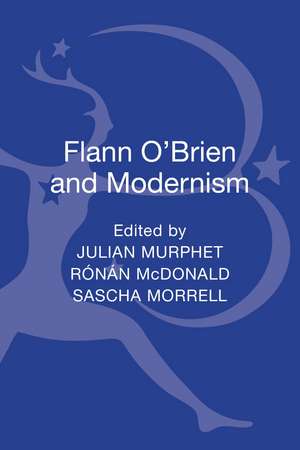
Flann O'Brien & Modernism
Editat de Julian Murphet, Dr Ronan McDonald, Sascha Morrellen Limba Engleză Hardback – 25 sep 2014
The distinct themes and concerns tracked in Flann O'Brien & Modernism include characterization in branching narrative forms; the ethics and paradoxes of naming; parody and homage; lies and deception; theatricality; sexuality; technology and transport; and the inevitable matter of drink and intoxication.
Taken together, these specific topics construct a mosaic image of O'Brien as an exemplary modernist auteur, abreast of all the most salient philosophical and technical concerns affecting literary production in the period immediately before and after World War Two.
| Toate formatele și edițiile | Preț | Express |
|---|---|---|
| Paperback (1) | 196.88 lei 6-8 săpt. | |
| Bloomsbury Publishing – 25 sep 2014 | 196.88 lei 6-8 săpt. | |
| Hardback (1) | 855.20 lei 6-8 săpt. | |
| Bloomsbury Publishing – 25 sep 2014 | 855.20 lei 6-8 săpt. |
Preț: 855.20 lei
Preț vechi: 1152.54 lei
-26%
Puncte Express: 1283
Preț estimativ în valută:
151.35€ • 176.88$ • 131.40£
151.35€ • 176.88$ • 131.40£
Carte tipărită la comandă
Livrare economică 19 februarie-05 martie
Preluare comenzi: 021 569.72.76
Specificații
ISBN-13: 9781623564872
ISBN-10: 1623564875
Pagini: 248
Ilustrații: 8 halftone illus
Dimensiuni: 140 x 216 x 23 mm
Greutate: 0.44 kg
Ediția:New.
Editura: Bloomsbury Publishing
Colecția Bloomsbury Academic
Locul publicării:New York, United States
ISBN-10: 1623564875
Pagini: 248
Ilustrații: 8 halftone illus
Dimensiuni: 140 x 216 x 23 mm
Greutate: 0.44 kg
Ediția:New.
Editura: Bloomsbury Publishing
Colecția Bloomsbury Academic
Locul publicării:New York, United States
V-ar putea interesa
-
 The Oxford Handbook of Global ModernismsMark Wollaeger-33%Preț: 351.33 lei522.72 lei
 -
 Loverly: The Life and Times of My Fair LadyDominic McHughPreț: 345.05 lei
 -
 The Life of GalileoBertolt Brecht-23%Preț: 74.84 lei96.81 lei
 -
 The Cambridge Introduction to Samuel BeckettRonan McDonaldPreț: 233.30 lei
 -
 Jane Austen: The Complete Novels in One SittingJennifer Kasius-29%Preț: 33.57 lei47.33 lei
 -
 Jane Smiley's A Thousand Acres: A Reader's GuideSusan FarrellPreț: 120.01 lei
 -
 Bret Easton Ellis's American Psycho: A Reader's GuideJulian Murphet-19%Preț: 146.34 lei181.46 lei
 -
 Zadie Smith's White TeethClaire Squires-19%Preț: 120.09 lei148.68 lei
 -
 Arundhati Roy's The God of Small ThingsDr Julie Mullaney-19%Preț: 120.01 lei147.90 lei
 -
 The Death of the CriticDr Ronan McDonald-42%Preț: 67.11 lei116.16 lei
 -
 The Science Fiction HandbookDr Nick Hubble-22%Preț: 192.06 lei247.41 lei
 -
 Sarah Waters: Contemporary Critical PerspectivesDr Kaye Mitchell-18%Preț: 183.09 lei224.09 lei
 -
 The Life of Ian FlemingJohn Pearson-26%Preț: 93.05 lei125.81 lei
 -
 Stephen King's the Dark Tower ConcordanceRobin FurthPreț: 195.48 lei
 -
 Music in Shakespeare: A DictionaryProfessor Christopher R. Wilson-28%Preț: 281.29 lei392.02 lei
 -
 Modernism: Evolution of an IdeaProfessor Sean Latham-18%Preț: 190.55 lei232.29 lei
 -
 The OdysseyHomer-18%Preț: 117.90 lei143.13 lei
 -
 Jonathan Franzen: The Comedy of RageProfessor Philip Weinstein-42%Preț: 209.21 lei361.15 lei
 -
 -24%Preț: 197.01 lei257.83 lei
 -
 Whiter than Snow & Diary of an Action ManMike Kenny-18%Preț: 69.40 lei84.19 lei
 -
 Shakespeare Goes to ParisJohn PemblePreț: 332.40 lei
 -
 Twelfth Night: Third SeriesWilliam Shakespeare-9%Preț: 68.84 lei75.85 lei
Cuprins
Acknowledgements
Contributors
Introduction
Rónán McDonald, University of New South Wales, Australia and Julian Murphet, University of New South Wales, Australia
Chapter 1 Making Evil, with Flann O'Brien
Sean Pryor, University of New South Wales, Australia
Chapter 2 Mythomaniac modernism: lying and bullshit in Flann O'Brien
John Attridge, University of New South Wales, Australia
Chapter 3 'The outward accidents of illusion': O'Brien and the Theatrical
Stefan Solomon, University of Sydney, Australia
Chapter 4 The Ghost of 'Poor Jimmy Joyce': A Portrait of the Artist as a Reluctant Modernist
Stephen Abblitt, La Trobe University, Australia
Chapter 5 'Do You Know What I'm Going to Tell You?': Flann O'Brien, Risibility and the Anxiety of Influence
David Kelly, University of Sydney, Australia
Chapter 6 An Béal Bocht, Translation and the Proper Name
Maebh Long, University of the South Pacific, Fiji
Chapter 7 Ploughmen Without Land: Flann O'Brien and Patrick Kavanagh
Joseph Brooker, University of London, United Kingdom
Chapter 8 Flann O'Brien's Ulysses: Marginalia and the Modernist Mind
Dirk Van Hulle, University of Antwerp, Belgium
Chapter 9 'Truth is an Odd Number': Flann O'Brien and Infinite Imperfection
Baylee Brits, University of New South Wales, Australia
Chapter 10 'An astonishing parade of nullity': Nihilism in The Third Policeman
Rónán McDonald, University of New South Wales, Australia
Chapter 11 Flann O'Brien and Modern Character
Julian Murphet, University of New South Wales, Australia
Chapter 12 'No unauthorized boozing': Flann O'Brien and the Thirsty Muse
Sam Dickson
Chapter 13 Soft drink, hard drink, and literary (re)production in Flann O'Brien and Frank Moorhouse
Sascha Morrell, University of New England, Australia
Chapter 14 Flann O'Brien's Aestho-Autogamy
Mark Steven, University of New South Wales, Australia
Chapter 15 Modernist Wheelmen
Mark Byron, University of Sydney, Australia
Contributors
Introduction
Rónán McDonald, University of New South Wales, Australia and Julian Murphet, University of New South Wales, Australia
Chapter 1 Making Evil, with Flann O'Brien
Sean Pryor, University of New South Wales, Australia
Chapter 2 Mythomaniac modernism: lying and bullshit in Flann O'Brien
John Attridge, University of New South Wales, Australia
Chapter 3 'The outward accidents of illusion': O'Brien and the Theatrical
Stefan Solomon, University of Sydney, Australia
Chapter 4 The Ghost of 'Poor Jimmy Joyce': A Portrait of the Artist as a Reluctant Modernist
Stephen Abblitt, La Trobe University, Australia
Chapter 5 'Do You Know What I'm Going to Tell You?': Flann O'Brien, Risibility and the Anxiety of Influence
David Kelly, University of Sydney, Australia
Chapter 6 An Béal Bocht, Translation and the Proper Name
Maebh Long, University of the South Pacific, Fiji
Chapter 7 Ploughmen Without Land: Flann O'Brien and Patrick Kavanagh
Joseph Brooker, University of London, United Kingdom
Chapter 8 Flann O'Brien's Ulysses: Marginalia and the Modernist Mind
Dirk Van Hulle, University of Antwerp, Belgium
Chapter 9 'Truth is an Odd Number': Flann O'Brien and Infinite Imperfection
Baylee Brits, University of New South Wales, Australia
Chapter 10 'An astonishing parade of nullity': Nihilism in The Third Policeman
Rónán McDonald, University of New South Wales, Australia
Chapter 11 Flann O'Brien and Modern Character
Julian Murphet, University of New South Wales, Australia
Chapter 12 'No unauthorized boozing': Flann O'Brien and the Thirsty Muse
Sam Dickson
Chapter 13 Soft drink, hard drink, and literary (re)production in Flann O'Brien and Frank Moorhouse
Sascha Morrell, University of New England, Australia
Chapter 14 Flann O'Brien's Aestho-Autogamy
Mark Steven, University of New South Wales, Australia
Chapter 15 Modernist Wheelmen
Mark Byron, University of Sydney, Australia
Recenzii
The essays in the collection do a good job of showing how O'Brien's work should be read within the context of trans-European modernism.
Flann O'Brien often denounced modernism but with a vehemence that was a kind of homage. This collection of essays, in exploring that uneasy but deep relationship, offers a wholly new perspective on his writings and one which goes well beyond the fall-back of treating them as a project on the fringes of Irish literature. In a sequence of deft, original, sometimes astounding studies, the authors take O'Brien's work as a test-case of the modern world. In their analyses, they go well beyond all narrowing models of Irish Studies and at the same time challenge and complicate many received paradigms of modernism. The result is an audacious and satisfying book. More than a collection of random essays on an eccentric, this volume suggests that the eccentric may simply be the person with a deeper than average understanding of what passes as normality. It is a major addition to the developing debate about Flann O'Brien.
Some day in a civilized world there will be a Comic's Corner in the Cathedral of Great Literature and Flann O'Brien will occupy an honourable place there. He remains for now an enigmatic figure, enjoying cult rather than canonical status, and possessed of so many variable and unstable identities as to be finally elusive. Elegantly introduced and intelligently developed, this study delivers many sharp and timely critical takes on O'Brien's evolving narrative styles and fixed obsessions. The writer that emerges here is an internationally-minded late modernist vertiginously distracted and delighted in the maze (without exit) of Irish fiction and the fictions of Irishness.
Reluctant modernist' or 'devilish apostate': this collection powerfully and decisively reassesses the relationship of Flann O'Brien to literary modernism. It marks a particularly significant contribution in refusing the binaries that can constrict an appreciation of O'Brien, who now rightly emerges as Irish and European, local and international, journalist and novelist. Most welcome of all, it reminds its readers of the recalcitrant, the comic, the gleeful, the subversive--and all that makes Flann O'Brien worth reading.
Through a series of well-considered interventions, the essays collected here succeed both in advancing the Irish modernist goal "to reveal not only the importance of modernism to Ireland, but also of Ireland to modernism" and in demonstrating the untapped potential of O'Nolan's mercurial, multi-genre writing for the future of new modernist inquiry. . The strong case that O'Nolan's unruly art recasts modernism's vestiges amid shifts in the field makes this collection highly recommended not only to O'Nolan scholars but also to those with a broader interest in Irish and (new) modernist studies. Indeed, liberated from calcified myths, O'Nolan's work emerges as an important coordinate against which to reconsider commonplaces about Joyce's own place in the modernist canon.
Flann O'Brien often denounced modernism but with a vehemence that was a kind of homage. This collection of essays, in exploring that uneasy but deep relationship, offers a wholly new perspective on his writings and one which goes well beyond the fall-back of treating them as a project on the fringes of Irish literature. In a sequence of deft, original, sometimes astounding studies, the authors take O'Brien's work as a test-case of the modern world. In their analyses, they go well beyond all narrowing models of Irish Studies and at the same time challenge and complicate many received paradigms of modernism. The result is an audacious and satisfying book. More than a collection of random essays on an eccentric, this volume suggests that the eccentric may simply be the person with a deeper than average understanding of what passes as normality. It is a major addition to the developing debate about Flann O'Brien.
Some day in a civilized world there will be a Comic's Corner in the Cathedral of Great Literature and Flann O'Brien will occupy an honourable place there. He remains for now an enigmatic figure, enjoying cult rather than canonical status, and possessed of so many variable and unstable identities as to be finally elusive. Elegantly introduced and intelligently developed, this study delivers many sharp and timely critical takes on O'Brien's evolving narrative styles and fixed obsessions. The writer that emerges here is an internationally-minded late modernist vertiginously distracted and delighted in the maze (without exit) of Irish fiction and the fictions of Irishness.
Reluctant modernist' or 'devilish apostate': this collection powerfully and decisively reassesses the relationship of Flann O'Brien to literary modernism. It marks a particularly significant contribution in refusing the binaries that can constrict an appreciation of O'Brien, who now rightly emerges as Irish and European, local and international, journalist and novelist. Most welcome of all, it reminds its readers of the recalcitrant, the comic, the gleeful, the subversive--and all that makes Flann O'Brien worth reading.
Through a series of well-considered interventions, the essays collected here succeed both in advancing the Irish modernist goal "to reveal not only the importance of modernism to Ireland, but also of Ireland to modernism" and in demonstrating the untapped potential of O'Nolan's mercurial, multi-genre writing for the future of new modernist inquiry. . The strong case that O'Nolan's unruly art recasts modernism's vestiges amid shifts in the field makes this collection highly recommended not only to O'Nolan scholars but also to those with a broader interest in Irish and (new) modernist studies. Indeed, liberated from calcified myths, O'Nolan's work emerges as an important coordinate against which to reconsider commonplaces about Joyce's own place in the modernist canon.