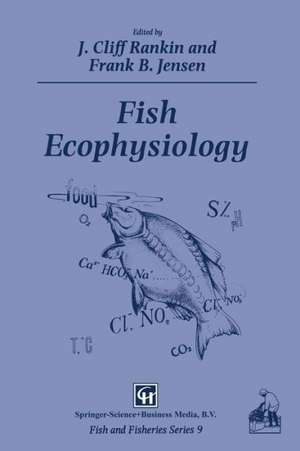
Fish Ecophysiology: Fish & Fisheries Series, cartea 9
Autor J.C. Rankin, Frank B. Jensenen Limba Engleză Paperback – 3 oct 2013
Din seria Fish & Fisheries Series
- 18%
 Preț: 1156.63 lei
 -
 Preț: 473.04 lei
 - 18%
 Preț: 1281.81 lei
 - 18%
 Preț: 1264.36 lei
 - 18%
 Preț: 1269.02 lei
 - 18%
 Preț: 906.17 lei
 - 18%
 Preț: 1278.48 lei
 - 18%
 Preț: 1178.99 lei
 - 15%
 Preț: 622.42 lei
 - 18%
 Preț: 2569.83 lei
 - 18%
 Preț: 1278.69 lei
 - 18%
 Preț: 1184.75 lei
 - 24%
 Preț: 1474.73 lei
 - 18%
 Preț: 2165.54 lei
 - 15%
 Preț: 654.74 lei
 - 18%
 Preț: 1896.58 lei
 - 18%
 Preț: 1760.10 lei
 - 18%
 Preț: 1265.54 lei
 - 18%
 Preț: 1176.72 lei
 - 18%
 Preț: 980.03 lei
 - 18%
 Preț: 1269.64 lei
 - 18%
 Preț: 1013.56 lei
 - 18%
 Preț: 1273.01 lei
 - 18%
 Preț: 1263.54 lei
 - 18%
 Preț: 1262.88 lei
 - 18%
 Preț: 1185.98 lei
 - 18%
 Preț: 1274.12 lei
 - 15%
 Preț: 688.48 lei
 - 18%
 Preț: 1274.34 lei
 - 18%
 Preț: 971.82 lei
 - 18%
 Preț: 1273.15 lei
 - 18%
 Preț: 2532.12 lei
 - 18%
 Preț: 956.69 lei
 - 18%
 Preț: 1239.36 lei
 - 18%
 Preț: 1275.93 lei
 - 18%
 Preț: 1124.63 lei
 - 18%
 Preț: 1260.37 lei
Preț: 622.73 lei
Preț vechi: 732.62 lei
-15%
Puncte Express: 934
Carte tipărită la comandă
Livrare economică 07-21 decembrie
Livrare prin curier în România Termenul estimat este afișat lângă disponibilitate.
Transport gratuit pentru acest produs Plată online sau ramburs, în funcție de opțiunile comenzii.
Retur gratuit în 14 zile Comandă securizată și suport în română.
Specificații
ISBN-13: 9789401050173
ISBN-10: 9401050171
Pagini: 444
Ilustrații: XX, 421 p. 29 illus.
Dimensiuni: 155 x 235 x 23 mm
Greutate: 0.62 kg
Ediția:1993
Editura: SPRINGER NETHERLANDS
Colecția Springer
Seria Fish & Fisheries Series
Locul publicării:Dordrecht, Netherlands
ISBN-10: 9401050171
Pagini: 444
Ilustrații: XX, 421 p. 29 illus.
Dimensiuni: 155 x 235 x 23 mm
Greutate: 0.62 kg
Ediția:1993
Editura: SPRINGER NETHERLANDS
Colecția Springer
Seria Fish & Fisheries Series
Locul publicării:Dordrecht, Netherlands
V-ar putea interesa
-
 Shallow SeasPeter HaywardPreț: 271.92 lei
 -
 StrandsJean Sprackland-37%Preț: 76.63 lei121.20 lei
 -
 Weird Sea CreaturesErich HoytPreț: 62.44 lei
 -
 DolphinAlan Rauch-9%Preț: 98.52 lei108.36 lei
 -
 Killers in the WaterSue Blackhall-19%Preț: 45.28 lei55.83 lei
 -
 Reef Creature Identification: Tropical PacificPaul HumannPreț: 316.75 lei
Public țintă
ResearchCuprins
1 Bioenergetics: feed intake and energy partitioning.- 1.1 Introduction.- 1.2 Basic principles.- 1.3 Factors influencing ingestion (R).- 1.4 Factors influencing faecal losses (F).- 1.5 Products of nitrogenous excretion (U).- 1.6 Factors influencing metabolism (M).- 1.7 Factors affecting growth and production (P).- 1.8 Concluding remarks.- References.- 2 Biochemical correlates of growth rate in fish.- 2.1 Introduction.- 2.2 Protein synthesis and growth.- 2.3 Perturbations in the general model.- 2.4 Protein synthesis and energy consumption.- 2.5 Free amino acids and protein turnover.- 2.6 Growth and its correlates in the tissues.- 2.7 Biochemical indices of growth rate.- 2.8 Linkage between aerobic enzymes and RNA.- 2.9 Body size effects on protein growth. synthesis and RNA concentrations.- 2.10 Temperature.- 2.11 Estimation of growth rate of fish in the North Sea.- Acknowledgements.- References.- 3 Growth, reproduction and death in lampreys and eels.- 3.1 General introduction.- 3.2 Lampreys.- 3.3 Eels.- 3.4 General discussion.- Acknowledgements.- References.- 4 Salmonid smolting: a pre-adaptation to the oceanic environment.- 4.1 Introduction.- 4.2 Changes during parr-smolt transformation.- 4.3 Role of environmental factors.- 4.4 Conclusion.- Acknowledgements.- References.- 5 Role of peptide hormones in fish osmoregulation.- 5.1 Introduction.- 5.2 Growth hormone (GH).- 5.3 Angiotensin II (ANGII).- 5.4 Arginine vasotocin (A VT).- 5.5 Urotensins (UI and UII).- 5.6 Vasoactive intestinal peptide (VIP).- 5.7 Natriuretic peptides.- Acknowledgements.- References.- 6 Environmental perturbations of oxygen transport in teleost fishes: causes, consequences and compensations.- 6.1 Introduction.- 6.2 Hypoxia.- 6.3 Combined hypoxia-hypercapnia.- 6.4 Temperature.- 6.5 Salinity change.- 6.6 Effects of toxicants.- 6.7 Concluding remarks.- Acknowledgements.- References.- 7 Cardiovascular and ventilatory control during hypoxia.- 7.1 Introduction.- 7.2 Chemoreceptors.- 7.3 Mechanoreceptors.- 7.4 Catecholamine release.- 7.5 Methods of studying ventilation in water-breathing animals.- 7.6 Ventilatory responses to hypoxia.- 7.7 Circulatory responses to hypoxia.- 7.8 General conclusions.- Acknowledgements.- References.- 8 Acid-base regulation in response to changes of the environment:characteristics and capacity.- 8.1 Introduction.- 8.2 Environmentally induced changes of the acid-base status.- 8.3 Characteristics of regulatory responses.- 8.4 Capacity of acid-base relevant ion-transfer mechanisms as a function of environmental conditions.- 8.5 Conclusion.- References.- 9 Environmental effects on fish gill structure and function.- 9.1 Introduction.- 9.2 Environmental ions.- 9.3 Morphological component to acid-base regulation.- 9.4 Environmental pH and oxygen.- Acknowledgements.- References.- 10 Effects of water pH on gas and ion transfer across fish gills.- 10.1 Introduction.- 10.2 Proton excretion.- 10.3 Effect of water pH on proton transport.- 10.4 Interactions between proton, carbon dioxide and ammonia excretion.- 10.5 Sodium uptake.- 10.6 Chloride uptake.- 10.7 Carbon dioxide transfer.- 10.8 Oxygen transfer.- 10.9 Ammonia excretion.- 10.10 Swimming performance.- References.- 11 Endocrine responses to environmental pollutants.- 11.1 Introduction.- 11.2 Adrenocortical response.- 11.3 Adrenergic responses.- 11.4 Prolactin.- 11.5 Thyroid response.- 11.6 Future studies.- References.- 12 Branchial mechanisms of acclimation to metals in freshwater fish.- 12.1 Introduction.- 12.2 Effects of metals on gill morphology.- 12.3 ‘Shock’ phase.- 12.4 Branchial defences against acute metal toxicity.- 12.5 Recovery and the origin of metal tolerance.- 12.6 Increased tolerance via decreased metal accumulation by the gills.- 12.7 Increased tolerance via increased metal storage and detoxification in gill tissue.- 12.8 Increased tolerance via increased resistance of metal-sensitive processes.- 12.9 Conclusions.- 12.10 Future research directions.- Acknowledgements.- References.- 13 Phenotypic plasticity of fish muscle to temperature change.- 13.1 Introduction.- 13.2 Muscle function and temperature.- 13.3 Temperature acclimation of swimming performance.- 13.4 Plasticity of muscle phenotypes.- 13.5 Muscle contractile properties.- 13.6 Muscle metabolism.- 13.7 Future prospects.- Acknowledgement.- References.- 14 Recent advances in the ecophysiology of Antarctic notothenioid fishes: metabolic capacity and sensory performance.- 14.1 Introduction.- 14.2 Respiration and metabolism.- 14.3 The cardiovascular system.- 14.4 The blood oxygen transport system.- 14.5 Responses to stress.- 14.6 Sensory ecophysiology of notothenioid fishes.- 14.7 Ecophysiology and evolution of notothenioid fishes.- Acknowledgements.- References.- 15 Ecophysiology of intertidal fish.- 15.1 Introduction.- 15.2 The intertidal environment.- 15.3 Temperature.- 15.4 Osmoregulation.- 15.5 Respiratory adaptations.- Acknowledgements.- References.- Author index.