First Principles
Autor Thomas E. Ricksen Limba Engleză Paperback – 9 noi 2021
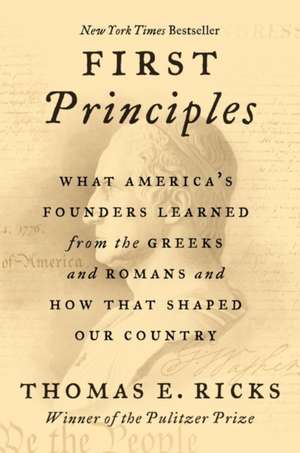
Notăm cu interes apariția ediției paperback a volumului First Principles, o lucrare care recontextualizează geneza democrației americane prin prisma educației clasice. Spre deosebire de ediția hardcover originală, acest format facilitează accesul la o cercetare densă, care mută focusul de la influența filozofilor iluminiști englezi, precum John Locke, către sursele primare ale antichității greco-romane. Thomas E. Ricks investighează modul în care primii patru președinți americani și-au însușit valorile lumii vechi: Washington prin cultura elitelor, Adams prin retorica Romei, Jefferson prin filozofia epicureană și Madison prin rigoarea cercetării politice. Apreciem modul în care autorul deconstruiește mitul fondatorilor, arătând cum lectura unor opere precum „Viețile paralele” de Plutarch sau scrierile lui Cicero a modelat arhitectura constituțională a Statelor Unite. First Principles acoperă aceeași arie tematică precum Greeks & Romans Bearing Gifts de Carl J. Richard, dar cu o abordare mult mai narativă și ancorată în biografiile individuale ale liderilor revoluționari. Dacă lucrarea lui Carl J. Richard este un studiu academic al impactului clasic, Ricks oferă o perspectivă jurnalistică și umană asupra modului în care aceste idei au fost testate în practică. În contextul operei sale, această carte reprezintă o evoluție tematică semnificativă. Dacă în Fiasco sau The Generals Thomas E. Ricks analiza eșecurile și leadership-ul militar contemporan, în First Principles el aplică aceeași rigoare de analist pentru a înțelege fundamentele morale și intelectuale ale statului. Este o lucrare de istorie regională care folosește instrumentele jurnalismului de investigație pentru a răspunde unor întrebări politice actuale.
Preț: 112.86 lei
Carte disponibilă
Livrare economică 04-18 noiembrie
Specificații
ISBN-10: 0062997467
Pagini: 416
Dimensiuni: 134 x 201 x 27 mm
Greutate: 0.31 kg
Editura: Harpercollins
De ce să citești această carte
Recomandăm această carte cititorilor pasionați de istorie politică și filozofie care doresc să înțeleagă rădăcinile intelectuale ale democrației moderne. Prin First Principles, câștigați o perspectivă inedită asupra modului în care textele lui Aristotel sau Xenofon au devenit fundamentul unei națiuni noi. Este o lectură esențială pentru a vedea cum educația clasică poate oferi soluții pentru dilemele politice contemporane.
Despre autor
Thomas E. Ricks este un jurnalist de prestigiu, laureat al Premiului Pulitzer, recunoscut la nivel internațional pentru expertiza sa în afaceri militare și istorie americană. Cariera sa este marcată de succesul volumului Fiasco, o analiză critică a intervenției americane în Irak care a ocupat prima poziție în topul New York Times. În lucrări precum The Generals sau Churchill and Orwell, Ricks explorează temele responsabilității și ale leadershipului în momente de criză. Prin First Principles, autorul își extinde aria de cercetare de la istoria militară recentă către originile intelectuale ale Statelor Unite.
Descriere scurtă
Editors' Choice —New York Times Book Review
"Ricks knocks it out of the park with this jewel of a book. On every page I learned something new. Read it every night if you want to restore your faith in our country." —James Mattis, General, U.S. Marines (ret.) & 26th Secretary of Defense
The Pulitzer Prize-winning journalist and #1 New York Times bestselling author offers a revelatory new work of intellectual history about the founding fathers, examining their educations and, in particular, their devotion to the ancient Greek and Roman classics—and how that influence would shape their ideals and the new American nation.
On the morning after the 2016 presidential election, Thomas Ricks awoke with a few questions on his mind: What kind of nation did we now have? Is it what was designed or intended by the nation’s founders? Trying to get as close to the source as he could, Ricks decided to go back and read the works of political philosophy that shaped the founders’ thinking, and the letters they wrote to each other debating these crucial works—among them the Iliad, Plutarch’s Lives, and the works of Xenophon, Epicurus, Aristotle, Cato, and Cicero. For though much attention has been paid the influence of English political philosophers, like John Locke, closer to their own era, the founders were far more immersed in the literature of the ancient world.
The first four American presidents came to their classical knowledge differently. Washington absorbed it mainly from the elite culture of his day; Adams from the laws and rhetoric of Rome; Jefferson immersed himself in classical philosophy, especially Epicureanism; and Madison, both a groundbreaking researcher and a deft politician, spent years studying the ancient world like a political scientist. Each of their experiences, and distinctive learning, played an essential role in the formation of the United States. In examining how and what they studied, looking at them in the unusual light of the classical world, Ricks is able to draw arresting and fresh portraits of men we thought we knew.
First Principles follows these four members of the Revolutionary generation from their youths to their adult lives, as they grappled with questions of independence, and forming and keeping a new nation rooted in the classical ideal of virtue. In doing so, Ricks interprets not only the effect of the ancient world on each man, and how that shaped our constitution and government, but in this defining work of American history, offers startling new insights into these legendary leaders.
How did the minds that shaped a nation first shape themselves?
- The Founders’ Classical Education: Explore the forgotten syllabus of the Revolutionary generation, discovering why they studied Cicero and Plutarch more than Locke, and how this classical knowledge provided the framework for a new republic.
- Four Presidents, Four Philosophies: Contrast Washington’s absorption of Roman values from elite culture, Adams’ devotion to Roman law, Jefferson’s immersion in Greek philosophy, and Madison’s methodical study of ancient republics.
- Greek vs. Roman Influence: Uncover why most founders favored the Roman model of public-mindedness and order, and how Jefferson’s preference for Greek ideals of liberty and happiness shaped the Declaration of Independence.
- From First Principles to a New Nation: Follow the founding fathers from their early studies to the Constitutional Convention, seeing how their shared understanding of classical history—and its warnings about faction and tyranny—shaped American government and its founding documents.
Recenzii
“One of my favorite works of history in a very long time. I grew up revering Jefferson. I found him loathsome here, but still recognize that like Churchill in 1940, a flawed man can move future events dramatically. Madison’s reach was remarkable. Poor Adams remained as miserable as I had always viewed him. But Washington was my revelation here. I have never been able to put flesh on those bones, but Ricks has done it.” — Joe Scarborough
“[An] extraordinarily timely book…If classical culture helped the new nation coalesce, what serves the same function today? Money? Pop culture? Political activism? And what about virtue? Does it still have a place in our society, and if so how might one define it? Interestingly, Mr. Ricks points out that for the Revolutionary generation, ‘silent virtue almost always would be valued more than loud eloquence.’ Of course the opposite is true now.” — Wall Street Journal
“A rich compendium of the ancient wisdom that Washington, Adams, Jefferson and Madison believed they were gleaning from Aristotle or Tacitus, and the formation of 'classically shaped behavior' in the early republic…Antiquity mattered, Ricks suggests, because it formed the intellectual foundation for the revolutionary generation. Knowing the source of the values they claimed to espouse and the historical comparisons they took as obvious, we can know more about the founders themselves — and perhaps something of how the country we now have measures up to the one they envisioned.” — Washington Post
“Ricks masterfully documents how examples of city states like Athens and the Roman Republic informed the four aforementioned Founding Fathers and their fellow travelers… So the question lurking in the shadows throughout this engaging political peregrination is the one the author asks in the epilogue: ‘Did the founders anticipate Donald Trump?’… Ricks points out that even iconic political figures oftentimes behaved in disturbing ways, just like politicians do today....It seems the document was eminently more perfect than the men who created it.” — USA Today
“In this instructive new book, [Ricks] offers a judicious account of the equivocal inheritance left to modern Americans by their 18th-century forebears…[He] urges Americans to fix their government so that it protects citizens from the inevitable lapses of a fallible people and, perhaps, even more fallible leaders.” — New York Times Book Review
"First Principles is a fascinating and erudite look at how Greek and Roman writers influenced members of the Founding Generation. From the Harvard-educated John Adams to the largely self-taught George Washington, the most well-known of American Revolutionaries, turned statesmen, looked to the classical world to answer critical questions about the nature of power and the nature of government." — Annette Gordon-Reed, the Charles Warren Professor of American Legal History at Harvard Law School, and Pulitzer Prize-winning author of The Hemingses of Monticello
"Ricks knows his subject well, and, equally important, he writes about it lucidly." — Gordon Wood, University Professor at Brown University, and author of The Radicalism of the American Revolution and Empire of Liberty: A History of the Early Republic
"Thomas Ricks’s deeply personal, patriotic quest to recover and renew the principles that animated America’s founders testifies eloquently to the value of historical understanding in these troubled times. Steeped in the classics, the founders could not have imagined our world and we are now, more than ever, acutely conscious of their failure to engage with the fundamental problem of racial slavery and its enduring legacies. But Ricks offers us a timely reminder of what the first four, nation-making presidents could imagine and did struggle to achieve."
— Peter S. Onuf, Thomas Jefferson Professor of History, Emeritus, University of Virginia, coauthor of Most Blessed of the Patriarchs: Thomas Jefferson and the Empire of the Imagination
"An immersive and enlightening look at how the classical educations of the first four U.S. presidents (George Washington, John Adams, Thomas Jefferson, and James Madison) influenced their thinking and the shape of American democracy....With incisive selections from primary sources and astute cultural and political analysis, this lucid and entertaining account is a valuable take on American history." — Publishers Weekly (starred review)
"Ricks does something quite remarkable: he takes a seemingly academic topic—the Greco-Roman education of the Founding Fathers—and makes it resonate with grand relevance....Offering a look at the Founders rarely glimpsed, Ricks successfully argues that America needs to rediscover its classical roots." — Library Journal (starred review)
“In First Principles, Ricks provides us the reading list we would have to undertake to get close to the Framers’ worldview. Ricks is not squeamish about their collective blindness to the evil of slavery, or its cruelty and brutality….What the flawed Framers gifted us was a blueprint of genius that we have since improved upon greatly because of Lincoln, the suffragists, the Rev. Martin Luther King Jr. and the many other civil rights leaders of that era….Ricks reminds us of our purpose.” — Hugh Hewitt, Washington Post
"The Pulitzer Prize-winning author offers a new interpretation of the individuals who shaped our constitution and government. You’ll find new insights into the past from the first page to the last." — Detroit Free Press
"In First Principles, a lively and accessible synthesis of the work of generations of historians and his own reading of the letters, speeches, and pamphlets of Washington, Adams, Jefferson, and Madison, Ricks assesses the influence of classical public philosophy and practice on politics in America in the late eighteenth and early nineteenth centuries — and draws conclusions about the country we have become."
— Psychology Today
“An exploration of the major influences of America’s first four presidents…[In 2016 Ricks asked,] ‘What kind of nation do we now have? Is this what was designed or intended by the nation’s founders?’…[He] reassures readers that the durable Constitutional order can handle a Donald Trump, and he concludes with 10 strategies for putting the nation back on course…Penetrating history with a modest dollop of optimism." — Kirkus Reviews
“Well informed, gracefully written and brimming with contemporary relevance.” — Bookreporter.com
“First Principles stands alone as an important work on the Revolutionary period.” — Journal of the American Revolution