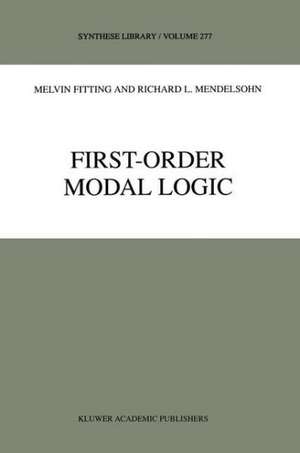
First-Order Modal Logic: Synthese Library, cartea 277
Autor M. Fitting, Richard L. Mendelsohnen Limba Engleză Paperback – 31 aug 1999
The book covers quantification itself, including the difference between actualist and possibilist quantifiers; equality, leading to a treatment of Frege's morning star/evening star puzzle; the notion of existence and the logical problems surrounding it; non-rigid constants and function symbols; predicate abstraction, which abstracts a predicate from a formula, in effect providing a scoping function for constants and function symbols, leading to a clarification of ambiguous readings at the heart of several philosophical problems; the distinction between nonexistence and nondesignation; and definite descriptions, borrowing from both Fregean and Russellian paradigms.
Din seria Synthese Library
- 18%
 Preț: 699.17 lei
 - 18%
 Preț: 984.05 lei
 - 18%
 Preț: 1262.67 lei
 - 18%
 Preț: 988.04 lei
 -
 Preț: 426.21 lei
 - 15%
 Preț: 666.00 lei
 - 18%
 Preț: 1770.63 lei
 - 18%
 Preț: 1272.36 lei
 - 18%
 Preț: 986.92 lei
 - 15%
 Preț: 667.07 lei
 - 18%
 Preț: 984.05 lei
 - 20%
 Preț: 1000.80 lei
 - 15%
 Preț: 669.62 lei
 - 15%
 Preț: 626.82 lei
 - 18%
 Preț: 915.29 lei
 - 15%
 Preț: 612.05 lei
 - 18%
 Preț: 1267.33 lei
 - 15%
 Preț: 661.18 lei
 -
 Preț: 369.60 lei
 - 15%
 Preț: 655.04 lei
 - 18%
 Preț: 981.10 lei
 - 18%
 Preț: 1276.58 lei
 - 15%
 Preț: 636.12 lei
 -
 Preț: 384.38 lei
 -
 Preț: 385.26 lei
 - 18%
 Preț: 1263.75 lei
 - 18%
 Preț: 1171.11 lei
 - 15%
 Preț: 658.36 lei
 - 18%
 Preț: 1270.78 lei
 -
 Preț: 368.38 lei
 -
 Preț: 383.23 lei
 - 15%
 Preț: 636.66 lei
 - 15%
 Preț: 658.54 lei
 -
 Preț: 369.85 lei
 - 15%
 Preț: 661.54 lei
 - 15%
 Preț: 694.24 lei
 - 18%
 Preț: 982.04 lei
 - 18%
 Preț: 909.67 lei
 -
 Preț: 375.24 lei
Preț: 1326.98 lei
Preț vechi: 1618.27 lei
-18%
Puncte Express: 1990
Carte tipărită la comandă
Livrare economică 27 noiembrie-11 decembrie
Livrare prin curier în România Termenul estimat este afișat lângă disponibilitate.
Transport gratuit pentru acest produs Plată online sau ramburs, în funcție de opțiunile comenzii.
Retur gratuit în 14 zile Comandă securizată și suport în română.
Specificații
ISBN-13: 9780792353355
ISBN-10: 0792353358
Pagini: 292
Ilustrații: XII, 292 p.
Dimensiuni: 160 x 240 x 18 mm
Greutate: 0.44 kg
Ediția:Softcover reprint of the original 1st ed. 1998
Editura: SPRINGER NETHERLANDS
Colecția Springer
Seria Synthese Library
Locul publicării:Dordrecht, Netherlands
ISBN-10: 0792353358
Pagini: 292
Ilustrații: XII, 292 p.
Dimensiuni: 160 x 240 x 18 mm
Greutate: 0.44 kg
Ediția:Softcover reprint of the original 1st ed. 1998
Editura: SPRINGER NETHERLANDS
Colecția Springer
Seria Synthese Library
Locul publicării:Dordrecht, Netherlands
Public țintă
ResearchCuprins
One/Propositional Modal Logic.- 1.1 What is a Modal?.- 1.2 Can There Be a Modal Logic?.- 1.3 What Are The Formulas?.- 1.4 Aristotle’s Modal Square.- 1.5 Informal Interpretations.- 1.6 What Are the Models?.- 1.7 Examples.- 1.8 Some Important Logics.- 1.9 Logical Consequence.- 1.10 Temporal Logic.- 1.11 Epistemic Logic.- 1.12 Historical Highlights.- Two/Tableau Proof Systems.- 2.1 What Is a Proof.- 2.2 Tableaus.- 2.3 More Tableau Systems.- 2.4 Logical Consequence and Tableaus.- 2.5 Tableaus Work.- Three/Axiom Systems.- 3.1 What Is an Axiomatic Proof.- 3.2 More Axiom Systems.- 3.3 Logical Consequence, Axiomatically.- 3.4 Axiom Systems Work Too.- Four/Quantified Modal Logic.- 4.1 First-Order Formulas.- 4.2 An Informal Introduction.- 4.3 Necessity De Re and De Dicto.- 4.4 Is Quantified Modal Logic Possible?.- 4.5 What the Quantifiers Quantify Over.- 4.6 Constant Domain Models.- 4.7 Varying Domain Models.- 4.8 Different Media, Same Message.- 4.9 Barcan and Converse Barcan Formulas.- Five/First-Order Tableaus.- 5.1 Constant Domain Tableaus.- 5.2 Varying Domain Tableaus.- 5.3 Tableaus Still Work.- Six/First-Order Axiom Systems.- 6.1 A Classical First-Order Axiom System.- 6.2 Varying Domain Modal Axiom Systems.- 6.3 Constant Domain Systems.- 6.4 Miscellany.- Seven/Equality.- 7.1 Classical Background.- 7.2 Frege’s Puzzle.- 7.3 The Indiscernibility of Identicals.- 7.4 The Formal Details.- 7.5 Tableau Equality Rules.- 7.6 Tableau Soundness and Completeness.- 7.7 An Example.- Eight/Existence and Actualist Quantification.- 8.1 To Be.- 8.2 Tableau Proofs.- 8.3 The Paradox of NonBeing.- 8.4 Deflationists.- 8.5 Parmenides’ Principle.- 8.6 Inflationists.- 8.7 Unactualized Possibles.- 8.8 Barcan and Converse Barcan, Again.- 8.9 Using Validities in Tableaus.- 8.10 On Symmetry.-Nine/Terms and Predicate Abstraction.- 9.1 Why constants should not be constant.- 9.2 Scope.- 9.3 Predicate Abstraction.- 9.4 Abstraction in the Concrete.- 9.5 Reading Predicate Abstracts.- Ten/Abstraction Continued.- 10.1 Equality.- 10.2 Rigidity.- 10.3 A Dynamic Logic Example.- 10.4 Rigid Designators.- 10.5 Existence.- 10.6 Tableau Rules, Varying Domain.- 10.7 Tableau Rules, Constant Domain.- Eleven/Designation.- 11.1 The Formal Machinery.- 11.2 Designation and Existence.- 11.3 Existence and Designation.- 11.4 Fiction.- 11.5 Tableau Rules.- Twelve/Definite Descriptions.- 12.1 Notation.- 12.2 Two Theories of Descriptions.- 12.3 The Semantics of Definite Descriptions.- 12.4 Some Examples.- 12.5 Hintikka’s Schema and Variations.- 12.6 Varying Domain Tableaus.- 12.7 Russell’s Approach.- 12.8 Possibilist Quantifiers.- References.
Recenzii
"This Text is an excellent and most useful volume. It is pitched correctly: the exercises are just right... It sets a high standard for anything following. It is to be highly recommended."
(Bulletin of Symbolic Logic, 8:3)
(Bulletin of Symbolic Logic, 8:3)