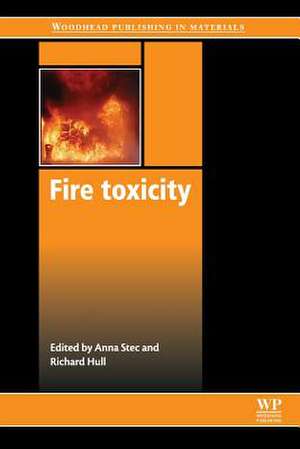
Fire Toxicity
Editat de A A Stec, T R Hullen Limba Engleză Paperback – 19 aug 2016
- Investigates the controversial subject of toxic effluents as the cause of the majority of fire deaths and injuries
- Describes the different types of toxic effluents and the specific fires that they produce, their physiological effects and methods for generation
- Provides an overview of national and international fire safety regulations including current and proposed regulations such as a standardized framework for prediction of fire gas toxicity
Preț: 1228.20 lei
Preț vechi: 1349.67 lei
-9%
Carte tipărită la comandă
Livrare economică 06-20 noiembrie
Specificații
ISBN-10: 0081014872
Pagini: 728
Dimensiuni: 156 x 234 x 37 mm
Greutate: 0.99 kg
Editura: ELSEVIER SCIENCE
V-ar putea interesa
-
 Guide to Foreign and International Legal CitationsNew York University School of LawPreț: 159.24 lei
 -
 -15%Preț: 606.34 lei711.09 lei
 -
 Cultural Heritage IssuesJames A R Nafziger-23%Preț: 1327.78 lei1724.39 lei
 -
 Legal Theory of International ArbitrationEmmanuel Gaillard-11%Preț: 455.59 lei511.90 lei
 -
 Das Kosovo-Gutachten des IGH vom 22. Juli 2010Peter Hilpold-23%Preț: 1078.32 lei1400.42 lei
Cuprins
Recenzii
Notă biografică
Dr. Stec and Prof. Hull have worked together on fire toxicity for the last 6 years, currently in the Centre for Fire and Hazard Science at University of Central Lancashire, UK.
Anna Stec is a lecturer in Fire Chemistry and Toxicology. Her work has focused on quantification of toxic hazards in fires, understanding the factors that affect fire gas toxicity, and the relationship between the physiological effects of the concentration and dose of different toxicants. She has conducted detailed comparisons on the yields of fire gases and other combustion products using a selection of different small-scale fire models in order to predict the effects of fire exposures to humans. Dr Stec has been designated as the UK s Principal Expert on fire chemistry, and an active participant at the ISO TC 92 Fire threat to people and environment meetings.
Richard Hull is a Professor of Chemistry and Fire Science. His work has focused on fire retardant mechanisms, fire effluent toxicity and fire science. With another contributor, Prof. David Purser, he has been pivotal in the development of the steady state tube furnace as the first internationally recognised standard for the assessment of fire gas toxicity (ISO TS 19700); as one of the only methods capable of replicating real fire conditions on a bench-scale, this has led to its growing acceptance, particularly for performance-based fire assessment."