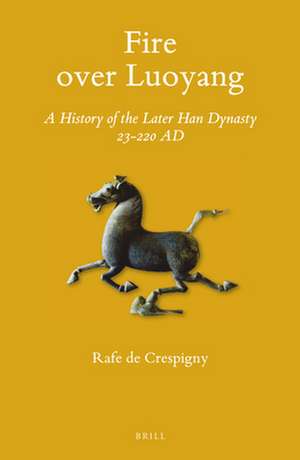
Fire over Luoyang
Autor Rafe de Crespignyen Limba Engleză Hardback – 27 oct 2016
Considerăm Fire over Luoyang o resursă academică de prim rang, esențială pentru cercetătorii și studenții axați pe istoria Asiei de Est, fiind validată prin prestigiosul premiu Choice Outstanding Academic Title Award în 2017. Această lucrare ocupă un loc singular în istoriografia de limbă engleză, fiind prima sinteză completă dedicată dinastiei Han de Răsărit, o perioadă adesea comparată ca influență și întindere cu Imperiul Roman timpuriu. Observăm în text o organizare riguroasă, care îmbină analiza structurală a guvernării cu o cronologie detaliată a succesiunii imperiale. Autorul debutează cu o examinare fascinantă a capitalei Luoyang — de la formalitățile de curte până la parcuri și morminte — oferind cadrul necesar pentru a înțelege dinamica puterii. Următoarele capitole urmăresc progresia dinastiei, de la stabilitatea adusă de împărații Ming și Zhang, până la perioadele de regență marcate de conflicte între facțiunile de eunuci și familiile aristocratice, culminând cu prăbușirea sub presiunea rebeliunii Turbanelor Galbene. Această monografie completează perspectiva oferită de Fan Ye's Book of Later Han (Houhanshu), adăugând o analiză critică modernă și un context politic extins traducerilor biografice ale lui Fan Ye. În cadrul operei lui Rafe de Crespigny, volumul reprezintă o sinteză narativă ce rafinează datele brute regăsite în A Biographical Dictionary of Later Han to the Three Kingdoms (23-220 AD). Dacă în lucrările sale anterioare, precum A Hundred Years of Han, autorul se concentra pe analiza textelor clasice ale lui Sima Guang, aici el oferă o viziune proprie, integrată, asupra modului în care un imperiu vast a cedat în fața fragmentării regionale.
Preț: 1249.76 lei
Preț vechi: 1623.06 lei
-23%
Carte tipărită la comandă
Livrare economică 24 iulie-07 august
Specificații
ISBN-10: 9004324917
Pagini: 580
Dimensiuni: 161 x 242 x 38 mm
Greutate: 0.98 kg
Editura: Brill
V-ar putea interesa
-
 Preț: 398.10 lei
 -
 Japan's Economic Offensive in ChinaLowe Chuan Hua-18%Preț: 1015.97 lei1238.99 lei
 -
 Champions from NormandyRafe de CrespignyPreț: 199.73 lei
 -
 ShudrasKancha Ilaiah ShepherdPreț: 146.29 lei
 -
 Muslim Rule in Medieval India: Power and Religion in the Delhi SultanateFouzia Farooq Ahmed-24%Preț: 226.02 lei298.18 lei
 -
 Preț: 386.81 lei
 -
 India and the WorldClaude Markovits-11%Preț: 580.75 lei652.52 lei
 -
 Waiting for SwarajAparna Vaidik-11%Preț: 567.69 lei637.85 lei
 -
 The Warrior Worker: Challenge of the Korean Way of WorkingRobert Kearney-28%Preț: 225.26 lei312.96 lei
 -
 -25%Preț: 225.44 lei298.77 lei
 -
 Chinese Civilization in Vistas of World CivilizationJiang Yi-hua-23%Preț: 522.99 lei679.21 lei
 -
 -27%Preț: 777.09 lei1064.51 lei
 -
 -36%Preț: 600.17 lei930.55 lei
 -
 China Hands and Old Cantons: Britons and the Middle KingdomJohn M. Carroll-34%Preț: 525.96 lei791.65 lei
 -
 -27%Preț: 247.75 lei341.62 lei
 -
 -34%Preț: 491.93 lei744.24 lei
 -
 Turbulent StreamsRoderick I Wilson-23%Preț: 678.42 lei881.06 lei
De ce să citești această carte
Pentru istorici și pasionații de sinologii, această carte oferă singura relatare cuprinzătoare în limba engleză a celor două secole de domnie Han de Răsărit. Cititorul câștigă o înțelegere profundă a mecanismelor administrative chineze și a cauzelor care duc la colapsul unui stat imperial. Este o achiziție obligatorie pentru bibliotecile universitare, oferind rigoare științifică într-un format accesibil.
Despre autor
Rafe de Crespigny este un distins istoric australian și profesor emerit la Australian National University, recunoscut la nivel mondial ca autoritate supremă în istoria dinastiei Han și a perioadei Celor Trei Regate. Opera sa vastă include dicționare biografice monumentale și traduceri comentate ale cronicilor clasice chineze. Expertiza sa în transformarea structurilor de putere și în geografia istorică a Chinei antice este reflectată în numeroasele distincții primite, transformând lucrările sale în referințe standard pentru orice studiu academic riguros despre China imperială timpurie.
Cuprins
Introduction 1
The Emperors of Han 6
Chronology of the Later Han Dynasty 8
1 Imperial Capital 17
Luoyang and its Surroundings 17
Emperor Guangwu and his New Capital 28
Formalities and Government 34
City, Suburbs and People 52
Parks, Pleasure-Grounds and Tombs 61
2 Emperor Ming and Emperor Zhang (57–88) 71
Chronology 71
Imperial Succession 72
The Government of Emperor Ming 82
The Government of Emperor Zhang 99
Empress Dou and the Boy from the Harem 108
3 The Reign of Emperor He (88–106) 117
Chronology 117
Triumph in the Steppe 118
The Fall of the Dou Family 127
The Peoples of the West 136
The Government of Emperor He 141
The Military Structure of Later Han 148
Peace and Settlement? 164
4 The Dowager Deng and Emperor An (106–125) 169
Chronology 169
The Child Emperors and the Regency 170
The Rebellion of the Qiang 177
Problems of Finance 190
The Government of the Dowager 199
The Favourites of Emperor An 207
5 The Reign of Emperor Shun (125–144) 220
Chronology 220
The Destruction of the Yan Clan 221
Emperor Shun and the Reformers 225
The Rise of the Liang Family 238
Barbarians, Migrants and Rebels 244
People and Land 257
6 The Hegemony of Liang Ji (144–159) 269
Chronology 269
Liang Ji and the Puppets 270
Rebel Emperors and Great Peace 274
The Government of Liang Ji 278
Great Families in the Provinces 294
The Fall of the House of Liang 303
7 Emperor Huan and the Eunuchs (159–168) 310
Chronology 310
Imperial Favourites 311
Problems of Finance 321
Gentlemen and Eunuchs 324
Imperial Consorts and the Worship of Huang-Lao 335
The First Faction Incident 351
Invitation to Genocide 357
8 Emperor Ling: Disordered Government (169–184) 361
Chronology 361
The Dou Family and the Eunuchs 362
Duan Jiong and the Barbarians 369
The Second Faction Incident, the Great Proscription and the Decline of the University 375
The Government of Emperor Ling 388
Tanshihuai and the Misfortunes of the Frontier 397
Yellow Turbans 402
9 End of an Empire (185–189) 418
Chronology 418
The Loss of Liang Province 420
Imperial Extravagance 428
Imperial Succession 436
Slaughter in the Palace 442
A Note on the Dates of the Crisis 448
Dong Zhuo 449
Ruin of a Capital 456
The End of Han 465
10 Epilogues and Conclusions 474
Part I: Elegy for a Lost Capital 474
Chronology 474
The Afterlife of Luoyang 475
Part II: What Went Wrong? Reflections on a Ruin 480
A Failure of Virtue? 480
The Division of China 497
The Difficulty of Reunification 504
Bibliography 513
Index and List of Characters 543
Notă biografică
Recenzii
"'We two reviewers see the riches that this book offers to specialists and non-specialists alike. Fire over Luoyang, along with de Crespigny’s Biographical Dictionary of Later Han to the Three Kingdoms (23–220 AD) (2007), has laid the firmest of hangtu foundation for many topics in Eastern Han history. Like the fabled palaces of Luoyang itself, it is a splendid edifice." - MICHAEL NYLAN, University of California, Berkeley & THOMAS H. HAHN, Independent Scholar, Berkeley, in: Monumenta Serica, 66:1 (2018)
Descriere
The Later Han dynasty, also known as Eastern Han, ruled China for the first two centuries of the Christian era. Comparable in extent and power to the early Roman empire, it dominated east Asia from present-day Vietnam to the Mongolian steppe.
Rafe de Crespigny presents here the first full account of this period in Chinese history to be found in a Western language. Commencing with a detailed account of the imperial capital, the history describes the nature of government, the expansion of the Chinese people to the south, the conflicts of scholars and officials with eunuchs at court, and the final collapse which followed the rebellion of the Yellow Turbans and the rise of regional warlords.