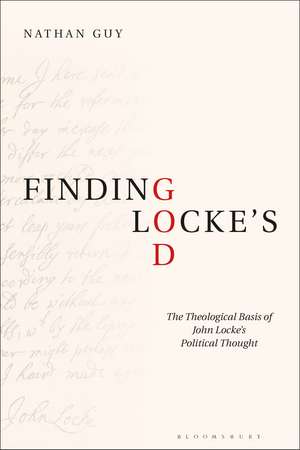
Finding Locke’s God: The Theological Basis of John Locke’s Political Thought
Autor Prof Nathan Guyen Limba Engleză Paperback – 25 mar 2021
Nestled between the secular political philosopher and the Christian public theologian stands Locke, the Christian political philosopher, whose arguments not only self-consciously depend upon Christian assumptions, but also offer a decidedly Christian theory of government. Finding Locke's God identifies three theological pillars crucial to Locke's political theory: (1) a biblical depiction of God, (2) the law of nature rooted in a doctrine of creation and (3) acceptance of divine revelation in scripture. As a result, Locke's political philosophy brings forth theologically-rich aims, while seeking to counter or disarm threats such as atheism, hyper-Calvinism, and religious enthusiasm.
Bringing these items together, Nathan Guy demonstrates how each pillar supports Locke's Latitudinarian political philosophy and provides a better understanding of how he grounds his notions of freedom, equality and religious toleration. Convincingly argued and meticulously researched, this book offers an exciting new direction for Locke studies.
| Toate formatele și edițiile | Preț | Express |
|---|---|---|
| Paperback (1) | 223.73 lei 6-8 săpt. | |
| Bloomsbury Publishing – 25 mar 2021 | 223.73 lei 6-8 săpt. | |
| Hardback (1) | 674.39 lei 6-8 săpt. | |
| Bloomsbury Publishing – 19 sep 2019 | 674.39 lei 6-8 săpt. |
Preț: 223.73 lei
Preț vechi: 297.58 lei
-25%
Puncte Express: 336
Preț estimativ în valută:
39.60€ • 46.27$ • 34.38£
39.60€ • 46.27$ • 34.38£
Carte tipărită la comandă
Livrare economică 20 februarie-06 martie
Preluare comenzi: 021 569.72.76
Specificații
ISBN-13: 9781350250055
ISBN-10: 1350250058
Pagini: 256
Dimensiuni: 156 x 234 mm
Greutate: 0.37 kg
Editura: Bloomsbury Publishing
Colecția Bloomsbury Academic
Locul publicării:London, United Kingdom
ISBN-10: 1350250058
Pagini: 256
Dimensiuni: 156 x 234 mm
Greutate: 0.37 kg
Editura: Bloomsbury Publishing
Colecția Bloomsbury Academic
Locul publicării:London, United Kingdom
Cuprins
Acknowledgements
List of Abbreviations
Introduction
Part I:In Defense of the Religious Turn
1. The New Perspective on Locke: The Religious (Re)Turn in Locke Scholarship
2. Life in the Areopagus: Secular Echoes, Religious Refrain
3. Locke and the Latitudinarians: Locke's Religious Experience and Theological Influences in the Context of Seventeenth-Century England
Part II: From A "Religious" to a "Theological" Turn: Tracing Locke's Theological Argumentation
4. The God of Christianity and the Foundations of Morality
5. Natural Law, the Law of Nature and a Theology of Creation
6. Revelation, Reason and Scripture
Conclusion
Bibliography
Index
List of Abbreviations
Introduction
Part I:In Defense of the Religious Turn
1. The New Perspective on Locke: The Religious (Re)Turn in Locke Scholarship
2. Life in the Areopagus: Secular Echoes, Religious Refrain
3. Locke and the Latitudinarians: Locke's Religious Experience and Theological Influences in the Context of Seventeenth-Century England
Part II: From A "Religious" to a "Theological" Turn: Tracing Locke's Theological Argumentation
4. The God of Christianity and the Foundations of Morality
5. Natural Law, the Law of Nature and a Theology of Creation
6. Revelation, Reason and Scripture
Conclusion
Bibliography
Index
Recenzii
This important book dispatches once and for all the notion that Locke was a deist. Placing Locke in historical context, Nathan Guy demonstrates how deeply Locke's theology, if at times heterodox, structured the whole of his political system. Locke emerges from this crisply argued study as a 'Christian political philosopher' with continuing lessons to teach about tolerance and faith.
Nathan Guy's Finding Locke's God breaks much-needed new ground in thinking carefully about the role of Christian theology in the origins of modern social order. Combining a deeply informed review of the scholarly literature with fresh and important questions about how Locke's argument relies on specific theological commitments, Guy invites scholarship on Locke's religion to move forward from the great question of the last generation - whether to place Locke within the Christian natural law tradition, even if his place there is an idiosyncratic one - to what promises to be the great question of the next generation: What specific theological commitments were essential for Locke, and how do they shape his political philosophy? This book makes an important contribution to our understanding of the perpetual crisis of religion and politics in the modern world, and anyone interested in that problem should read it.
In this concise, well-researched and carefully argued book Nathan Guy an authoritative path between the multitude of interpretations to clarify precisely what is the relationship between Locke's faith and his political theory. Few doubt Locke's personal religious beliefs but many disagree about what implication they have for his politics. Some argue that they destroy any credible case for deriving a liberal political philosophy from his thought; others argue that his liberal political philosophy either undermines those beliefs or exposes them as a sham. Guy sorts through these complex debates with authority and skill presenting an account of Locke as a Christian political philosopher whilst addressing all the important complications that go with this description. This book is an indispensable guide to political philosophers and theologians who are interested in Locke, liberalism and the place of Christianity in public debate.
Nathan Guy's Finding Locke's God breaks much-needed new ground in thinking carefully about the role of Christian theology in the origins of modern social order. Combining a deeply informed review of the scholarly literature with fresh and important questions about how Locke's argument relies on specific theological commitments, Guy invites scholarship on Locke's religion to move forward from the great question of the last generation - whether to place Locke within the Christian natural law tradition, even if his place there is an idiosyncratic one - to what promises to be the great question of the next generation: What specific theological commitments were essential for Locke, and how do they shape his political philosophy? This book makes an important contribution to our understanding of the perpetual crisis of religion and politics in the modern world, and anyone interested in that problem should read it.
In this concise, well-researched and carefully argued book Nathan Guy an authoritative path between the multitude of interpretations to clarify precisely what is the relationship between Locke's faith and his political theory. Few doubt Locke's personal religious beliefs but many disagree about what implication they have for his politics. Some argue that they destroy any credible case for deriving a liberal political philosophy from his thought; others argue that his liberal political philosophy either undermines those beliefs or exposes them as a sham. Guy sorts through these complex debates with authority and skill presenting an account of Locke as a Christian political philosopher whilst addressing all the important complications that go with this description. This book is an indispensable guide to political philosophers and theologians who are interested in Locke, liberalism and the place of Christianity in public debate.