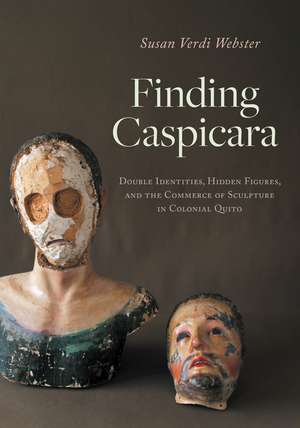
Finding Caspicara: Double Identities, Hidden Figures, and the Commerce of Sculpture in Colonial Quito
Autor Susan Verdi Websteren Limba Engleză Hardback – oct 2024
An examination of sculpture and authorship in eighteenth-century Quito that documents Caspicara as a participant in the innovative artistic production of the city’s workshops and its widespread commerce of polychrome sculptures.
Who is Caspicara? Nothing is known of Caspicara’s life, and not a single sculpture has been documented as his work. Yet traditional histories laud him as a prolific Indigenous sculptor in eighteenth-century Quito who created exquisite polychrome figures and became a national artistic icon. Drawing on extensive archival, historical, and object research, Susan Verdi Webster peels away layers of historiographical fabrication to reveal what we do and do not know about Caspicara and his work.
Rather than being a solitary master, Caspicara collaborated with other, largely Indigenous artists in Quito’s protoindustrial workshops, manufacturing sculptures now credited to him alone. The high quality of Quito sculptures produced by anonymous artists turned the city into a hub of wide-ranging commerce in religious icons. The art world and post-independence Ecuadorians have lionized the one named sculptor, Caspicara, according to the Western model of the artist-genius, amplifying the market for works bearing his name and creating a national hero on par with European masters. Lost in this process were the artists themselves. Webster returns to their world, detailing their methods and labor and, for the first time, documenting a sculpture made by Caspicara.
Preț: 421.10 lei
Puncte Express: 632
Carte disponibilă
Livrare economică 28 octombrie-11 noiembrie
Livrare prin curier în România Termenul estimat este afișat lângă disponibilitate.
Transport gratuit pentru acest produs Plată online sau ramburs, în funcție de opțiunile comenzii.
Retur gratuit în 14 zile Comandă securizată și suport în română.
Specificații
ISBN-13: 9781477329726
ISBN-10: 1477329722
Pagini: 272
Ilustrații: 44 color photos, 5 b&w photos
Dimensiuni: 178 x 254 x 23 mm
Greutate: 0.68 kg
Editura: University of Texas Press
Colecția University of Texas Press
ISBN-10: 1477329722
Pagini: 272
Ilustrații: 44 color photos, 5 b&w photos
Dimensiuni: 178 x 254 x 23 mm
Greutate: 0.68 kg
Editura: University of Texas Press
Colecția University of Texas Press
V-ar putea interesa
-
 Natural HistoryCarlos FonsecaPreț: 113.50 lei
 -
 Scarred Landscapes: Place, Trauma, and Memory in Caribbean Latinx ArtStephanie LewthwaitePreț: 265.11 lei
 -
 Slashed BeautiesA. Rushby-19%Preț: 112.10 lei137.56 lei
 -
 My Own PastAlejandro De La FuentePreț: 314.78 lei
 -
 -8%Preț: 444.97 lei483.66 lei
 -
 Preț: 435.69 lei
 -
 The Art of a LieLaura Shepherd-RobinsonPreț: 107.46 lei
 -
 Collective Creativity and Artistic Agency in Colonial Latin AmericaMaya Stanfield-MazziPreț: 222.43 lei
 -
 The Keeper of All the SecretsVictoria LanePreț: 91.41 lei
 -
 AmnionStephanie Sy-QuiaPreț: 77.21 lei
 -
 We Are Green and TremblingGabriela Cabezón CámaraPreț: 135.73 lei
 -
 Street Style: Art and Dress in the Time of CaravaggioElizabeth CurriePreț: 264.91 lei
 -
 Pedlars, Poseurs and PerformersBrian JaquestPreț: 392.82 lei
 -
 A Wise One, a WarriorMeena KandasamyPreț: 60.36 lei
 -
 Human Marks: Tattooing in Contemporary ArtCarrie Cushman-17%Preț: 291.50 lei353.17 lei
 -
 The Art Escapes AtlasGestaltenPreț: 312.69 lei
 -
 Isay WIsay Weinfeld-8%Preț: 389.51 lei423.38 lei
 -
 Pedro Reyes: Social SculpturePedro AlonzoPreț: 403.73 lei
 -
 Preț: 116.75 lei
 -
 WitchcraftSole Otero-17%Preț: 206.84 lei249.27 lei
Notă biografică
Susan Verdi Webster is the Mahoney Professor Emerita of Art History at the College of William & Mary. She is the author of Art and Ritual in Golden-Age Spain: Sevillian Confraternities and the Processional Sculpture of Holy Week.
Cuprins
- List of Illustrations
- Preface
- Acknowledgments
- Introduction
- 1. Inventing Caspicara
- 2. Painted Sculpture: The Paragone and Division of Labor in Quito
- 3. Caspicara in the Taller
- 4. Bultos and Body Parts: The Production and Commerce of Quito Sculpture
- 5. Caspicara in the Archive
- 6. Tracking Caspicara in Popayán: Confraternities and Holy Week
- 7. Hidden Figures: Caspicara and Quito Sculpture
- 8. Subsidiary Figures: More Commissions from Quito
- 9. Mise en Scène: Sculptures in Motion
- Conclusion: Seeing Caspicara Anew
- Appendix A. Last Will and Testament of Juan Manuel Legarda (Excerpt), 1773
- Appendix B. Inventory of the Confraternity of Saint Peter, Popayán, 1777
- Appendix C. Artistic Commissions from Quito to Popayán, 1792–1802
- Notes
- Bibliography
- Index
Recenzii
Webster’s commitment to detailed analysis and context delivers a book that not only transforms our understanding of Caspicara and his oeuvre, but also the broader field of colonial polychrome sculpture. Her careful and thorough analysis, as well as her eloquent assessment of many of the issues that have held back previous scholarship on polychrome sculpture...should inspire others to pick up where she left off. Ultimately, this book is a must read for all of those who are interested in Caspicara, Quito, or polychrome sculpture across the Spanish empire.
This informative book...provides a wealth of important information on quiteño sculpture and its producers, workshop conditions, and the sale of these objects in markets throughout South America and beyond.
Finding Caspicara is the work of an accomplished scholar at her finest. Fast-paced, clearly written, and exceptionally well researched, the volume’s nine short chapters read like a mystery novel…[The book] could easily have been an article critiquing the nationalistic historiography that has emerged around the [Caspicara]; Webster’s genius is in combining this with an undeniably compelling new narrative, bolstered by rigorous archival research and visual analysis…Beautifully illustrated, the accompanying photographs effectively illustrate Webster’s points and help readers see what Webster evocatively describes in the text.
Descriere
An examination of sculpture and authorship in eighteenth-century Quito that documents Caspicara as a participant in the innovative artistic production of the city’s workshops and its widespread commerce of polychrome sculptures.