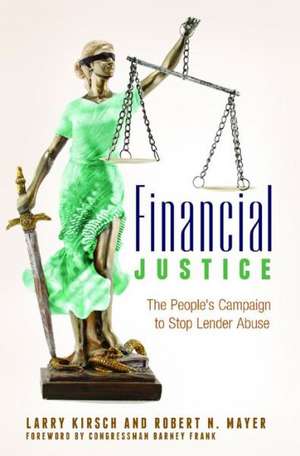
Financial Justice: The People's Campaign to Stop Lender Abuse
Autor Larry Kirsch Cuvânt înainte de Barney Frank Autor Robert N. Mayeren Limba Engleză Hardback – 9 mai 2013
What would Congress do-if anything-to tame Wall Street and the nation's lenders following the financial meltdown of 2008? This book tells the true story of how an alliance of consumer, civil rights, labor, fair lending, and other progressive groups emerged to effectively challenge Wall Street and its official protectors and to win substantial new legislative reforms-actions that resulted in the Dodd-Frank Act and its path-breaking Consumer Financial Protection Bureau (CFPB).
Based largely on in-depth interviews with the leading activists involved in the campaign, Financial Justice: The People's Campaign to Stop Lender Abuse taps into the world of contemporary citizen movements to present evidence into the conditions that determine the success and failure of social movement campaigns. It goes well beyond general, global variables, such as "effective management," to show how the formal and informal rules adopted by a campaign can serve to preclude fragmentation and incoherence.
Preț: 372.55 lei
Preț vechi: 424.05 lei
-12%
Puncte Express: 559
Carte disponibilă
Livrare economică 17 noiembrie-01 decembrie
Livrare prin curier în România Termenul estimat este afișat lângă disponibilitate.
Transport gratuit de la 400.00 lei Plată online sau ramburs, în funcție de opțiunile comenzii.
Retur gratuit în 14 zile Comandă securizată și suport în română.
Specificații
ISBN-13: 9781440829512
ISBN-10: 1440829519
Pagini: 256
Ilustrații: 15
Dimensiuni: 156 x 235 x 33 mm
Greutate: 0.82 kg
Editura: Bloomsbury Publishing
Colecția Praeger
Locul publicării:New York, United States
ISBN-10: 1440829519
Pagini: 256
Ilustrații: 15
Dimensiuni: 156 x 235 x 33 mm
Greutate: 0.82 kg
Editura: Bloomsbury Publishing
Colecția Praeger
Locul publicării:New York, United States
V-ar putea interesa
-
 Preț: 234.34 lei
 -
 Fixed Income Markets 2e - Management, Trading and Hedging + WSMoorad Choudhry-9%Preț: 675.51 lei742.32 lei
 -
 A Trader's Guide to Financial AstrologyLarry Pasavento-8%Preț: 479.72 lei521.43 lei
 -
 Merger ArbitrageThomas Kirchner-8%Preț: 529.96 lei576.05 lei
 -
 -8%Preț: 574.78 lei624.76 lei
 -
 Why Moats MatterHeather BrilliantPreț: 249.48 lei
 -
 Quantitative Finance For DummiesSteve BellPreț: 167.49 lei
 -
 Asset RotationMatthew P EricksonPreț: 330.64 lei
 -
 Preț: 142.75 lei
 -
 Dark PoolsScott Patterson-18%Preț: 77.08 lei93.66 lei
Cuprins
Foreword by Congressman Barney Frank
Acknowledgments
Introduction
1. How Did We Ever Get into This Mess?
2. Elizabeth Warren Has a Notion
3. The Magic Moment for Reform
4. Activists Need Leaders, Too
5. Coalescing the Coalition
6. The Battle in the House
7. Wanted: A Few Votes in the Senate
8. Auto Dealers Drive for an Exemption
9. Preemption: The Role of State Reformers
10. What Did the Advocates Accomplish and How?
Afterword: Backward and Forward with Elizabeth Warren
Norman I. Silber
Notes
Selected Bibliography
Index
Acknowledgments
Introduction
1. How Did We Ever Get into This Mess?
2. Elizabeth Warren Has a Notion
3. The Magic Moment for Reform
4. Activists Need Leaders, Too
5. Coalescing the Coalition
6. The Battle in the House
7. Wanted: A Few Votes in the Senate
8. Auto Dealers Drive for an Exemption
9. Preemption: The Role of State Reformers
10. What Did the Advocates Accomplish and How?
Afterword: Backward and Forward with Elizabeth Warren
Norman I. Silber
Notes
Selected Bibliography
Index
Recenzii
Financial Justice portrays a lively, in-depth narrative of the people waging the battle for consumer finance protection and their victories, setbacks, and compromises. It brings to life the legislative history of the Act that created the Consumer Finance Protection Bureau (CFPB) by illustrating the work of activists, policy advocates, and policymakers involved in the creation of the CFPB. . . . With all its attention to detail, this book is a valuable asset to anyone researching the history of the Dodd-Frank Act and the CFPB.
The book, based on solid research and interviews with Elizabeth Warren and campaign advocates, has fascinating chapters dealing with the legislative struggles showing how the activists held wavering members of Congress accountable for key votes, while addressing the larger issue of how social movements can contribute to progressive political change.
A very readable account of the creation of the Consumer Financial Protection Bureau . . . authors do an excellent job of describing the congressional maneuvering on both sides in both houses, as well as the work of the activists and business interests in shaping the final outcome. Very informative . . . highly recommended.
While the future of the CFPB is uncertain, Kirsch and Mayer's book provides a good guide to how the agency came to be despite the odds stacked against it.
The authors should be commended for their recognition of the need for an empirical study here and for the skill and thoroughness they employed in getting the job done during an especially contentious time for the US Congress.
The book, based on solid research and interviews with Elizabeth Warren and campaign advocates, has fascinating chapters dealing with the legislative struggles showing how the activists held wavering members of Congress accountable for key votes, while addressing the larger issue of how social movements can contribute to progressive political change.
A very readable account of the creation of the Consumer Financial Protection Bureau . . . authors do an excellent job of describing the congressional maneuvering on both sides in both houses, as well as the work of the activists and business interests in shaping the final outcome. Very informative . . . highly recommended.
While the future of the CFPB is uncertain, Kirsch and Mayer's book provides a good guide to how the agency came to be despite the odds stacked against it.
The authors should be commended for their recognition of the need for an empirical study here and for the skill and thoroughness they employed in getting the job done during an especially contentious time for the US Congress.