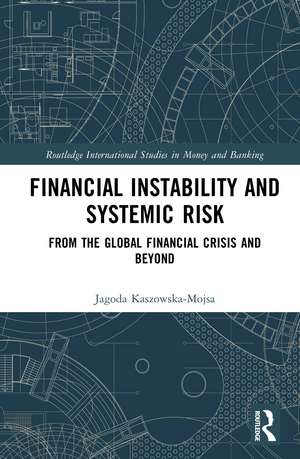
Financial Instability and Systemic Risk: From the Global Financial Crisis and Beyond: Routledge International Studies in Money and Banking
Autor Jagoda Kaszowska-Mojsaen Limba Engleză Hardback – mai 2026
This book illustrates how agent-based modelling (ABM) can enrich the study of crises, systemic risk and uncertainty, and the distributional effects of policies that are designed to contain them. Rather than treating crises as external shocks, the book highlights how fragility can emerge endogenously within economies that are understood as complex, evolving systems. Through clear explanations and targeted applications, it not only demonstrates how ABM can capture the effects of macroprudential regulation on the real economy and inequality and shed light on moments of financial instability but also provides a practical guide to building such data-driven models in the first place. At the same time, it situates these insights within a broader discussion of contagion, procyclicality and global financial regulation, thus connecting the modelling results with ongoing debates on how best to safeguard financial stability. Further, it offers a valuable synthesis of lessons learned from advanced economies, illustrating how institutional design and macroprudential policy can strengthen financial resilience while also generating significant redistributive effects across sectors and households.
The book is primarily aimed at an academic audience of scholars and advanced students in economics, finance and computational social science. It will also appeal to professionals in central banks, regulators and policymakers engaged in designing and evaluating macroprudential frameworks.
The Open Access version of this book, available at http://www.taylorfrancis.com, has been made available under a Creative Commons Attribution-Non Commercial-No Derivatives (CC BY-NC-ND) 4.0 license.
Din seria Routledge International Studies in Money and Banking
-
 Preț: 439.64 lei
 - 18%
 Preț: 1254.12 lei
 - 18%
 Preț: 1253.07 lei
 - 18%
 Preț: 1259.00 lei
 - 18%
 Preț: 1250.28 lei
 -
 Preț: 458.47 lei
 - 18%
 Preț: 1301.21 lei
 - 15%
 Preț: 480.53 lei
 -
 Preț: 479.45 lei
 - 18%
 Preț: 1253.77 lei
 -
 Preț: 304.58 lei
 - 18%
 Preț: 1314.99 lei
 - 18%
 Preț: 1398.27 lei
 - 18%
 Preț: 1261.45 lei
 - 15%
 Preț: 419.92 lei
 -
 Preț: 466.27 lei
 -
 Preț: 473.93 lei
 -
 Preț: 364.81 lei
 -
 Preț: 462.43 lei
 - 18%
 Preț: 1263.19 lei
 -
 Preț: 457.75 lei
 - 15%
 Preț: 436.67 lei
 - 18%
 Preț: 755.97 lei
 -
 Preț: 471.93 lei
 - 18%
 Preț: 1253.07 lei
 - 18%
 Preț: 786.40 lei
 - 15%
 Preț: 515.86 lei
 - 18%
 Preț: 1256.21 lei
 -
 Preț: 465.23 lei
 - 15%
 Preț: 469.13 lei
 - 18%
 Preț: 1259.00 lei
 - 18%
 Preț: 765.46 lei
 - 18%
 Preț: 1250.64 lei
 - 18%
 Preț: 1254.12 lei
 -
 Preț: 466.27 lei
 - 18%
 Preț: 1260.05 lei
 - 18%
 Preț: 1308.72 lei
 - 18%
 Preț: 1255.17 lei
 - 18%
 Preț: 964.45 lei
 - 18%
 Preț: 1422.11 lei
Preț: 1312.02 lei
Preț vechi: 1600.02 lei
-18%
Puncte Express: 1968
Carte tipărită la comandă
Livrare economică 17 noiembrie-01 decembrie
Livrare prin curier în România Termenul estimat este afișat lângă disponibilitate.
Transport gratuit pentru acest produs Plată online sau ramburs, în funcție de opțiunile comenzii.
Retur gratuit în 14 zile Comandă securizată și suport în română.
Specificații
ISBN-13: 9781041260271
ISBN-10: 104126027X
Pagini: 288
Ilustrații: 12
Dimensiuni: 178 x 254 mm
Greutate: 0.72 kg
Ediția:1
Editura: Taylor & Francis
Colecția Routledge
Seria Routledge International Studies in Money and Banking
Locul publicării:Oxford, United Kingdom
ISBN-10: 104126027X
Pagini: 288
Ilustrații: 12
Dimensiuni: 178 x 254 mm
Greutate: 0.72 kg
Ediția:1
Editura: Taylor & Francis
Colecția Routledge
Seria Routledge International Studies in Money and Banking
Locul publicării:Oxford, United Kingdom
Public țintă
Academic and PostgraduateCuprins
Part 1. Systemic Risk and the Global Financial Crisis (GFC) Introduction 1. Defining Systemic Risk and Uncertainty: Nature, Measurement and Modelling 2. Systemic Risk and the 2008-2009 U.S. Financial Crisis: Causes, Course and Consequences 3. The Role of Systemic Risk and Uncertainty in the Development of the EU Crisis Part 2. Macroprudential Policies after the Global Financial Crisis (GFC) 4. Systemic Risk Mitigation Through Regulation and Macroprudential Policies 5. Analysing the Effects of Macroprudential Policies through an
Agent-Based Model with Heterogeneous Agents Conclusions A. The Bewley's Theorems B. A General-Equilibrium Framework for Macroprudential Analysis C. The Data-Driven Agent-Based Model D. Tables and Figures
Agent-Based Model with Heterogeneous Agents Conclusions A. The Bewley's Theorems B. A General-Equilibrium Framework for Macroprudential Analysis C. The Data-Driven Agent-Based Model D. Tables and Figures
Notă biografică
Jagoda Kaszowska-Mojsa is a researcher and lecturer and holds positions at the National Bank of Poland and Cracow University of Economics, Poland.
Descriere
This book illustrates how agent-based modelling (ABM) can enrich the study of crises, systemic risk and uncertainty, and the distributional effects of policies that are designed to contain them. Rather than treating crises as external shocks, it highlights how fragility can emerge endogenously within economies.