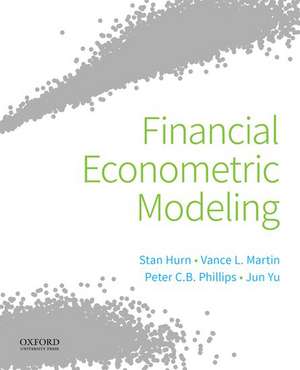
Financial Econometric Modeling
Autor Stan Hurn, Vance L. Martin, Jun Yu, Peter C.B. Phillipsen Limba Engleză Paperback – 21 mai 2020
Preț: 683.75 lei
Preț vechi: 887.99 lei
-23%
Puncte Express: 1026
Carte disponibilă
Livrare economică 28 octombrie-11 noiembrie
Livrare express 14-20 octombrie pentru 202.51 lei
Livrare prin curier în România Termenul estimat este afișat lângă disponibilitate.
Transport gratuit pentru acest produs Plată online sau ramburs, în funcție de opțiunile comenzii.
Retur gratuit în 14 zile Comandă securizată și suport în română.
Specificații
ISBN-13: 9780190857066
ISBN-10: 0190857064
Pagini: 640
Dimensiuni: 191 x 231 x 31 mm
Greutate: 1.09 kg
Editura: Oxford University Press
Colecția OUP USA
Locul publicării:New York, United States
ISBN-10: 0190857064
Pagini: 640
Dimensiuni: 191 x 231 x 31 mm
Greutate: 1.09 kg
Editura: Oxford University Press
Colecția OUP USA
Locul publicării:New York, United States
Recenzii
Financial econometrics is the study and application of compelling econometric methods with a cogent financial purpose. This new book delivers a masterful introduction to financial econometrics at its best. It does so with enticing prose, motivating examples, utmost clarity and, ultimately, just the right balance of breadth and depth. In a world of big data and new technologies, not only does this rich treatment provide the fundamentals needed for more advanced explorations but also, in my view, the desire to explore further. To anyone new to this field, or to anyone who does not believe the field to be approachable and exciting, I say: this book will be an eye-opener.
A comprehensive and long-overdue pedagogical treatment of financial econometrics
Financial Econometric Modeling provides a broad introduction to financial econometrics, with an emphasis on applications and encouraging students to get their hands dirty from the very beginning. The authors cover a vast amount of material. The fact that all of the topics come with sample data sets for students to use
I strongly recommend this textbook. It offers the perfect mix between solid bases and new developments, and between theoretical descriptions of tools and algorithms and a rich set of fully worked-out examples.
A comprehensive and long-overdue pedagogical treatment of financial econometrics
Financial Econometric Modeling provides a broad introduction to financial econometrics, with an emphasis on applications and encouraging students to get their hands dirty from the very beginning. The authors cover a vast amount of material. The fact that all of the topics come with sample data sets for students to use
I strongly recommend this textbook. It offers the perfect mix between solid bases and new developments, and between theoretical descriptions of tools and algorithms and a rich set of fully worked-out examples.
Notă biografică
Stan Hurn is Professor of Econometrics at Queensland University of Technology. He held previous positions at the University of Glasgow and Brasenose College, Oxford. He is a Fellow of the Society of Financial Econometrics and Founding Member and Director of the National Centre for Econometric Research in Australia.Vance L. Martin is Professor of Econometrics at the University of Melbourne. He has published widely in the area of financial econometrics and is coauthor, with Stan Hurn, of the highly successful introductory text Econometric Modeling with Time Series Specification, Estimation, and Testing (2013).Peter C.B. Phillips is Sterling Professor of Economics at Yale University, Distinguished Professor at the University of Auckland, and Distinguished Term Professor at Singapore Management University. He is Founding Editor of the journal Econometric Theory and an elected fellow of many learned societies including the British Academy, the American Academy of Arts and Sciences, and the Royal Society of New Zealand. His work has advanced diverse areas of econometrics, introduced new methods of research in financial economics, and influenced applied work throughout the social and business sciences.Jun Yu is Lee Kong Chian Professor of Economics and Finance at Singapore Management University and Lead Principal Investigator at the Centre for Research on the Economics of Aging (CREA). He is a Fellow of the Journal of Econometrics and the Society of Financial Econometrics, and an Associate Editor of the Journal of Econometrics, Econometric Theory, and Journal of Financial Econometrics.
Cuprins
- I: Fundamentals
- 1. Prices and Returns
- 1.1 What is Financial Econometrics?
- 1.2 Financial Assets
- 1.3 Equity Prices and Returns
- 1.4 Stock Market Indices
- 1.5 Bond Yields
- 1.6 Exercises
- 2. Financial Data
- 2.1irst Look at the Data
- 2.2 Summary Statistics
- 2.3 Percentiles and Value at Risk
- 2.4 The Efficient Market Hypothesis
- 2.5 Exercises
- 3. Linear Regression
- 3.1 The Capital Asset Pricing Model
- 3.2 Multi-factor CAPM
- 3.3 Properties of Ordinary Least Squares
- 3.4 Diagnostics
- 3.5 Measuring Portfolio Performance
- 3.6 Minimum Variance Portfolios
- 3.7 Event Analysis
- 3.8 Exercises
- 4. Stationary Dynamics
- 4.1 Stationarity
- 4.2 Univariate Time Series Models
- 4.3 Autocorrelation and Partial Autocorrelations
- 4.4 Mean Aversion and Reversion in Returns
- 4.5 Vector Autoregressive Models
- 4.6 Analysing VARs
- 4.7 Diebold-Yilmaz Spillover Index
- 4.8 Exercises
- 5. Nonstationarity
- 5.1 The RandomWalk with Drift
- 5.2 Characteristics of Financial Data
- 5.3 Dickey-Fuller Methods and Unit Root Testing
- 5.4 Beyond the Simple Unit Root Framework
- 5.5 Asset Price Bubbles
- 5.6 Exercises
- 6. Cointegration
- 6.1 The Present Value Model and Cointegration
- 6.2 Vector Error Correction Models
- 6.3 Estimation
- 6.4 Cointegration Testing
- 6.5 Parameter Testing
- 6.6 Cointegration and the Gordon Model
- 6.7 Cointegration and the Yield Curve
- 6.8 Exercises
- 7. Forecasting
- 7.1 Types of Forecasts
- 7.2 Forecasting Univariate Time Series Models
- 7.3 Forecasting Multivariate Time Series Models
- 7.4 Combining Forecasts.
- 7.5 Forecast Evaluation Statistics
- 7.6 Evaluating the Density of Forecast Errors
- 7.7 Regression Model Forecasts
- 7.8 Predicting the Equity Premium
- 7.9 Stochastic Simulation of Value at Risk
- 7.10 Exercises
- II. Methods
- 8. Instrumental Variables
- 8.1 The Exogeneity Assumption
- 8.2 Estimating the Risk-Return Tradeoff
- 8.3 The General Instrumental Variables Estimator
- 8.4 Testing for Endogeneity
- 8.5 Weak Instruments
- 8.6 Consumption CAPM
- 8.7 Endogeneity and Corporate Finance
- 8.8 Exercises
- 9. Generalised Method of Moments
- 9.1 Single Parameter Models
- 9.2 Multiple Parameter Models
- 9.3 Over-Identified Models
- 9.4 Estimation
- 9.5 Properties of the GMM Estimator
- 9.6 Testing
- 9.7 Consumption CAPM Revisited
- 9.8 The CKLS Model of Interest Rates
- 9.9 Exercises
- 10. Maximum Likelihood
- 10.1 Distributions in Finance
- 10.2 Estimation by Maximum Likelihood
- 10.3 Applications
- 10.4 Numerical Methods
- 10.5 Properties
- 10.6 Quasi Maximum Likelihood Estimation
- 10.7 Testing
- 10.8 Exercises
- 11. Panel Data Models
- 11.1 Types of Panel Data
- 11.2 Reasons for Using Panel Data
- 11.3 Two Introductory Panel Models
- 11.4 Fixed and Random Effects Panel Models
- 11.5 Dynamic Panel Models
- 11.6 Nonstationary Panel Models
- 11.7 Exercises
- 12. Latent Factor Models
- 12.1 Motivation
- 12.2 Principal Components
- 12.3atent Factor CAPM
- 12.4 Dynamic Factor Models: the Kalman Filter
- 12.5arametric Approach to Factors
- 12.6 Stochastic Volatility
- 12.7 Exercises
- III: Topics
- 13. Univariate GARCH Models
- 13.1 Volatility Clustering.
- 13.2 The GARCH Model
- 13.3 Asymmetric Volatility Effects
- 13.4 Forecasting
- 13.5 The Risk-Return Tradeoff.
- 13.6 Heatwaves and Meteor Showers
- 13.7 Exercises
- 14. Multivariate GARCH Models
- 14.1 Motivation
- 14.2 Early Covariance Estimators
- 14.3 The BEKK Model
- 14.4 The DCC Model
- 14.5 Optimal Hedge Ratios
- 14.6 Capital Ratios and Financial Crises
- 14.7 Exercises
- 15. Realised Variance and Covariance
- 15.1 High Frequency Data
- 15.2 Realised Variance
- 15.3 Integrated Variance
- 15.4 Microstructure Noise
- 15.5 Bipower Variation and Jumps
- 15.6 Forecasting
- 15.7 The Realised GARCH Model
- 15.8 Realised Covariance
- 15.9 Exercises
- 16. Microstructure Models
- 16.1 Characteristics of High Frequency Data
- 16.2 Limit Order Book
- 16.3 Bid Ask Bounce
- 16.4 Information Content of Trades
- 16.5 Modelling Price Movements in Trades
- 16.6 Modelling Durations
- 16.7 Modelling Volatility in Transactions Time
- 16.8 Exercises
- 17. Options
- 17.1 Option Pricing Basics.
- 17.2 The Black-Scholes Option Price Model
- 17.3irst Look at Options Data
- 17.4 Estimating the Black-Scholes Model
- 17.5 Testing the Black-Scholes Model
- 17.6 Option Pricing and GARCH Volatility
- 17.7 The Melick-Thomas Option Price Model
- 17.8 Nonlinear Option Pricing.
- 17.9 Using Options to Estimate GARCH Models
- 17.10 Exercises
- 18. Extreme Values and Copulas
- 18.1 Motivation.
- 18.2 Evidence of Heavy Tails
- 18.3 Extreme Value Theory
- 18.4 Modelling Dependence using Copulas
- 18.5 Properties of Copulas
- 18.6 Estimating Copula Models
- 18.7 MGARCH Model Using Copulas
- 18.8 Exercises
- 19. Concluding Remarks
- A. Mathematical Preliminaries
- A.1 Summation Notation
- A.2 Expectations Operator
- A.3 Differentiation
- A.4 Taylor Series Expansions
- A.5 Matrix Algebra
- A.6 Transposition ofatrix
- A.7 Symmetric Matrix
- B. Properties of Estimators
- B.1 Finite Sample Properties
- B.2 Asymptotic Properties
- C. Linear Regression Model in Matrix Notation
- D. Numerical Optimisation
- E. Simulating Copulas
- Author index
- Subject index