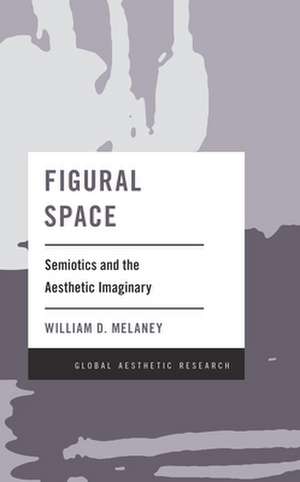
Figural Space: Semiotics and the Aesthetic Imaginary: Global Aesthetic Research
Autor William D. Melaneyen Limba Engleză Hardback – 15 apr 2021
| Toate formatele și edițiile | Preț | Express |
|---|---|---|
| Paperback (1) | 209.17 lei 43-57 zile | |
| Bloomsbury Publishing – 2 feb 2023 | 209.17 lei 43-57 zile | |
| Hardback (1) | 577.52 lei 43-57 zile | |
| Bloomsbury Publishing – 15 apr 2021 | 577.52 lei 43-57 zile |





Preț: 577.52 lei
Preț vechi: 873.16 lei
-34%
Puncte Express: 866
Preț estimativ în valută:
102.24€ • 119.05$ • 88.82£
102.24€ • 119.05$ • 88.82£
Carte tipărită la comandă
Livrare economică 23 februarie-09 martie
Preluare comenzi: 021 569.72.76
Specificații
ISBN-13: 9781538147856
ISBN-10: 1538147858
Pagini: 224
Dimensiuni: 164 x 228 x 22 mm
Greutate: 0.49 kg
Editura: Bloomsbury Publishing
Colecția Rowman & Littlefield Publishers
Seria Global Aesthetic Research
Locul publicării:New York, United States
ISBN-10: 1538147858
Pagini: 224
Dimensiuni: 164 x 228 x 22 mm
Greutate: 0.49 kg
Editura: Bloomsbury Publishing
Colecția Rowman & Littlefield Publishers
Seria Global Aesthetic Research
Locul publicării:New York, United States
Cuprins
Introduction: An Opening of Figural Space
1. Kristeva and Hegel:
Subjectivity Reconfigured
2. Spenser's Renaissance:
Ideality and Discourse
3. Image in Wordsworth:
Space/Time and Semiotics
4. Shelley's Double Vision:
Figural Counter-Worlds
5. Proust and Aesthetics:
A Narrative Sensibility
6. Space in Blanchot:
Orphic Testimonies
7. H.D. and Life Writing:
A Logos of Difference
8. Revisiting Jean Rhys:
Postcolonial Ethics
9. Ishiguro's Imaginary:
Figures of History
Conclusion: Negotiating the Figural
Index
1. Kristeva and Hegel:
Subjectivity Reconfigured
2. Spenser's Renaissance:
Ideality and Discourse
3. Image in Wordsworth:
Space/Time and Semiotics
4. Shelley's Double Vision:
Figural Counter-Worlds
5. Proust and Aesthetics:
A Narrative Sensibility
6. Space in Blanchot:
Orphic Testimonies
7. H.D. and Life Writing:
A Logos of Difference
8. Revisiting Jean Rhys:
Postcolonial Ethics
9. Ishiguro's Imaginary:
Figures of History
Conclusion: Negotiating the Figural
Index
Recenzii
Taking its point of departure in Kristeva's original combination of speculative philosophy and psychoanalysis, Figural Space offers us the best of what literary theory has in store: real gems, as why Spenser's epic anticipates Hegel's Phenomenology of Spirit or why The Prelude echoes Kant. Kristeva's hitherto untapped critical energies provide a welcome corrective to historicist accounts of literature like those of Gadamer or Rancière, as Melaney's inspired readings of Rimbaud, Proust, Blanchot, Rhys and Ishiguro abundantly prove.
I was struck by how Hegel's aesthetics provides a significant and illuminating point of reference in this work. The book argues for a rehabilitation of Hegel in a cautious yet appreciative spirit. Negotiating its way between more traditional foundational readings and more recent hermeneutical ones, it brings its claim to bear on the writings of many authors, among whom areSpenser, Wordsworth, Shelly, Proust, Blanchot, and Kristeva. It pursues its notion of figural space in an intriguing and informative way, suggestive of the latent power of equivocal dialectic to be aesthetically illuminating in a variety of contexts and figures.
Through subtle readings of very different writers (poets, novelists and philosophers from a range of times and places) Melaney persuasively shows how the aesthetic, described as 'a form of non-knowledge', allows us to know so much that would otherwise elude us. A remarkable achievement.
I was struck by how Hegel's aesthetics provides a significant and illuminating point of reference in this work. The book argues for a rehabilitation of Hegel in a cautious yet appreciative spirit. Negotiating its way between more traditional foundational readings and more recent hermeneutical ones, it brings its claim to bear on the writings of many authors, among whom areSpenser, Wordsworth, Shelly, Proust, Blanchot, and Kristeva. It pursues its notion of figural space in an intriguing and informative way, suggestive of the latent power of equivocal dialectic to be aesthetically illuminating in a variety of contexts and figures.
Through subtle readings of very different writers (poets, novelists and philosophers from a range of times and places) Melaney persuasively shows how the aesthetic, described as 'a form of non-knowledge', allows us to know so much that would otherwise elude us. A remarkable achievement.