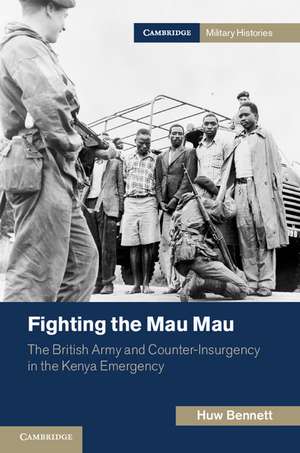
Fighting the Mau Mau
Autor Huw Bennetten Limba Engleză Paperback – 3 ian 2017
Notăm cu interes modul în care Fighting the Mau Mau oferă o perspectivă riguroasă asupra aplicabilității practice a tacticilor de contrainsurgență, demontând mitul utilizării forței minime în teatrele de operațiuni coloniale. Huw Bennett analizează în detaliu campania britanică din Kenya anilor 1950, demonstrând cum necesitatea militară a prevalat adesea asupra dreptului internațional, transformând populația civilă într-o țintă a coerciției sistematice. Reținem că această lucrare extinde cadrul propus de Defeating Mau Mau, Creating Kenya de Daniel Branch cu date noi privind comportamentul trupelor pe teren, mutând accentul de pe loialiștii locali către mecanismele interne de comandă ale armatei britanice. Descoperim aici o examinare critică a modului în care disciplina militară a coexistat cu măsuri represive severe, precum tortura și execuțiile sumare, folosite pentru a teroriza populația și a tăia sprijinul pentru rebeli. Cartea este organizată în nouă capitole ce urmăresc progresia conflictului, de la primele operațiuni împotriva bandelor teroriste până la structurarea alianțelor civil-militare sub conducerea generalului Erskine. Huw Bennett continuă astfel linia de cercetare începută în Uncivil War, unde a investigat rolul armatei în Irlanda de Nord, consolidându-și poziția de specialist în istoria conflictelor asimetrice. Față de abordările mai generale din British Ways of Counter-insurgency, volumul de față oferă o disecție microscopică a dinamicii forței, fiind esențial pentru înțelegerea modului în care tradiția colonială a 'forței exemplare' a influențat realitatea brutală a decolonizării.
Preț: 240.84 lei
Carte tipărită la comandă
Livrare economică 05-19 decembrie
Specificații
ISBN-10: 1107656249
Pagini: 320
Ilustrații: 1 b/w illus. 3 maps
Dimensiuni: 152 x 229 x 17 mm
Greutate: 0.47 kg
Ediția:New.
Editura: Cambridge University Press
Locul publicării:New York, United States
V-ar putea interesa
-
 Warfare in African HistoryRichard J. ReidPreț: 211.81 lei
 -
 Darfur's SorrowM. W. DalyPreț: 251.99 lei
 -
 The Great African WarFilip ReyntjensPreț: 257.19 lei
 -
 Transformations in SlaveryPaul E. LovejoyPreț: 252.24 lei
 -
 A History of NigeriaToyin FalolaPreț: 213.79 lei
 -
 Concise History of South Africa 2edRobert RossPreț: 180.99 lei
 -
 Rorke's Drift & Isandlwana 1879Chris PeersPreț: 149.92 lei
 -
 Cape Verde: Crioulo Colony To Independent NationRichard A Lobban-15%Preț: 452.25 lei532.06 lei
 -
 The RecordDonald Moodie-19%Preț: 577.83 lei713.37 lei
 -
 -26%Preț: 90.55 lei122.49 lei
 -
 The War for AfricaFred BridglandPreț: 222.00 lei
 -
 Lord Leverhulme's GhostsJules MarchalPreț: 119.88 lei
 -
 How Long Will South Africa Survive?R. W. JohnsonPreț: 103.41 lei
De ce să citești această carte
Această lucrare din seria Cambridge Military Histories este indispensabilă pentru istoricii militari și specialiștii în relații internaționale. Cititorul câștigă o înțelegere factuală, lipsită de eufemisme, a modului în care armata britanică a gestionat una dintre cele mai violente rebeliuni din Africa. Este o resursă critică pentru oricine studiază decalajul dintre doctrina militară oficială și realitatea dură a execuției pe teren în timpul războaielor de decolonizare.
Descriere scurtă
Cuprins
Recenzii
'In this first document-based study of the wars of decolonisation fought by the British Army after 1945, Huw Bennett provides a gripping, revisionist account of the campaign against Mau Mau rebels in Kenya. Britain's Army, war-weary, over-stretched, under-trained and dependent upon reluctant conscripts, held on to a philosophy of 'minimum force' in Kenya. But on the ground the 'rule of law' was bent, and sometimes broken, as the Army used whatever force it needed. Newly unearthed documents tell a story that shatters our view of Britain's Army as the 'hearts-and-minds' counter-insurgency specialists. This is more than just another colonial history, it is a commentary on the myths we still live by in post-imperial Britain. If you want to know what went wrong in Basra and Helmand, start here.' David M. Anderson, author of Histories of the Hanged: Britain's Dirty War in Kenya and the End of Empire
'Huw Bennett leaves no stone unturned in debunking the self-serving mythology surrounding the role of the British Army in the 'Emergency'.' Morning Star
'… Bennett is to be congratulated for an exciting, lively, readable, informed, and scholarly study of Mau Mau that both supplements and complements the growing corpus on British counter-insurgency.' Matthew Hughes, War in History
'Bennett's comprehensive use of previously unseen documents - and, indeed, the weight of this evidence - will silence those who have claimed that Kikuyu oral testimonies are 'untrustworthy' or cannot serve as 'proper' evidence. The same people will argue that abuses carried out by Mau Mau are little mentioned here, but that is not the focus of Bennett's book. This is no sensationalist account of a dirty colonial war, but an exhaustively researched and carefully unpacked indictment of British conduct in one of its perennially difficult colonies. Fighting the Mau Mau is essential reading for anyone concerned with Kenya's history or the decolonization of the British Empire.' International Journal of African Historical Studies
'Offers a careful dissection of the dynamic of the use of force during the insurgency, disassembling the issues surrounding minimum force and the army's behaviour towards civilians the better to put them back together. Locating the study within the 'military phase' of the Kenya Emergency (which lasted from 1952 until the capture of the Mau Mau leader Dedan Kimathi in October 1956), Bennett underlines the decisive role played by the army in quashing the rebellion within what was a relatively short period for a counterinsurgency campaign - although the official end of the emergency only came four years later. The issue at hand, then, is not whether the army was effective in countering the insurgency, but rather how it comported itself.' Michael P. M. Finch, The English Historical Review