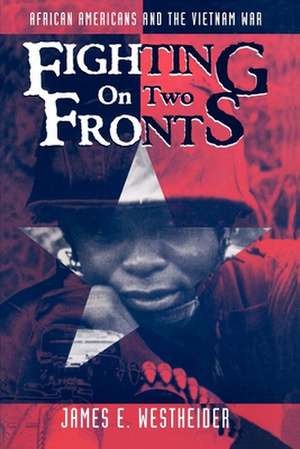
Fighting on Two Fronts
Autor James E Westheideren Limba Engleză Paperback – apr 1999
Preț: 254.48 lei
Puncte Express: 382
Preț estimativ în valută:
45.01€ • 52.13$ • 39.08£
45.01€ • 52.13$ • 39.08£
Carte tipărită la comandă
Livrare economică 21 aprilie-05 mai
Specificații
ISBN-13: 9780814793244
ISBN-10: 081479324X
Pagini: 248
Dimensiuni: 148 x 222 x 16 mm
Greutate: 0.36 kg
Ediția:Revised edition
Editura: NEW YORK UNIVERSITY PRESS
ISBN-10: 081479324X
Pagini: 248
Dimensiuni: 148 x 222 x 16 mm
Greutate: 0.36 kg
Ediția:Revised edition
Editura: NEW YORK UNIVERSITY PRESS
V-ar putea interesa
-
 Our Kind of PeopleLawrence Otis GrahamPreț: 106.39 lei
 -
 Trouble in Mind: Black Southerners in the Age of Jim CrowLeon F. LitwackPreț: 142.44 lei
 -
 Preț: 97.47 lei
 -
 Coming of Age in MississippiAnne MoodyPreț: 54.43 lei
 -
 The Debt: What America Owes to BlacksRandall N. RobinsonPreț: 126.57 lei
 -
 Preț: 165.81 lei
 -
 Black Skin, White MasksFrantz FanonPreț: 86.16 lei
 -
 Preț: 137.75 lei
 -
 Death of InnocenceMamie Till-MobleyPreț: 106.38 lei
 -
 Impossible WitnessesDwight McbridePreț: 241.54 lei
 -
 Black Gay ManRobert F Reid-PharrPreț: 237.22 lei
 -
 Once You Go BlackRobert F Reid-PharrPreț: 233.53 lei
 -
 -23%Preț: 607.71 lei789.23 lei
 -
 The Civil Rights Movement in American MemoryRenee C. RomanoPreț: 270.67 lei
Recenzii
"A very powerful account of a significant aspect of recent American military history."
--Journal of Military History "Westheider has researched very thoroughly-an effort including extensive interviews with Vietnam veterans-and he possesses a rare gift for narrative that makes the result of all this research eminently readable. A highly desirable addition for both African American studies and military affairs collections. . . . [an] invaluable history."
--Booklist "Highly recommended."
--Library Journal "James E. Westheider persuasively argues that black soldiers were the key factor in bringing about a more egalitarian military. This book significantly advances our understanding of both race relations and armed forces."
--Charles Moskos, Northwestern University "With this meticulous investigation of how institutional racism operated in the military of the 1960s and 70s, James Westheider provides us with a model for making sense of institutional sexism in the Tailhook-era military."
--Cynthia Enloe, author of The Morning After: Sexual Politics at the End of the Cold War
"A very powerful account of a significant aspect of recent American military history." --Journal of Military History "Westheider has researched very thoroughly-an effort including extensive interviews with Vietnam veterans-and he possesses a rare gift for narrative that makes the result of all this research eminently readable. A highly desirable addition for both African American studies and military affairs collections... [an] invaluable history." --Booklist "Highly recommended." --Library Journal "James E. Westheider persuasively argues that black soldiers were the key factor in bringing about a more egalitarian military. This book significantly advances our understanding of both race relations and armed forces." --Charles Moskos, Northwestern University "With this meticulous investigation of how institutional racism operated in the military of the 1960s and 70s, James Westheider provides us with a model for making sense of institutional sexism in the Tailhook-era military." --Cynthia Enloe, author of The Morning After: Sexual Politics at the End of the Cold War
--Journal of Military History "Westheider has researched very thoroughly-an effort including extensive interviews with Vietnam veterans-and he possesses a rare gift for narrative that makes the result of all this research eminently readable. A highly desirable addition for both African American studies and military affairs collections. . . . [an] invaluable history."
--Booklist "Highly recommended."
--Library Journal "James E. Westheider persuasively argues that black soldiers were the key factor in bringing about a more egalitarian military. This book significantly advances our understanding of both race relations and armed forces."
--Charles Moskos, Northwestern University "With this meticulous investigation of how institutional racism operated in the military of the 1960s and 70s, James Westheider provides us with a model for making sense of institutional sexism in the Tailhook-era military."
--Cynthia Enloe, author of The Morning After: Sexual Politics at the End of the Cold War
"A very powerful account of a significant aspect of recent American military history." --Journal of Military History "Westheider has researched very thoroughly-an effort including extensive interviews with Vietnam veterans-and he possesses a rare gift for narrative that makes the result of all this research eminently readable. A highly desirable addition for both African American studies and military affairs collections... [an] invaluable history." --Booklist "Highly recommended." --Library Journal "James E. Westheider persuasively argues that black soldiers were the key factor in bringing about a more egalitarian military. This book significantly advances our understanding of both race relations and armed forces." --Charles Moskos, Northwestern University "With this meticulous investigation of how institutional racism operated in the military of the 1960s and 70s, James Westheider provides us with a model for making sense of institutional sexism in the Tailhook-era military." --Cynthia Enloe, author of The Morning After: Sexual Politics at the End of the Cold War