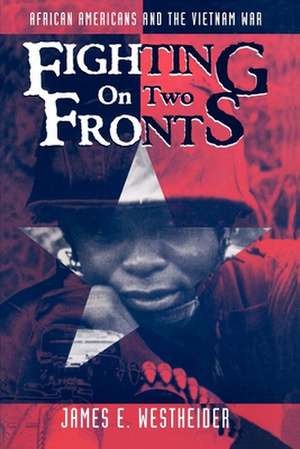
Fighting on Two Fronts
Autor James E Westheideren Limba Engleză Paperback – apr 1999
Preț: 269.26 lei
Puncte Express: 404
Carte tipărită la comandă
Livrare economică 30 noiembrie-14 decembrie
Livrare prin curier în România Termenul estimat este afișat lângă disponibilitate.
Transport gratuit de la 400.00 lei Plată online sau ramburs, în funcție de opțiunile comenzii.
Retur gratuit în 14 zile Comandă securizată și suport în română.
Specificații
ISBN-13: 9780814793244
ISBN-10: 081479324X
Pagini: 248
Dimensiuni: 148 x 222 x 16 mm
Greutate: 0.36 kg
Ediția:Revised edition
Editura: NEW YORK UNIVERSITY PRESS
ISBN-10: 081479324X
Pagini: 248
Dimensiuni: 148 x 222 x 16 mm
Greutate: 0.36 kg
Ediția:Revised edition
Editura: NEW YORK UNIVERSITY PRESS
V-ar putea interesa
-
 Our Kind of PeopleLawrence Otis GrahamPreț: 114.81 lei
 -
 Trouble in MindLeon F. LitwackPreț: 153.81 lei
 -
 There Are No Children HereAlex KotlowitzPreț: 105.22 lei
 -
 Coming of Age in MississippiAnne MoodyPreț: 54.43 lei
 -
 The DebtRandall RobinsonPreț: 147.33 lei
 -
 Preț: 165.81 lei
 -
 Black Skin, White MasksFrantz FanonPreț: 93.26 lei
 -
 Jefferson's PillowRoger W. WilkinsPreț: 143.17 lei
 -
 Death of InnocenceMamie Till-MobleyPreț: 110.15 lei
 -
 Impossible WitnessesDwight McbridePreț: 248.48 lei
 -
 Black Gay ManRobert F Reid-PharrPreț: 249.24 lei
 -
 Once You Go BlackRobert F Reid-PharrPreț: 252.74 lei
 -
 -23%Preț: 607.71 lei789.23 lei
 -
 The Civil Rights Movement in American MemoryRenee C. RomanoPreț: 282.53 lei
Recenzii
"A very powerful account of a significant aspect of recent American military history."
--Journal of Military History "Westheider has researched very thoroughly-an effort including extensive interviews with Vietnam veterans-and he possesses a rare gift for narrative that makes the result of all this research eminently readable. A highly desirable addition for both African American studies and military affairs collections. . . . [an] invaluable history."
--Booklist "Highly recommended."
--Library Journal "James E. Westheider persuasively argues that black soldiers were the key factor in bringing about a more egalitarian military. This book significantly advances our understanding of both race relations and armed forces."
--Charles Moskos, Northwestern University "With this meticulous investigation of how institutional racism operated in the military of the 1960s and 70s, James Westheider provides us with a model for making sense of institutional sexism in the Tailhook-era military."
--Cynthia Enloe, author of The Morning After: Sexual Politics at the End of the Cold War
"A very powerful account of a significant aspect of recent American military history." --Journal of Military History "Westheider has researched very thoroughly-an effort including extensive interviews with Vietnam veterans-and he possesses a rare gift for narrative that makes the result of all this research eminently readable. A highly desirable addition for both African American studies and military affairs collections... [an] invaluable history." --Booklist "Highly recommended." --Library Journal "James E. Westheider persuasively argues that black soldiers were the key factor in bringing about a more egalitarian military. This book significantly advances our understanding of both race relations and armed forces." --Charles Moskos, Northwestern University "With this meticulous investigation of how institutional racism operated in the military of the 1960s and 70s, James Westheider provides us with a model for making sense of institutional sexism in the Tailhook-era military." --Cynthia Enloe, author of The Morning After: Sexual Politics at the End of the Cold War
--Journal of Military History "Westheider has researched very thoroughly-an effort including extensive interviews with Vietnam veterans-and he possesses a rare gift for narrative that makes the result of all this research eminently readable. A highly desirable addition for both African American studies and military affairs collections. . . . [an] invaluable history."
--Booklist "Highly recommended."
--Library Journal "James E. Westheider persuasively argues that black soldiers were the key factor in bringing about a more egalitarian military. This book significantly advances our understanding of both race relations and armed forces."
--Charles Moskos, Northwestern University "With this meticulous investigation of how institutional racism operated in the military of the 1960s and 70s, James Westheider provides us with a model for making sense of institutional sexism in the Tailhook-era military."
--Cynthia Enloe, author of The Morning After: Sexual Politics at the End of the Cold War
"A very powerful account of a significant aspect of recent American military history." --Journal of Military History "Westheider has researched very thoroughly-an effort including extensive interviews with Vietnam veterans-and he possesses a rare gift for narrative that makes the result of all this research eminently readable. A highly desirable addition for both African American studies and military affairs collections... [an] invaluable history." --Booklist "Highly recommended." --Library Journal "James E. Westheider persuasively argues that black soldiers were the key factor in bringing about a more egalitarian military. This book significantly advances our understanding of both race relations and armed forces." --Charles Moskos, Northwestern University "With this meticulous investigation of how institutional racism operated in the military of the 1960s and 70s, James Westheider provides us with a model for making sense of institutional sexism in the Tailhook-era military." --Cynthia Enloe, author of The Morning After: Sexual Politics at the End of the Cold War