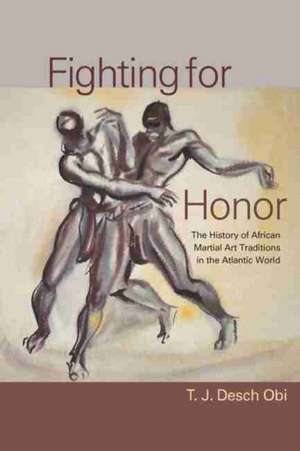
Fighting for Honor
Autor T J Desch-Obien Limba Engleză Paperback – 12 apr 2021
Grounded in historical and cultural anthropological methodologies, Obi's investigation traces the influence of well-delineated African traditions on long-observed but misunderstood African and African American cultural activities in North America, Brazil, and the Caribbean. He links the Brazilian martial art capoeira to reports of slave activities recorded in colonial and antebellum North America. Likewise Obi connects images of the kalenda African stick-fighting techniques to the Haitian Revolution. Throughout the study Obi examines the ties between physical mastery of these arts and changing perceptions of honor.
Including forty-five illustrations, this rich history of the arrival and dissemination of African martial arts in the Atlantic world offers a new vantage for furthering our understanding of the powerful influence of enslaved populations on our collective social history.
Preț: 188.41 lei
Puncte Express: 283
Carte indisponibilă temporar
Doresc să fiu notificat când acest titlu va fi disponibil:
Se trimite...
Specificații
ISBN-13: 9781643361925
ISBN-10: 1643361929
Pagini: 368
Dimensiuni: 145 x 226 x 25 mm
Greutate: 0.52 kg
Editura: University of South Carolina Press
ISBN-10: 1643361929
Pagini: 368
Dimensiuni: 145 x 226 x 25 mm
Greutate: 0.52 kg
Editura: University of South Carolina Press
Notă biografică
T. J. Desch-Obi received his doctorate in African history from the University of California, Los Angeles. His research focuses on historical ethnography, which he explores through the lens of African and African diaspora martial arts. He is currently an assistant professor of African and African diaspora history at the City University of New York's Baruch College.
Descriere
In this thorough survey of the history of African martial arts techniques, T.J. Desch Obi maps the translation of numerous physical combat techniques across three continents and several centuries to illustrate how these practices evolved over time and are still recognizable in American culture today.