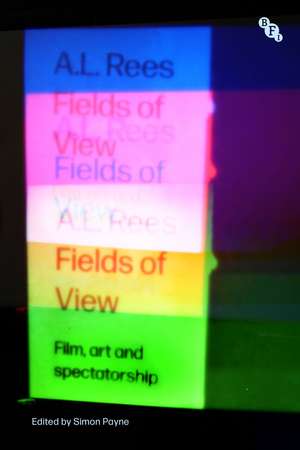
Fields of View: Film, Art and Spectatorship
Autor A.L. Rees Simon Payneen Limba Engleză Paperback – 29 oct 2020
Preț: 255.52 lei
Preț vechi: 332.30 lei
-23%
Puncte Express: 383
Carte disponibilă
Livrare economică 12-26 noiembrie
Livrare prin curier în România Termenul estimat este afișat lângă disponibilitate.
Transport gratuit de la 400.00 lei Plată online sau ramburs, în funcție de opțiunile comenzii.
Retur gratuit în 14 zile Comandă securizată și suport în română.
Specificații
ISBN-13: 9781838719920
ISBN-10: 183871992X
Pagini: 240
Ilustrații: 68 bw illus; 19 colour illus
Dimensiuni: 152 x 232 x 12 mm
Greutate: 0.44 kg
Editura: Bloomsbury Publishing
Colecția British Film Institute
Locul publicării:London, United Kingdom
ISBN-10: 183871992X
Pagini: 240
Ilustrații: 68 bw illus; 19 colour illus
Dimensiuni: 152 x 232 x 12 mm
Greutate: 0.44 kg
Editura: Bloomsbury Publishing
Colecția British Film Institute
Locul publicării:London, United Kingdom
V-ar putea interesa
-
 Digital UncannyKriss Ravetto-BiagioliPreț: 338.29 lei
 -
 -12%Preț: 256.59 lei291.82 lei
 -
 Preț: 300.23 lei
 -
 Preț: 461.15 lei
 -
 Women in African Cinema: Beyond the Body PoliticLizelle BisschoffPreț: 394.62 lei
 -
 -23%Preț: 586.80 lei762.08 lei
 -
 Preț: 250.82 lei
 -
 Frame by FrameHannah FrankPreț: 284.07 lei
 -
 Fascism in FilmMarcia Landy-23%Preț: 967.52 lei1256.52 lei
 -
 Genre and Contemporary HollywoodSteve NealePreț: 253.60 lei
 -
 The Nosferatu StoryRolf GiesenPreț: 394.06 lei
 -
 Cowboy CourageWilliam HampesPreț: 293.36 lei
 -
 Film Appreciation through GenresMichael Patrick GillespiePreț: 296.18 lei
 -
 Panel to the ScreenDrew MortonPreț: 285.28 lei
 -
 Irish Cinema in the Twenty-First CenturyRuth Barton-19%Preț: 676.48 lei835.15 lei
 -
 Preț: 95.74 lei
 -
 Performing Bodies: Female Illness in Italian Literature and Cinema (1860–1920)Catherine Ramsey-Portolano-34%Preț: 509.80 lei767.98 lei
 -
 The Life and Death of Colonel BlimpAl Kennedy-42%Preț: 64.87 lei111.82 lei
 -
 Thelma & LouiseMarita Sturken-42%Preț: 64.87 lei112.33 lei
 -
 Sansho Dayu (Sansho the Bailiff)Dudley Andrew-41%Preț: 66.82 lei113.95 lei
 -
 PerformanceColin Maccabe-33%Preț: 66.59 lei98.93 lei
 -
 Caché (Hidden)Catherine Wheatley-41%Preț: 66.80 lei113.95 lei
 -
 The Manchurian CandidateGreil Marcus-32%Preț: 66.76 lei98.90 lei
 -
 Mother IndiaGayatri Chatterjee-42%Preț: 64.87 lei112.33 lei
 -
 Scotland Film LocationsPhoebe Taplin-32%Preț: 38.51 lei56.62 lei
 -
 The Griffith Project, Volume 9: Films Produced in 1916-18Paolo Cherchi Usai-24%Preț: 631.79 lei832.28 lei
 -
 A History of Experimental Film and VideoA.L. Rees-24%Preț: 226.26 lei299.28 lei
 -
 -18%Preț: 177.60 lei217.85 lei
 -
 -33%Preț: 177.64 lei266.27 lei
Cuprins
Foreword: Harvesting Fields
Acknowledgements
Fields
Film Machine
Film as Optic and Idea
Expanding Cinema
Room Films
Film Objects
Projection Space
Time Frames
Realisms
Asymptote
Digital Dialectic
Fields in Braque and Gehr
Classic Film Theory and the Spectator
Field and Gestalt
Monet, Lumière and Cinematic Time
Displacement, Sculpture
Bodies in Motion
Intervals
Methods of Montage
Frames
Frames and Windows
Constructivism and Computers
Geometry of Intervals
Notes
Acknowledgements
Fields
Film Machine
Film as Optic and Idea
Expanding Cinema
Room Films
Film Objects
Projection Space
Time Frames
Realisms
Asymptote
Digital Dialectic
Fields in Braque and Gehr
Classic Film Theory and the Spectator
Field and Gestalt
Monet, Lumière and Cinematic Time
Displacement, Sculpture
Bodies in Motion
Intervals
Methods of Montage
Frames
Frames and Windows
Constructivism and Computers
Geometry of Intervals
Notes
Recenzii
Al Rees's testament is a cinematic thinking: film and world swooping towards each other across a landscape of fields and intervals, projections and geometries, movements in and of time and space. On every page, the generosity of the man, the curator and the teacher shape new insights into our audiovisual century and its lineage. A work of permanent illumination.
In the unlikely event that there was any doubt, Fields of View affirms A.L. Rees as one of experimental cinema's most erudite, insightful, and passionate critics and advocates. His writings, which range across a breathtaking array of subjects, ideas, works, and references, are intelligent - frequently brilliant - without ever devoting into intellectualism. They are astonishingly well-read without succumbing to mere scholasticism; we never lose the sense of an original voice, a distinct sensibility, and a great mind. Like all the best critical writing, Rees's is itself elegant, artful, provocative, and personal. This collection of essays is an excellent introduction for those unfamiliar with Rees, and a reminder to those of us who already knew his writing how important he was (and remains), and what great writing about art looks like.
In this posthumous collection of essays, A.L. Rees has woven his outstanding knowledge of avant-garde film into a startlingly original, and non-linear, reconfiguration of its history. With great agility and lightness of touch, his perceptive but unexpected juxtapositions between theorists and artists, ideas and technologies, movements and moments throw new light on key issues of film theory and aesthetics. This radical rejection of chronology, however, has an underlying message. Rees traces ways in which experimental art and artists' film have challenged traditions of space and time that, rather than abrupt rupture, create a direct connection with the forms of digital art. In the brilliant last chapters of the book, he zeroes in on this dialectic.
In the unlikely event that there was any doubt, Fields of View affirms A.L. Rees as one of experimental cinema's most erudite, insightful, and passionate critics and advocates. His writings, which range across a breathtaking array of subjects, ideas, works, and references, are intelligent - frequently brilliant - without ever devoting into intellectualism. They are astonishingly well-read without succumbing to mere scholasticism; we never lose the sense of an original voice, a distinct sensibility, and a great mind. Like all the best critical writing, Rees's is itself elegant, artful, provocative, and personal. This collection of essays is an excellent introduction for those unfamiliar with Rees, and a reminder to those of us who already knew his writing how important he was (and remains), and what great writing about art looks like.
In this posthumous collection of essays, A.L. Rees has woven his outstanding knowledge of avant-garde film into a startlingly original, and non-linear, reconfiguration of its history. With great agility and lightness of touch, his perceptive but unexpected juxtapositions between theorists and artists, ideas and technologies, movements and moments throw new light on key issues of film theory and aesthetics. This radical rejection of chronology, however, has an underlying message. Rees traces ways in which experimental art and artists' film have challenged traditions of space and time that, rather than abrupt rupture, create a direct connection with the forms of digital art. In the brilliant last chapters of the book, he zeroes in on this dialectic.
Notă biografică
A.L. Rees was Head of the Time-Based Media course at Maidstone College of Art from 1988 - 1995 and then Research Tutor at the Royal College of Art until 2014. At various times he was the chair of the Arts Council's artists' film and video committee, and an adviser on experimental film to the British Film Institute, Tate, the Arts and Humanities Research Council and Channel 4. His book A History of Experimental Film and Video (BFI, 1999/2011) remains a key text, supplemented by the wide range of essays he wrote for journals and books on film and art.