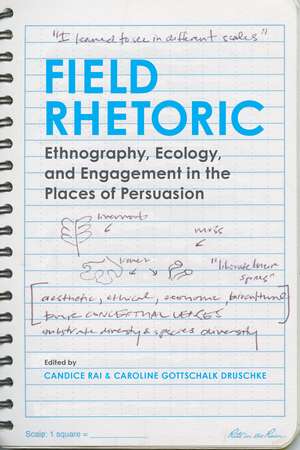
Field Rhetoric: Ethnography, Ecology, and Engagement in the Places of Persuasion: Rhetoric, Culture, and Social Critique
Editat de Candice Rai, Caroline Gottschalk Druschke Cuvânt după de Phaedra Carmen Pezzullo, Gerard A. Hauser Contribuţii de John M. Ackerman, Heather Brook Adams, Ralph Cintron, Rick Cruse, Lauren Cutlip, Jane Disney, Danielle Endres, Emma Fox, Jeffrey T. Grabill, Carl G. Herndl, Aaron Hess, Sarah Beth Hopton, Kendall Leon, Laura Lindenfeld, Erin Daina McClellan, Bridie McGreavy, Michael K. Middleton, Chris Petersen, Stacey Pigg, Elena Yu Polush, Samantha Senda-Cook, Mack Shelleyen Limba Engleză Paperback – 30 sep 2025 – vârsta ani
A variety of research areas within rhetorical studies—including everyday and public rhetorics, space and place-based work, material and ecological approaches, environmental communication, technical communication, and critical and participatory action research, among others—have increasingly called for ethnographic fieldwork that grounds the study of rhetoric within the contexts of its use and circulation. Employing field methods more commonly used by ethnographers allows researchers to capture rhetoric in action and to observe the dynamic circumstances that shape persuasion in ordinary life.
Field Rhetoric: Ethnography, Ecology, and Engagement in the Places of Persuasion gathers new essays that describe and theorize this burgeoning transdisciplinary mode of field-based scholarship. Contributors document and support this ethnographic turn in rhetorical studies through sustained examination of the diverse trends, methods, tools, theories, practices, and possibilities for engaging in rhetorical field research.
This fascinating volume offers an introduction to these inquiries and serves as both a practical resource and theoretical foundation for scholars, teachers, and students interested in the intersection of rhetoric and field studies. Editors Candice Rai and Caroline Gottschalk Druschke have assembled scholars working in diverse field sites to map and initiate key debates on the practices, limitations, and value of rhetorical field methods and research. Working synthetically at the junction of rhetorical theory and field practices, the contributors to this collection build from myriad field-based cases to examine diverse theoretical and methodological considerations. The volume also serves as a useful reference for interdisciplinary qualitative researchers interested in doing research from a rhetorical or discursive perspective in various disciplines and fields, such as English, composition, communication, natural resources, geography, sociology, urban planning, anthropology, and more.
Din seria Rhetoric, Culture, and Social Critique
-
 Preț: 270.90 lei
 -
 Preț: 249.71 lei
 -
 Preț: 151.13 lei
 -
 Preț: 204.98 lei
 -
 Preț: 160.88 lei
 -
 Preț: 230.21 lei
 -
 Preț: 161.89 lei
 -
 Preț: 231.53 lei
 -
 Preț: 249.17 lei
 - 5%
 Preț: 156.35 lei
 -
 Preț: 233.27 lei
 -
 Preț: 190.22 lei
 -
 Preț: 371.61 lei
 -
 Preț: 234.12 lei
 -
 Preț: 245.81 lei
 -
 Preț: 211.61 lei
 -
 Preț: 187.07 lei
 -
 Preț: 280.96 lei
 -
 Preț: 231.52 lei
 -
 Preț: 232.33 lei
 -
 Preț: 207.44 lei
 -
 Preț: 230.96 lei
 -
 Preț: 165.20 lei
 -
 Preț: 353.69 lei
 -
 Preț: 208.09 lei
 -
 Preț: 280.65 lei
 -
 Preț: 163.25 lei
 -
 Preț: 382.35 lei
 -
 Preț: 267.31 lei
 -
 Preț: 384.73 lei
 -
 Preț: 197.48 lei
 -
 Preț: 196.54 lei
 -
 Preț: 281.62 lei
 -
 Preț: 349.58 lei
 -
 Preț: 231.61 lei
 -
 Preț: 163.88 lei
 - 9%
 Preț: 694.47 lei
 -
 Preț: 198.99 lei
Preț: 188.61 lei
Puncte Express: 283
Carte indisponibilă temporar
Doresc să fiu notificat când acest titlu va fi disponibil:
Se trimite...
Specificații
ISBN-13: 9780817362478
ISBN-10: 0817362479
Pagini: 320
Ilustrații: 12 B&W figures - 2 maps - 2 tables
Dimensiuni: 152 x 229 x 25 mm
Greutate: 0.51 kg
Ediția:First Edition
Editura: University Of Alabama Press
Colecția University Alabama Press
Seria Rhetoric, Culture, and Social Critique
ISBN-10: 0817362479
Pagini: 320
Ilustrații: 12 B&W figures - 2 maps - 2 tables
Dimensiuni: 152 x 229 x 25 mm
Greutate: 0.51 kg
Ediția:First Edition
Editura: University Of Alabama Press
Colecția University Alabama Press
Seria Rhetoric, Culture, and Social Critique
Notă biografică
Candice Rai is an associate professor of English at the University of Washington. She is the author of Democracy’s Lot: Rhetoric, Publics, and the Places of Invention.
Caroline Gottschalk Druschke is an assistant professor of English at the University of Wisconsin-Madison.
Caroline Gottschalk Druschke is an assistant professor of English at the University of Wisconsin-Madison.
Cuprins
List of Illustrations
Acknowledgments
On Being There: An Introduction to Studying Rhetoric in the Field - Candice Rai and Caroline Gottschalk Druschke
Chapter 1. Agonistic Methodology: A Rhetorical Case Study in Agricultural Stewardship - Caroline Gottschalk Druschke
Chapter 2. Historiographic Remembering and Emotional Encounters: Possibilities for Field-Based Rhetorical Research - Heather Brook Adams
Chapter 3. What’s a Farm? The Languages of Space and Place - Carl G. Herndl, Sarah Beth Hopton, Lauren Cutlip, Elena Yu Polush, Rick Cruse, and Mack Shelley
Chapter 4. Rhetorical Cartographies: (Counter) Mapping Urban Spaces - Samantha Senda-Cook, Michael K. Middleton, and Danielle Endres
Chapter 5. Bus Trip Named Desire: Doing Fieldwork in the Balkans - Ralph Cintron
Chapter 6. Belonging to the World: Rhetorical Fieldwork as Mundane Aesthetic - Bridie McGreavy, Emma Fox, Jane Disney, Chris Petersen, and Laura Lindenfeld
Chapter 7. Rhetorical Life among the Ruins - John M. Ackerman
Chapter 8. Fieldwork and the Identification and Assembling of Agencies - Jeffrey T. Grabill, Kendall Leon, and Stacey Pigg
Chapter 9. Rhetoric(s) of Urban Public Life - erin daina mcclellan
Chapter 10. Rhetoric, Ethnography, and the Machine: Technological Reflexivity and the Participatory Critic - Aaron Hess
Afterword: Traveling Worlds to Engage Rhetoric’s Perennial Questions - Phaedra C. Pezzullo and Gerard A. Hauser
Bibliography
Contributor Notes
Index
Acknowledgments
On Being There: An Introduction to Studying Rhetoric in the Field - Candice Rai and Caroline Gottschalk Druschke
Chapter 1. Agonistic Methodology: A Rhetorical Case Study in Agricultural Stewardship - Caroline Gottschalk Druschke
Chapter 2. Historiographic Remembering and Emotional Encounters: Possibilities for Field-Based Rhetorical Research - Heather Brook Adams
Chapter 3. What’s a Farm? The Languages of Space and Place - Carl G. Herndl, Sarah Beth Hopton, Lauren Cutlip, Elena Yu Polush, Rick Cruse, and Mack Shelley
Chapter 4. Rhetorical Cartographies: (Counter) Mapping Urban Spaces - Samantha Senda-Cook, Michael K. Middleton, and Danielle Endres
Chapter 5. Bus Trip Named Desire: Doing Fieldwork in the Balkans - Ralph Cintron
Chapter 6. Belonging to the World: Rhetorical Fieldwork as Mundane Aesthetic - Bridie McGreavy, Emma Fox, Jane Disney, Chris Petersen, and Laura Lindenfeld
Chapter 7. Rhetorical Life among the Ruins - John M. Ackerman
Chapter 8. Fieldwork and the Identification and Assembling of Agencies - Jeffrey T. Grabill, Kendall Leon, and Stacey Pigg
Chapter 9. Rhetoric(s) of Urban Public Life - erin daina mcclellan
Chapter 10. Rhetoric, Ethnography, and the Machine: Technological Reflexivity and the Participatory Critic - Aaron Hess
Afterword: Traveling Worlds to Engage Rhetoric’s Perennial Questions - Phaedra C. Pezzullo and Gerard A. Hauser
Bibliography
Contributor Notes
Index
Recenzii
“Rhetoric, says Aristotle famously, is the art of “finding all the available means of persuasion.” In contrast to poetics, rhetoric is characterized by its situatedness or entanglement in contexts constitutive of what is called polis. Taking as its starting point the idea that the study of rhetoric 'is both enriched and perplexed by being present, being there, in places where rhetoric does its work,' Field Rhetoric collects 10 essays addressing various aspects central to the practice of rhetoric as a goal-oriented verbal art in situ. Divided into three parts—field methodologies, field ontologies, field interventions—these essays offer “related but varying visions, methods, and theoretical underpinnings for rhetorical fieldwork,” displaying the possibility of a coherent research program capable of ranging over multiple issues essential to civic life. The volume provides an unblinking glimpse into what can rightly be described as a field study of live engagements in the living space of persuasion. Field Rhetoric belongs in the bookcase of anyone who believes in the power and importance of an ancient art as it is made to return to its original vocation, revived by contemporary methods and their distinctly modern, ecological point of view. Highly recommended.” —CHOICE
“Rai and Druschke have brought together an outstanding group of scholars to address an important and increasing area of concern for rhetorical scholars: How may we incorporate field methods into our research to study a wider range of rhetorical practices? This volume will appeal to rhetoric faculty and graduate students in both communication and English, as well as scholars in related disciplines who may be interested in a rhetorical approach to studying culture and society.” —Robert Asen, author of Democracy, Deliberation, and Education
“Rai and Druschke have brought together an outstanding group of scholars to address an important and increasing area of concern for rhetorical scholars: How may we incorporate field methods into our research to study a wider range of rhetorical practices? This volume will appeal to rhetoric faculty and graduate students in both communication and English, as well as scholars in related disciplines who may be interested in a rhetorical approach to studying culture and society.” —Robert Asen, author of Democracy, Deliberation, and Education
Descriere
Field Rhetoric explores how rhetorical scholarship can be enriched through ethnographic fieldwork, offering a compelling look at how persuasion operates in everyday life and ecological contexts. This interdisciplinary volume brings together diverse voices to examine rhetoric in action, making it an essential resource for scholars and students interested in the dynamic interplay between place, discourse, and engagement.