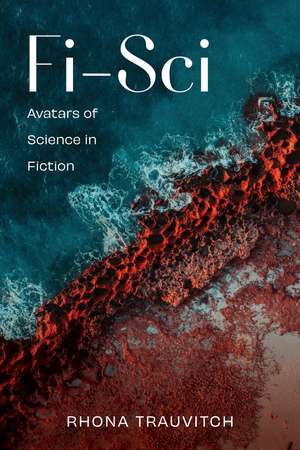
Fi-Sci: Avatars of Science in Fiction: Theory and Interpretation of Narrative
Autor Rhona Trauvitchen Limba Engleză Hardback – 5 noi 2026
Lays out a rhetorical approach to fictionality as key to understanding scientific phenomena that otherwise might be beyond imagination.
In Fi-Sci, Rhona Trauvitch melds literary and scientific thought to advance a theory of how narrative, and specifically fictionality, is one of the most powerful tools we have for understanding science, particularly those concepts that defy imagination. Centering her argument on a rhetorical approach to fictionality, she proposes that fiction uniquely offers a means of conceptualizing and understanding perplexing and counterintuitive scientific phenomena, such as recombinant DNA or quantum superposition: Through finding analogous patterns in fiction, we can open up new pathways to understanding. Put another way, our abilities to perceive strange and confounding science phenomena are bolstered and even enabled by our experiences with fiction.
Drawing on a range of theorists such as James Phelan, Gérard Genette, Erwin Schrödinger, and others in her analysis of texts by Jorge Luis Borges, Julio Cortázar, Ursula K. Le Guin, Richard Powers, and many more, Trauvitch shows how literary forms—such as metafiction, metalepsis, and recursion—mirror and clarify complex scientific concepts including genetics, spacetime curvature, and quantum mechanics. In this way, she shows us how fiction is key to unlocking conceptual access to the indiscernible and inconceivable.
In Fi-Sci, Rhona Trauvitch melds literary and scientific thought to advance a theory of how narrative, and specifically fictionality, is one of the most powerful tools we have for understanding science, particularly those concepts that defy imagination. Centering her argument on a rhetorical approach to fictionality, she proposes that fiction uniquely offers a means of conceptualizing and understanding perplexing and counterintuitive scientific phenomena, such as recombinant DNA or quantum superposition: Through finding analogous patterns in fiction, we can open up new pathways to understanding. Put another way, our abilities to perceive strange and confounding science phenomena are bolstered and even enabled by our experiences with fiction.
Drawing on a range of theorists such as James Phelan, Gérard Genette, Erwin Schrödinger, and others in her analysis of texts by Jorge Luis Borges, Julio Cortázar, Ursula K. Le Guin, Richard Powers, and many more, Trauvitch shows how literary forms—such as metafiction, metalepsis, and recursion—mirror and clarify complex scientific concepts including genetics, spacetime curvature, and quantum mechanics. In this way, she shows us how fiction is key to unlocking conceptual access to the indiscernible and inconceivable.
Din seria Theory and Interpretation of Narrative
-
 Preț: 300.32 lei
 - 23%
 Preț: 463.34 lei
 -
 Preț: 249.85 lei
 -
 Preț: 289.01 lei
 -
 Preț: 244.93 lei
 -
 Preț: 317.26 lei
 - 8%
 Preț: 474.48 lei
 -
 Preț: 247.23 lei
 -
 Preț: 311.22 lei
 -
 Preț: 270.54 lei
 -
 Preț: 299.49 lei
 -
 Preț: 350.06 lei
 -
 Preț: 250.35 lei
 -
 Preț: 235.76 lei
 -
 Preț: 189.39 lei
 -
 Preț: 295.26 lei
 -
 Preț: 322.78 lei
 -
 Preț: 285.15 lei
 - 23%
 Preț: 534.79 lei
 -
 Preț: 302.83 lei
 -
 Preț: 311.22 lei
 -
 Preț: 260.53 lei
 -
 Preț: 303.82 lei
 -
 Preț: 298.18 lei
 -
 Preț: 275.57 lei
 -
 Preț: 222.69 lei
 -
 Preț: 252.09 lei
 -
 Preț: 312.58 lei
 -
 Preț: 203.11 lei
 -
 Preț: 308.67 lei
 -
 Preț: 351.97 lei
 -
 Preț: 277.92 lei
 -
 Preț: 486.37 lei
 -
 Preț: 259.43 lei
 - 23%
 Preț: 461.34 lei
 -
 Preț: 341.85 lei
 - 23%
 Preț: 497.47 lei
 -
 Preț: 299.22 lei
 - 23%
 Preț: 490.80 lei
 -
 Preț: 334.73 lei
 - 23%
 Preț: 455.83 lei
 -
 Preț: 262.98 lei
 -
 Preț: 280.50 lei
 -
 Preț: 362.26 lei
Preț: 488.81 lei
Preț vechi: 603.47 lei
-19% Precomandă
Puncte Express: 733
Carte nepublicată încă
Livrare prin curier în România Precomanda se expediază când titlul devine disponibil.
Transport gratuit pentru acest produs Plată online sau ramburs, în funcție de opțiunile comenzii.
Retur gratuit în 14 zile Comandă securizată și suport în română.
Doresc să fiu notificat când acest titlu va fi disponibil:
Se trimite...
Specificații
ISBN-13: 9780814216255
ISBN-10: 0814216250
Pagini: 228
Ilustrații: 4 diagrams, 15 tables
Dimensiuni: 152 x 229 mm
Greutate: 0.45 kg
Editura: Ohio State University Press
Colecția Ohio State University Press
Seria Theory and Interpretation of Narrative
ISBN-10: 0814216250
Pagini: 228
Ilustrații: 4 diagrams, 15 tables
Dimensiuni: 152 x 229 mm
Greutate: 0.45 kg
Editura: Ohio State University Press
Colecția Ohio State University Press
Seria Theory and Interpretation of Narrative
Recenzii
“Trauvitch’s immensely ambitious study demonstrates an unsung cognitive advantage of fictionality. Separable from generic fiction and even narrative, fictionality is a rhetorical mode that augments the power of analogy in helping us grasp what we at first don’t recognize. . . . A wonderful book, provocative in the best sense of earned provocation.” —H. Porter Abbott, author of Real Mysteries: Narrative and the Unknowable
“Brilliantly original,Fi-Sci presents a dazzling meta-cartography of the patterns that underlie both science and fiction, and how the recognition of such patterns can illuminate both. A tour de force that will surprise and delight transdisciplinary thinkers from both sides of the abyss.” —Vandana Singh, author of Teaching Climate Change: Science, Stories, Justice
“Fi-Sci is fascinating and original. Trauvitch deconstructs the artificial binary between literature and science by referring both to the operations of language and rhetoric. A must-read for anyone interested in the role of narrative in science communication.” —Jon Hegglund, coeditor of Modernism and the Anthropocene: Material Ecologies of Twentieth-Century Literature
“Fi-Sci proposes an innovative way for readers to understand mysterious or counterintuitive scientific results. I highly recommend it as a classroom text for educators teaching popular science and for literary critics teaching scientific concepts.” —N. Katherine Hayles, author of Bacteria to AI: Human Futures with Our Nonhuman Symbionts
Notă biografică
Rhona Trauvitch is Teaching Professor in the Department of English at Florida International University, where she specializes in cross-disciplinary analysis and analogical reasoning at the intersections of literature and STEM.
Extras
In the twentieth century, scientists made astonishing discoveries, such as the process of time dilation, the condition of quantum superposition, and the state of quantum entanglement. They postulated the unvisualizable, like dark matter and an eleven-dimensional spacetime. What makes these breakthroughs extraordinary is that unlike the findings of earlier periods, the phenomena just listed are difficult to conceptualize. How might we think about—or even begin to approach—science that ranges from perplexing to unobservable to entirely counterintuitive? In this book I propose that we can do so with a tool that is not an instrument like a microscope, nor a machine like a particle collider, but a rhetorical device: fictionality. More specifically, we can wield the human capacity to invent, to imagine the nonactual, as a means to the end of conceptualizing science. If you find my proposal persuasive, we’ll have arrived at a remarkable conclusion: Our abilities to perceive strange and confounding science phenomena may be boosted by our experiences with fiction.
To explore this hypothesis, we set off on a path that begins with the aforementioned question’s core: How do we think about—or even begin to approach—any new thing? In Surfaces and Essences, Douglas Hofstadter and Emmanuel Sander show that we do so by making analogies: We automatically compare every novel thing we come across to something we encountered earlier that is in some way similar. Consider your experience with gravity. When you see an apple rolling across the table, you instinctively know that if it reaches the edge while maintaining its speed it will fall to the floor—even if you’ve never found yourself in that particular circumstance before. You know it because you recognize that this situation is like your countless previous observations of gravity’s pull. You have made an analogy.
If this sort of reasoning is instinctive—automatic—why not use it to conceptualize confounding science? The answer is that apparently there is nothing we can compare phenomena like quantum superposition to. Superposition describes the condition of a quantum particle that is simultaneously in two incompatible states. Erwin Schrödinger famously illustrated the bizarre nature of quantum superposition by positing a concurrently living-and-dead cat—which intuitively does not seem possible. By definition, a concept that is counterintuitive cannot be linked to anything we would recognize from our embodied experience of the world. This is no rolling apple.
Since quantum superposition does not correspond to anything in our everyday, observed reality, to find something comparable to it—which we must do in order to make an analogy that will in turn allow us to conceptualize it—we may have to seek objects that do not exist in reality, ones unconstrained by facts, referentiality, or correspondence to embodied experience. Such objects can be found in fiction. James Phelan defines fiction as “intentionally communicated invention, projection, or other means of directing an audience to consider nonactual states or events” (Gammelgaard et al. 7). To begin reaching toward the counterintuitive, we could sure use concepts that bear these characteristics.
Let us then forage fiction for something analogous to quantum superposition. “Comparison takes place via a structure-mapping process of alignment of conceptual representations” (Gentner and Medina 267); what in fiction aligns with the conceptual representation “something is in two different states at once?” Fictional figures that are simultaneously in different states can manifest as ones whose ontological status is ambiguous. Think of characters who are both fictional and nonfictional at the same time. This situation perfectly describes the Muppets. Kermit the Frog and Miss Piggy are fictional characters in The Great Muppet Caper (1981) and Muppets from Space (1999). But when Kermit appears as a guest on Conan O’Brien’s talk show (“Conan Interviews Kermit the Frog”) or when Wendy Williams interviews Miss Piggy (“Wendy Williams Show”), we intuitively understand that the Muppets both retain their fictionality and present as nonfictional beings. A phenomenon in fiction thus shares a pattern with a phenomenon in science: An entity is simultaneously in two seemingly incompatible states. In their Muppetness, the Muppets serve as intermediaries. Our ability to imagine them at least somewhat familiarizes the similarly patterned yet counterintuitive phenomenon of quantum superposition.
To explore this hypothesis, we set off on a path that begins with the aforementioned question’s core: How do we think about—or even begin to approach—any new thing? In Surfaces and Essences, Douglas Hofstadter and Emmanuel Sander show that we do so by making analogies: We automatically compare every novel thing we come across to something we encountered earlier that is in some way similar. Consider your experience with gravity. When you see an apple rolling across the table, you instinctively know that if it reaches the edge while maintaining its speed it will fall to the floor—even if you’ve never found yourself in that particular circumstance before. You know it because you recognize that this situation is like your countless previous observations of gravity’s pull. You have made an analogy.
If this sort of reasoning is instinctive—automatic—why not use it to conceptualize confounding science? The answer is that apparently there is nothing we can compare phenomena like quantum superposition to. Superposition describes the condition of a quantum particle that is simultaneously in two incompatible states. Erwin Schrödinger famously illustrated the bizarre nature of quantum superposition by positing a concurrently living-and-dead cat—which intuitively does not seem possible. By definition, a concept that is counterintuitive cannot be linked to anything we would recognize from our embodied experience of the world. This is no rolling apple.
Since quantum superposition does not correspond to anything in our everyday, observed reality, to find something comparable to it—which we must do in order to make an analogy that will in turn allow us to conceptualize it—we may have to seek objects that do not exist in reality, ones unconstrained by facts, referentiality, or correspondence to embodied experience. Such objects can be found in fiction. James Phelan defines fiction as “intentionally communicated invention, projection, or other means of directing an audience to consider nonactual states or events” (Gammelgaard et al. 7). To begin reaching toward the counterintuitive, we could sure use concepts that bear these characteristics.
Let us then forage fiction for something analogous to quantum superposition. “Comparison takes place via a structure-mapping process of alignment of conceptual representations” (Gentner and Medina 267); what in fiction aligns with the conceptual representation “something is in two different states at once?” Fictional figures that are simultaneously in different states can manifest as ones whose ontological status is ambiguous. Think of characters who are both fictional and nonfictional at the same time. This situation perfectly describes the Muppets. Kermit the Frog and Miss Piggy are fictional characters in The Great Muppet Caper (1981) and Muppets from Space (1999). But when Kermit appears as a guest on Conan O’Brien’s talk show (“Conan Interviews Kermit the Frog”) or when Wendy Williams interviews Miss Piggy (“Wendy Williams Show”), we intuitively understand that the Muppets both retain their fictionality and present as nonfictional beings. A phenomenon in fiction thus shares a pattern with a phenomenon in science: An entity is simultaneously in two seemingly incompatible states. In their Muppetness, the Muppets serve as intermediaries. Our ability to imagine them at least somewhat familiarizes the similarly patterned yet counterintuitive phenomenon of quantum superposition.
Cuprins
Contents
List of Illustrations
List of Tables
Preface
Introduction Pattern Mapping
Part 1 Biology
Chapter 1 Permutation
Chapter 2 Proliferation—Gametic Reproduction
Chapter 3 Proliferation—Clonal Reproduction
Part 2 Nonclassical Physics
Chapter 4 Warp
Chapter 5 Ambiguity
Chapter 6 Recursion
Coda Weave
Acknowledgments
Appendix: Variations on a Theme
Works Cited
Index
List of Illustrations
List of Tables
Preface
Introduction Pattern Mapping
Part 1 Biology
Chapter 1 Permutation
Chapter 2 Proliferation—Gametic Reproduction
Chapter 3 Proliferation—Clonal Reproduction
Part 2 Nonclassical Physics
Chapter 4 Warp
Chapter 5 Ambiguity
Chapter 6 Recursion
Coda Weave
Acknowledgments
Appendix: Variations on a Theme
Works Cited
Index
Descriere
Draws on narrative and rhetorical theory to identify how mapping fiction onto science allows us to conceptualize otherwise inconceivable scientific phenomena.