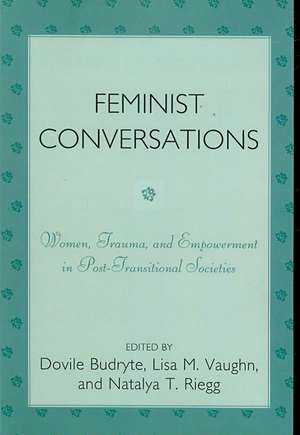
Feminist Conversations: Women, Trauma and Empowerment in Post-Transitional Societies
Editat de Dovile Budryte, Lisa M. Vaughn, Natalya T. Riegg Contribuţii de Svetlana Aslanyan, Eric Boos, Karene M. Boos, Gabriela de Cabrera, Azniv Eyramjyants, J Kay Keels, Suzanne Leclerc-Madlala, Mary Beth Looney, Isabella Manassarian, Vilana Pilinkaite-Sotirovic, Dovile Rukaite, Kate Wellsen Limba Engleză Paperback – 5 noi 2008
Preț: 313.26 lei
Preț vechi: 406.70 lei
-23%
Puncte Express: 470
Carte tipărită la comandă
Livrare economică 21 noiembrie-05 decembrie
Livrare prin curier în România Termenul estimat este afișat lângă disponibilitate.
Transport gratuit de la 400.00 lei Plată online sau ramburs, în funcție de opțiunile comenzii.
Retur gratuit în 14 zile Comandă securizată și suport în română.
Specificații
ISBN-13: 9780761843795
ISBN-10: 0761843795
Pagini: 179
Dimensiuni: 155 x 230 x 14 mm
Greutate: 0.3 kg
Editura: Bloomsbury Publishing
Colecția University Press of America
Locul publicării:New York, United States
ISBN-10: 0761843795
Pagini: 179
Dimensiuni: 155 x 230 x 14 mm
Greutate: 0.3 kg
Editura: Bloomsbury Publishing
Colecția University Press of America
Locul publicării:New York, United States
Cuprins
Part 1 Part I. Reflecting on Trauma and Empowerment: Theories and Practices
Chapter 2 Chapter 1. Revision of the Visions: Feminism and Empowerment in Post-Transitional Societies
Chapter 3 Chapter 2. From "Dirty Laundry" to a Human Rights Concern? International Norms and Gender Violence in Armenia and Lithuania
Chapter 4 Chapter 3. Paradoxes of "Gender Equality" in Lithuania: Violence against Women and Equal Opportunites
Chapter 5 Chapter 4. "Come Rape Us!" The Everyday Trauma of Sexual Violence in South Africa
Chapter 6 Chapter 5. Losing Ground: How the Lack of Opportunity for Women to Own Land Impales the Tanzanian Economy
Chapter 7 Chapter 6. Entrepreneurship: Antidote to Women's Economic Oppression
Part 8 Part II. Living Trauma and Empowerment: Stories and Strategies
Chapter 9 Chapter 7. Left Alone, the Widows of the War: Trauma Reframed through Community Empowerment in Guatemala
Chapter 10 Chapter 8. Dolls with Jobs: A Compelling Response by Traditional KwaZulu-Natal Craftswomen in an Era of HIV-AIDS
Chapter 11 Chapter 9. Confined Space:The Simultaneous Installation of Art and the De-Installation of a Relationship
Part 12 Part III. Authentic Voices: Nothing Lost in Translation!
Chapter 13 Chapter 10. Were All Women Born to Suffer? Understanding Resistance to Empowerment: A Lithuanian NGO Activist's Perspective
Chapter 14 Chapter 11. Women and Empowerment in Armenia: Traditions, Transitions and Current Politics
Chapter 15 Chapter 12. Zara's Travail: A Life Story
Chapter 16 Chapter 13. Gender In/Equality in Egypt and Armenia
Chapter 17 Chapter 14. Addressing Trauma through Political Action: Nineth Montenegro's Story
Chapter 18 Conclusion: A Conversation among the Editors
Chapter 2 Chapter 1. Revision of the Visions: Feminism and Empowerment in Post-Transitional Societies
Chapter 3 Chapter 2. From "Dirty Laundry" to a Human Rights Concern? International Norms and Gender Violence in Armenia and Lithuania
Chapter 4 Chapter 3. Paradoxes of "Gender Equality" in Lithuania: Violence against Women and Equal Opportunites
Chapter 5 Chapter 4. "Come Rape Us!" The Everyday Trauma of Sexual Violence in South Africa
Chapter 6 Chapter 5. Losing Ground: How the Lack of Opportunity for Women to Own Land Impales the Tanzanian Economy
Chapter 7 Chapter 6. Entrepreneurship: Antidote to Women's Economic Oppression
Part 8 Part II. Living Trauma and Empowerment: Stories and Strategies
Chapter 9 Chapter 7. Left Alone, the Widows of the War: Trauma Reframed through Community Empowerment in Guatemala
Chapter 10 Chapter 8. Dolls with Jobs: A Compelling Response by Traditional KwaZulu-Natal Craftswomen in an Era of HIV-AIDS
Chapter 11 Chapter 9. Confined Space:The Simultaneous Installation of Art and the De-Installation of a Relationship
Part 12 Part III. Authentic Voices: Nothing Lost in Translation!
Chapter 13 Chapter 10. Were All Women Born to Suffer? Understanding Resistance to Empowerment: A Lithuanian NGO Activist's Perspective
Chapter 14 Chapter 11. Women and Empowerment in Armenia: Traditions, Transitions and Current Politics
Chapter 15 Chapter 12. Zara's Travail: A Life Story
Chapter 16 Chapter 13. Gender In/Equality in Egypt and Armenia
Chapter 17 Chapter 14. Addressing Trauma through Political Action: Nineth Montenegro's Story
Chapter 18 Conclusion: A Conversation among the Editors
Recenzii
The oppression of women happens in all parts of the world and takes many forms-from domestic abuse to economic disenfranchisement and the use of violence against women as a weapon of war. But responses to trauma and women's empowerment also take diverse forms, as this important and engaging volume illustrates. Drawing on different countries and speaking from the experiences of women themselves, the contributors explore the diverse ways in which women understand and respond to experiences of trauma and violence.
The focus on dialogue is powerfully sustained throughout this study of the ways in which women are affected by traumatic, societal transitions. The editors have done a marvelous job at performing a close encounter between theory and personal experience. This book makes us all wiser about the role of conversations between academics and women experiencing the consequences of often violent transitions. The book thus makes a significant contribution to speeding up the process of empowering women in their variant roles.
The book offers a unique and valuable perspective about violence against women in different countries. There is truth to the saying that violence against women does not recognize borders. Globalization has affected families, family lives, and has led to new problems, demanding for innovative knowledge and skills to solve them.
This book offers a wealth of knowledge about addressing women's social and political issues and discusses some of the most striking examples of democratization. Women across all cultural lines will feel empowered to re-ignite our movement towards an egalitarian society transcending all boundaries and barriers.
Feminist Conversations offers a fresh approach to transnational feminist discourse by bringing together voices of scholars and practitioners from Eastern Europe, the United States, Africa and Latin America. The book disrupts traditional frameworks of transnational feminist exchanges, ie. East/West and North/South, by facilitiating a conversation among contributors from all of these geographical areas. In addition to serving as a productive model for future cross-cultural dialogue, the book's other strengths include its focus on women's empowerment in less-studied states; comparative analysis among societies in the "West", "East", and "South"; and its understanding of the need for balance between practical gender needs and strategic gender interests. As an interdisciplinary text, Feminist Conversations could be employed in both undergraduate and graduate classes examining post-transitional societies, democratization processes, and women's empowerment. As a conversation among diverse contributors from various geographical regions, the book should find broad appeal in many progressive communities.
Feminist Conversations is a book full of fresh thought and hopeful strategies on how to improve the prospects for women's rights in post-transitional societies. The stories the editors included as a background to their deliberations also speak most eloquently about how far away we are from eradicating violence against women in much of the world. One sees clearly that in most post-transitional societies there are only the beginnings of women's rights, overshadowed relentlessly by patriarchy. But in presenting this insightful book, the editors have at best taken bold and creative steps toward providing the one indispensable element in the struggle for women's rights-international awareness.
The focus on dialogue is powerfully sustained throughout this study of the ways in which women are affected by traumatic, societal transitions. The editors have done a marvelous job at performing a close encounter between theory and personal experience. This book makes us all wiser about the role of conversations between academics and women experiencing the consequences of often violent transitions. The book thus makes a significant contribution to speeding up the process of empowering women in their variant roles.
The book offers a unique and valuable perspective about violence against women in different countries. There is truth to the saying that violence against women does not recognize borders. Globalization has affected families, family lives, and has led to new problems, demanding for innovative knowledge and skills to solve them.
This book offers a wealth of knowledge about addressing women's social and political issues and discusses some of the most striking examples of democratization. Women across all cultural lines will feel empowered to re-ignite our movement towards an egalitarian society transcending all boundaries and barriers.
Feminist Conversations offers a fresh approach to transnational feminist discourse by bringing together voices of scholars and practitioners from Eastern Europe, the United States, Africa and Latin America. The book disrupts traditional frameworks of transnational feminist exchanges, ie. East/West and North/South, by facilitiating a conversation among contributors from all of these geographical areas. In addition to serving as a productive model for future cross-cultural dialogue, the book's other strengths include its focus on women's empowerment in less-studied states; comparative analysis among societies in the "West", "East", and "South"; and its understanding of the need for balance between practical gender needs and strategic gender interests. As an interdisciplinary text, Feminist Conversations could be employed in both undergraduate and graduate classes examining post-transitional societies, democratization processes, and women's empowerment. As a conversation among diverse contributors from various geographical regions, the book should find broad appeal in many progressive communities.
Feminist Conversations is a book full of fresh thought and hopeful strategies on how to improve the prospects for women's rights in post-transitional societies. The stories the editors included as a background to their deliberations also speak most eloquently about how far away we are from eradicating violence against women in much of the world. One sees clearly that in most post-transitional societies there are only the beginnings of women's rights, overshadowed relentlessly by patriarchy. But in presenting this insightful book, the editors have at best taken bold and creative steps toward providing the one indispensable element in the struggle for women's rights-international awareness.