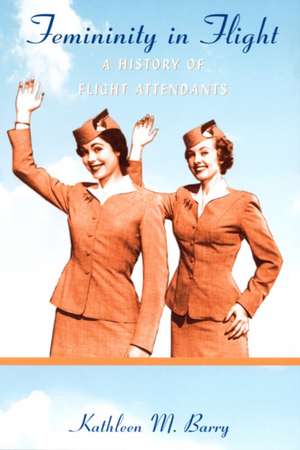
Femininity in Flight
Autor Kathleen Barryen Limba Engleză Paperback – 28 feb 2007
Barry argues that largely because their glamour obscured their labor, flight attendants unionized in the late 1940s and 1950s to demand recognition and respect as workers and self-styled professionals. In the 1960s and 1970s, flight attendants were one of the first groups to take advantage of new laws prohibiting sex discrimination. Their challenges to airlines' restrictive employment policies and exploitive marketing practices (involving skimpy uniforms and provocative slogans such as "fly me") made them high-profile critics of the cultural mystification and economic devaluing of "women's work." Barry combines attention to the political economy and technology of the airline industry with perceptive readings of popular culture, newspapers, industry publications, and first-person accounts. In so doing, she provides a potent mix of social and cultural history and a major contribution to the history of women's work and working women's activism.
Preț: 255.12 lei
Puncte Express: 383
Carte tipărită la comandă
Livrare economică 20 noiembrie-04 decembrie
Livrare prin curier în România Termenul estimat este afișat lângă disponibilitate.
Transport gratuit de la 400.00 lei Plată online sau ramburs, în funcție de opțiunile comenzii.
Retur gratuit în 14 zile Comandă securizată și suport în română.
Specificații
ISBN-13: 9780822339465
ISBN-10: 0822339463
Pagini: 328
Ilustrații: 19 b&w photographs
Dimensiuni: 154 x 236 x 22 mm
Greutate: 0.48 kg
Editura: Duke University Press
ISBN-10: 0822339463
Pagini: 328
Ilustrații: 19 b&w photographs
Dimensiuni: 154 x 236 x 22 mm
Greutate: 0.48 kg
Editura: Duke University Press
V-ar putea interesa
-
 ShatteredRebecca AsherPreț: 89.83 lei
 -
 Millions Like UsVirginia Nicholson-28%Preț: 76.49 lei106.85 lei
 -
 -17%Preț: 237.88 lei286.76 lei
 -
 Exile Through a Gendered LensG. ZinnPreț: 387.78 lei
 -
 Price of MotherhoodAnn CrittendenPreț: 144.63 lei
 -
 New Women in Colonial Korea: A SourcebookHyaeweol Choi-18%Preț: 1307.32 lei1594.29 lei
 -
 Women and WarsCarol CohnPreț: 227.98 lei
 -
 800 Year's of Women's LettersOlga KenyonPreț: 92.09 lei
 -
 I Am an Emotional CreatureEve Ensler-20%Preț: 78.97 lei99.08 lei
 -
 Female MasculinityJack HalberstamPreț: 169.39 lei
 -
 Preț: 216.81 lei
 -
 I Killed ScheherazadeJoumana HaddadPreț: 70.24 lei
 -
 Preț: 151.87 lei
 -
 StrippedJennifer Hayashi DannsPreț: 64.14 lei
Recenzii
Femininity in Flight is outstanding. It is the most thoroughly presented book on femininity, work, and pink-collar activism to date. It expands the contours of the womens rights movement and complicates the grounds on which women make demands for better working conditions. Eileen Boris, author of Home to Work: Motherhood and the Politics of Industrial Homework in the United StatesFemininity in Flight is the first book that tells the story of the flight attendant occupation as a whole and gives us the history of the occupation in so compelling and rich a fashion. Kathleen M. Barry offers us an entertaining and witty account of how flight attendants embodied changing notions of femininity, and then she boldly challenges conventional wisdom by arguing that it was those very cultural constraints that in part spurred flight attendant activism. Dorothy Sue Cobble, author of The Other Womens Movement: Workplace Justice and Social Justice in Modern America"One of the great strengths of Femininity in Flight is the broad context within which Barry views flight attendants' struggles, in terms of women's work, union organisation and second-wave feminism. By contextualising her study so well and drawing out the parallels between stewardresses and other pink-collar workers, Barry has produced a book with wide appeal and relevance to many interested in labour history, the women's movement, and the growth of service work."--Rosie Cox, The Times Higher March 23 2007"In the early chapters of Kathleen M. Barry's excellent study, Feminity in FLight, she explains why airlines went with pretty young white women, many of them trained nurses, rather than, say, the middle-aged African American men who acted as stewards on Pullman cars; cutting-edge modernity in the 1930s colour-coded itself white. . . . Barry's well-documented history spends more of its length on union charters and test cases than it does on hemlines One of its strengths is a demonstration that cultural history does not have to be impressionistic, and that economic imperatives and consciousness-raising can be as entertaining to read about as exploitation movies."--Times Literary Supplement, 2 April 2007"Kathleen Barry's history of how gracious stewardesses turned into sexy air hostesses and then into tough grumpy flight attendants tries hard to be dull, but thankfully does not succeed."--The Economist, 5 May 2007
"Femininity in Flight is outstanding. It is the most thoroughly presented book on femininity, work, and pink-collar activism to date. It expands the contours of the women's rights movement and complicates the grounds on which women make demands for better working conditions." Eileen Boris, author of Home to Work: Motherhood and the Politics of Industrial Homework in the United States "Femininity in Flight is the first book that tells the story of the flight attendant occupation as a whole and gives us the history of the occupation in so compelling and rich a fashion. Kathleen M. Barry offers us an entertaining and witty account of how flight attendants embodied changing notions of femininity, and then she boldly challenges conventional wisdom by arguing that it was those very cultural constraints that in part spurred flight attendant activism." Dorothy Sue Cobble, author of The Other Women's Movement: Workplace Justice and Social Justice in Modern America "One of the great strengths of Femininity in Flight is the broad context within which Barry views flight attendants' struggles, in terms of women's work, union organisation and second-wave feminism. By contextualising her study so well and drawing out the parallels between stewardresses and other pink-collar workers, Barry has produced a book with wide appeal and relevance to many interested in labour history, the women's movement, and the growth of service work."--Rosie Cox, The Times Higher March 23 2007 "In the early chapters of Kathleen M. Barry's excellent study, Feminity in FLight, she explains why airlines went with pretty young white women, many of them trained nurses, rather than, say, the middle-aged African American men who acted as stewards on Pullman cars; cutting-edge modernity in the 1930s colour-coded itself white... Barry's well-documented history spends more of its length on union charters and test cases than it does on hemlines One of its strengths is a demonstration that cultural history does not have to be impressionistic, and that economic imperatives and consciousness-raising can be as entertaining to read about as exploitation movies."--Times Literary Supplement, 2 April 2007 "Kathleen Barry's history of how gracious stewardesses turned into sexy air hostesses and then into tough grumpy flight attendants tries hard to be dull, but thankfully does not succeed."--The Economist, 5 May 2007
"Femininity in Flight is outstanding. It is the most thoroughly presented book on femininity, work, and pink-collar activism to date. It expands the contours of the women's rights movement and complicates the grounds on which women make demands for better working conditions." Eileen Boris, author of Home to Work: Motherhood and the Politics of Industrial Homework in the United States "Femininity in Flight is the first book that tells the story of the flight attendant occupation as a whole and gives us the history of the occupation in so compelling and rich a fashion. Kathleen M. Barry offers us an entertaining and witty account of how flight attendants embodied changing notions of femininity, and then she boldly challenges conventional wisdom by arguing that it was those very cultural constraints that in part spurred flight attendant activism." Dorothy Sue Cobble, author of The Other Women's Movement: Workplace Justice and Social Justice in Modern America "One of the great strengths of Femininity in Flight is the broad context within which Barry views flight attendants' struggles, in terms of women's work, union organisation and second-wave feminism. By contextualising her study so well and drawing out the parallels between stewardresses and other pink-collar workers, Barry has produced a book with wide appeal and relevance to many interested in labour history, the women's movement, and the growth of service work."--Rosie Cox, The Times Higher March 23 2007 "In the early chapters of Kathleen M. Barry's excellent study, Feminity in FLight, she explains why airlines went with pretty young white women, many of them trained nurses, rather than, say, the middle-aged African American men who acted as stewards on Pullman cars; cutting-edge modernity in the 1930s colour-coded itself white... Barry's well-documented history spends more of its length on union charters and test cases than it does on hemlines One of its strengths is a demonstration that cultural history does not have to be impressionistic, and that economic imperatives and consciousness-raising can be as entertaining to read about as exploitation movies."--Times Literary Supplement, 2 April 2007 "Kathleen Barry's history of how gracious stewardesses turned into sexy air hostesses and then into tough grumpy flight attendants tries hard to be dull, but thankfully does not succeed."--The Economist, 5 May 2007
Notă biografică
Kathleen M. Barry has a doctorate in history from New York University. She has taught American history at NYU and the University of Cambridge.
Textul de pe ultima copertă
""Femininity in Flight" is the first book that tells the story of the flight attendant occupation as a whole and gives us the history of the occupation in so compelling and rich a fashion. Kathleen M. Barry offers us an entertaining and witty account of how flight attendants embodied changing notions of femininity, and then she boldly challenges conventional wisdom by arguing that it was those very cultural constraints that in part spurred flight attendant activism."-- Dorothy Sue Cobble, author of "The Other Women's Movement: Workplace Justice and Social Rights in Modern America"
Descriere
Considers flight attendants as cultural icons, looking at how attendants redeployed the "glamorization" used to sell air travel to campaign for professional respect, higher wages, and women's rights