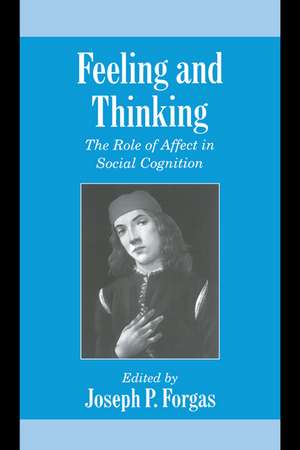
Feeling and Thinking: Studies in Emotion and Social Interaction
Editat de Joseph P. Forgas, Keith Oatley, Antony Mansteaden Limba Engleză Paperback – 11 feb 2005
Bazându-ne pe datele furnizate de Cambridge University Press, observăm că Feeling and Thinking reprezintă un efort de sinteză esențial pentru înțelegerea interfeței dintre afect și cogniția socială. Reținem că această ediție revizuită nu se limitează la o simplă trecere în revistă a literaturii, ci integrează cercetările din ultimele două decenii pentru a explica modul în care stările afective modelează judecățile și interacțiunile umane. Ne-a atras atenția structura riguroasă a volumului, care trece de la aspecte fundamentale, precum relația ontologică dintre simțire și gândire, la aplicații practice privind comportamentul social. Această lucrare completează perspectiva oferită de Theories of Mood and Cognition de Leonard L. Martin, adăugând o dimensiune mai largă asupra antecedentelor emoționale, dincolo de influența stărilor de spirit asupra memoriei sau creativității. În contextul operei editorului, Feeling and Thinking se situează la intersecția preocupărilor sale constante pentru procesele mentale. Dacă în Social Cognition and Communication, Joseph P. Forgas explora rolul limbajului în relațiile interpersonale, aici accentul cade pe mecanismele afective care preced și influențează aceste schimburi simbolice. De asemenea, volumul dezvoltă temele controlului comportamental abordate în Psychology of Self-Regulation, oferind baza teoretică pentru înțelegerea modului în care afectul poate facilita sau inhiba autoreglarea în contexte sociale complexe. Cu 60 de ilustrații și 7 tabele, textul facilitează asimilarea unor modele teoretice dense, fiind un instrument de lucru indispensabil pentru cercetătorii care studiază dinamica dintre emoție și rațiune.




Preț: 404.78 lei
Carte tipărită la comandă
Livrare economică 21 noiembrie-05 decembrie
Specificații
ISBN-10: 0521011892
Pagini: 440
Ilustrații: 60 b/w illus. 7 tables
Dimensiuni: 152 x 229 x 26 mm
Greutate: 0.71 kg
Ediția:Revised
Editura: Cambridge University Press
Seria Studies in Emotion and Social Interaction
Locul publicării:New York, United States
V-ar putea interesa
-
 The Mind and Its StoriesPatrick Colm HoganPreț: 366.14 lei
 -
 Hurt FeelingsLuciano L'Abate-5%Preț: 293.50 lei308.95 lei
 -
 Feelings and MoodsChristophe AndréPreț: 252.28 lei
 -
 Psychology of CultureGraham R Hayes-27%Preț: 1250.99 lei1703.53 lei
 -
 Psychology of BiasGlenn W. Mills-27%Preț: 1055.62 lei1438.86 lei
 -
 Changing EmotionsDirk Hermans-15%Preț: 519.78 lei611.50 lei
 -
 Social Thinking and Interpersonal BehaviorJoseph P. Forgas-18%Preț: 1125.28 lei1372.29 lei
De ce să citești această carte
Recomandăm această carte specialiștilor și studenților la psihologie care doresc să înțeleagă fundamentele științifice ale intuiției că „simțim înainte de a gândi”. Cititorul câștigă acces la o sinteză actualizată a teoriilor afectului, beneficiind de expertiza unor cercetători internaționali de renume. Este un volum esențial pentru a decoda modul în care emoțiile ne ghidează, adesea invizibil, deciziile sociale și judecățile morale.
Despre autor
Joseph P. Forgas este Scientia Professor de psihologie la University of New South Wales din Sydney, Australia. Cu o carieră academică remarcabilă, acesta a publicat peste 17 volume și 150 de articole în jurnale de specialitate de prestigiu, munca sa primind recunoaștere internațională constantă. Expertiza sa se concentrează pe cogniția socială și influența afectului asupra comportamentului interpersonal, fiind coordonatorul seriei de simpozioane Sydney Symposium of Social Psychology. În Feeling and Thinking, Forgas își folosește experiența vastă pentru a edita un volum care a devenit o sursă de referință în studiul emoțiilor.
Descriere scurtă
Cuprins
Recenzii
'At last there is a book that brings together the central findings and theories concerning the interface of social cognition and affect. This important new volume is sure to become the sourcebook for understanding the critical question of how feeling and thinking are interrelated. The editor has done an outstanding job of bringing together major contributors to answering this question. This exciting book is must reading for anyone interested in the vital role of affect in social life.' Tory Higgins, Columbia University