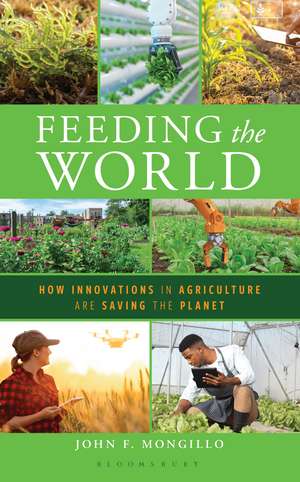
Feeding the World: How Innovations in Agriculture Are Saving the Planet
Autor John F. Mongilloen Limba Engleză Hardback – 19 feb 2026
The United Nations reports that "climate change is the defining issue of our time, and we are at a defining moment." Climate change issues are in the news every day. From disasters ranging from the California wildfires to floods in Brazil, droughts in East Africa and rising sea levels globally, the threats and challenges caused by climate change are already present and rapidly increasing.
In Feeding the World: How Innovations in Agriculture Are Saving the Planet, John F. Mongillo looks specifically at how climate change impacts agriculture production by creating adverse effects on human health, loss of wildlife, food and water insecurities, devastation to ecosystems, and even animal and human migration. Mongillo advocates that these are solvable issues, though. Through interviews and case studies of the changemakers in the agricultural industry, Mongillo highlights positive projects working to mitigate climate change, illuminating how a wide variety of people and organizations are creating salvable projects to curtail the impact of a warming world. From farmers to colleges technicians, and government and non-government organizations, these projects include regenerative farming practices, building vertical farms, engaging in soil-less farming, constructing rooftop gardens, and using precision agriculture with robots, drones, GPS systems, and even salt-water farming.
No one book can keep track of all the changing events and developments of climate change and its impact on agriculture and human health. However, Feeding the World provides an excellent introduction for developing a working knowledge of climate-related issues and a call to service for readers wanting to make a difference. This is an essential guide to possible solutions, understanding how the agricultural industry works, and the effect on the economy, environment, and technology.
Preț: 192.67 lei
Preț vechi: 244.51 lei
-21%
Puncte Express: 289
Carte disponibilă
Livrare economică 14-28 noiembrie
Livrare express 31 octombrie-06 noiembrie pentru 83.36 lei
Livrare prin curier în România Termenul estimat este afișat lângă disponibilitate.
Transport gratuit de la 400.00 lei Plată online sau ramburs, în funcție de opțiunile comenzii.
Retur gratuit în 14 zile Comandă securizată și suport în română.
Specificații
ISBN-13: 9798881807689
Pagini: 184
Ilustrații: 6 bw illus
Dimensiuni: 152 x 230 x 18 mm
Greutate: 0.43 kg
Editura: Bloomsbury Publishing
Colecția Bloomsbury Academic
Locul publicării:New York, United States
Pagini: 184
Ilustrații: 6 bw illus
Dimensiuni: 152 x 230 x 18 mm
Greutate: 0.43 kg
Editura: Bloomsbury Publishing
Colecția Bloomsbury Academic
Locul publicării:New York, United States
V-ar putea interesa
-
 RegenesisGeorge Monbiot-30%Preț: 65.18 lei93.51 lei
 -
 Into the Clear Blue SkyRob JacksonPreț: 79.10 lei
 -
 RegenerationPaul Hawken-14%Preț: 130.64 lei151.95 lei
 -
 World Without EndJean-Marc JancoviciPreț: 200.87 lei
 -
 Adventures in FermentationJohnny DrainPreț: 166.76 lei
 -
 -22%Preț: 75.98 lei97.66 lei
 -
 -51%Preț: 67.11 lei136.04 lei
 -
 Sixty Harvests Left: How to Reach a Nature-Friendly FuturePhilip Lymbery-26%Preț: 69.14 lei93.61 lei
 -
 Call of the Reed WarblerCharles Massy-20%Preț: 117.57 lei146.50 lei
 -
 On ExtinctionMelanie ChallengerPreț: 109.95 lei
 -
 Tech to Table: 25 Innovators Reimagining FoodRichard MunsonPreț: 213.87 lei
 -
 The Great RegenerationDorn Cox-21%Preț: 102.95 lei129.58 lei
 -
 Food for the FutureMia WenjenPreț: 57.69 lei
 -
 39 Ways to Save the PlanetTom Heap-19%Preț: 74.54 lei92.40 lei
 -
 The Fate of FoodAmanda LittlePreț: 78.92 lei
 -
 The Future of AgricultureSarah BearchellPreț: 71.26 lei
 -
 Our Fragile MomentMichael MannPreț: 122.90 lei
 -
 -17%Preț: 121.49 lei146.13 leiRecomandat
 -
 -18%Preț: 926.96 lei1130.44 lei
 -
 The Future of Food: Issues and Innovations in the 21st Century and BeyondHonor May Eldridge-25%Preț: 388.62 lei520.68 lei
Cuprins
Acknowledgements
Introduction
Chapter 1: Impacts of Climate Change
Chapter 2: Agriculture Production and Global Warming
Chapter 3: Regenerative Agriculture: Farmers Mitigate Climate Change
Chapter 4: Agriculture Technologies: The Future of Farming
Chapter 5: Vertical Farms: Hydroponics and Aeroponics
Chapter 6: Aquaponic Farms, Aquaculture Seaweed, and Floating Farms
Chapter 7: US Urban Farms: Cities Feeding Themselves
Chapter 8: Global Urban Farms: Cities Feeding Themselves
Chapter 9: Agricultural Literacy, Climate Literacy, And Education
Conclusion: Agriculture Is Facing Many Challenges
Appendix 1: Farm Bureaus, Associations, Administrations, and Businesses
Appendix 2: A Condensed History of American Agriculture 1800-2000
Further Reading
Notes
Index
About the Author
Introduction
Chapter 1: Impacts of Climate Change
Chapter 2: Agriculture Production and Global Warming
Chapter 3: Regenerative Agriculture: Farmers Mitigate Climate Change
Chapter 4: Agriculture Technologies: The Future of Farming
Chapter 5: Vertical Farms: Hydroponics and Aeroponics
Chapter 6: Aquaponic Farms, Aquaculture Seaweed, and Floating Farms
Chapter 7: US Urban Farms: Cities Feeding Themselves
Chapter 8: Global Urban Farms: Cities Feeding Themselves
Chapter 9: Agricultural Literacy, Climate Literacy, And Education
Conclusion: Agriculture Is Facing Many Challenges
Appendix 1: Farm Bureaus, Associations, Administrations, and Businesses
Appendix 2: A Condensed History of American Agriculture 1800-2000
Further Reading
Notes
Index
About the Author
Recenzii
Feeding the World is both urgent and hopeful-a blueprint for how science, innovation, and human ingenuity can converge to solve one of the greatest challenges of our time. John F. Mongillo doesn't just catalog the obstacles of feeding a growing population in the face of climate change, resource scarcity, and inequity, he illuminates pathways forward. With clarity and conviction, he shows us that food systems are not fixed, but designed, and that we have the agency to reimagine them. This book will resonate with anyone who believes that sustainability and equity must be at the heart of our global food future. It's not just a call to action; it's a reminder that the choices we make today can design a future where all people are nourished on a thriving planet.
[This title] contains myriad examples to raise awareness and inspire others to cultivate agricultural systems that can feed a growing, more urbanized global population.
[This title] contains myriad examples to raise awareness and inspire others to cultivate agricultural systems that can feed a growing, more urbanized global population.