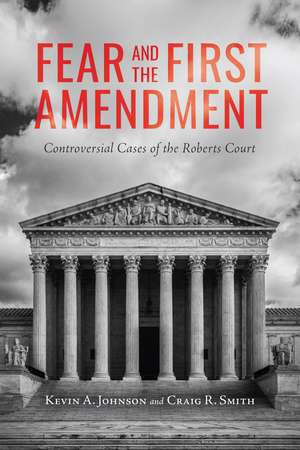
Fear and the First Amendment: Controversial Cases of the Roberts Court: Rhetoric, Law, and the Humanities
Autor Kevin A. Johnson, Craig R. Smithen Limba Engleză Paperback – 4 iun 2024
The First Amendment: protected by law, threatened by fear in the Roberts Supreme Court.
In Fear and the First Amendment: Controversial Cases of the Roberts Court, Kevin A. Johnson and Craig R. Smith offer a deeply considered examination of the ways fear figures in First Amendment questions. Bringing together literature on theories of fear in rhetorical and philosophical traditions, Johnson and Smith focus on the rulings from the Roberts Court, which form a pivotal era of dramatic precedents. Each chapter analyzes one or more First Amendment cases and a variety of related fears—whether evidentiary or not—that pertain to a given case.
These cases include Morse v. Frederick, which takes up the competing fears of school administrators’ loss of authority and students’ loss of free speech rights. The authors touch on corporate funding of elections in Citizens United v. Federal Elections Commission, from the fear of corporate influence on electoral politics to corporate fears of alienating their consumers by backing political candidates. They explore religious freedom and fears of homosexuality in Christian Legal Society v. Martinez. Similarly, in Snyder v. Phelps, the authors delve further into fears of God, death, emotional distress, failing as a parent, and losing one’s reputation. Next, they investigate parents’ anxieties about violence in video games in Brown v. Entertainment Merchants Association. Finally, Johnson and Smith examine the role of fear in indecent, obscene, and graphic communication in three cases: FCC v. Fox Television Stations, Ashcroft v. American Civil Liberties Union, and United States v. Stevens.
Together these cases reveal fear to be an endemic factor in the rhetoric of First Amendment cases. This fascinating and original work will appeal to current legal practitioners and students of law, rhetoric, philosophy, and the First Amendment.

Preț: 265.67 lei
Puncte Express: 399
Carte disponibilă
Livrare economică 20 octombrie-03 noiembrie
Livrare express 06-10 octombrie pentru 27.11 lei
Livrare prin curier în România Termenul estimat este afișat lângă disponibilitate.
Transport gratuit de la 400.00 lei Plată online sau ramburs, în funcție de opțiunile comenzii.
Retur gratuit în 14 zile Comandă securizată și suport în română.
Specificații
ISBN-13: 9780817361457
ISBN-10: 0817361456
Pagini: 256
Dimensiuni: 152 x 229 x 20 mm
Greutate: 0.4 kg
Editura: University Of Alabama Press
Colecția University Alabama Press
Seria Rhetoric, Law, and the Humanities
ISBN-10: 0817361456
Pagini: 256
Dimensiuni: 152 x 229 x 20 mm
Greutate: 0.4 kg
Editura: University Of Alabama Press
Colecția University Alabama Press
Seria Rhetoric, Law, and the Humanities
V-ar putea interesa
-
 -15%Preț: 162.89 lei192.25 lei
 -
 Academic FreedomDavid M. RabbanPreț: 193.87 lei
 -
 Evolving Constitutional Rights: The Roberts Court and Criminal JusticeChristopher E. SmithPreț: 154.77 lei
 -
 FDR DriveJames ComeyPreț: 107.10 lei
 -
 The Roberts CourtMarcia CoylePreț: 114.36 lei
 -
 -35%Preț: 132.28 lei204.53 lei
 -
 The United States of AnonymousJeff KosseffPreț: 163.69 lei
 -
 Preț: 79.37 lei
 -
 Is Free Speech Under Threat?Charlotte Lydia RileyPreț: 76.86 lei
 -
 -31%Preț: 128.88 lei188.08 lei
 -
 Men in BlackMark R LevinPreț: 107.33 lei
 -
 Free Speech & the Supreme Court: Select Decisions from 2011Oswald L Knight-27%Preț: 997.95 lei1361.38 lei
 -
 Fearless Speech: Breaking Free from the First AmendmentMary Anne Franks-31%Preț: 128.27 lei186.88 lei
 -
 -31%Preț: 145.73 lei210.61 lei
 -
 -19%Preț: 116.00 lei142.96 lei
 -
 Speechless: Controlling Words, Controlling MindsMichael Knowles-18%Preț: 76.36 lei93.50 lei
 -
 When Freedom SpeaksLynn GreenkyPreț: 148.57 lei
 -
 Is Free Speech Under Threat?Charlotte Lydia RileyPreț: 120.18 lei
 -
 -44%Preț: 66.37 lei117.62 lei
Notă biografică
Kevin A. Johnson is professor of communication studies at California State University, Long Beach, and director of the Center for First Amendment Studies. He has published over thirty scholarly articles and served as editor of the National Communication Association’s First Amendment Studies and Communication and Democracy journals.
Craig R. Smith is emeritus professor of communication studies at California State University, Long Beach. He has published over twenty books and sixty-five scholarly articles.
Craig R. Smith is emeritus professor of communication studies at California State University, Long Beach. He has published over twenty books and sixty-five scholarly articles.
Cuprins
Contents
Chapter 1. Fear as a Recurring Theme in First Amendment Conflicts
Chapter 2. Fear and Student Speech: Morse v. Frederick
Chapter 3. Fear and Unlimited Spending in Election Campaigns: Citizens United v. Federal Elections Commission
Chapter 4. Fear and Religious Freedom: Christian Legal Society v. Martinez, Burwell v. Hobby Lobby, and Kennedy v. Bremerton School District
Chapter 5. Fear at the Burial of a Soldier: Snyder v. Phelps
Chapter 6. Fear and Protecting Depictions of Violence in Video Games: Brown v. Entertainment Merchants Association
Chapter 7. Fear and Indecent, Obscene, and Graphic Speech: FCC v. Fox Television Stations, Ashcroft v. American Civil Liberties Union, and United States v. Stevens
Chapter 8. Themes and Implications of Fear and the First Amendment
Notes
Bibliography
Index
Chapter 1. Fear as a Recurring Theme in First Amendment Conflicts
Chapter 2. Fear and Student Speech: Morse v. Frederick
Chapter 3. Fear and Unlimited Spending in Election Campaigns: Citizens United v. Federal Elections Commission
Chapter 4. Fear and Religious Freedom: Christian Legal Society v. Martinez, Burwell v. Hobby Lobby, and Kennedy v. Bremerton School District
Chapter 5. Fear at the Burial of a Soldier: Snyder v. Phelps
Chapter 6. Fear and Protecting Depictions of Violence in Video Games: Brown v. Entertainment Merchants Association
Chapter 7. Fear and Indecent, Obscene, and Graphic Speech: FCC v. Fox Television Stations, Ashcroft v. American Civil Liberties Union, and United States v. Stevens
Chapter 8. Themes and Implications of Fear and the First Amendment
Notes
Bibliography
Index
Recenzii
“An insightful read about using fear to frame public policies for political advantage. For First Amendment Scholars and general readers alike.” —Library Journal
“A whole host of fears may motivate calls to restrict First Amendment rights, prioritizing one fear over another. Fear and the First Amendment unveils these negotiations of various fears and related protections as they appear in the contemporary Supreme Court, showing that fear is significant and rhetorical in First Amendment conflicts.” —Katie Gibson, author of Ruth Bader Ginsburg’s Legacy of Dissent: Feminist Rhetoric and the Law
“Johnson and Smith argue elegantly that fear has been a central rhetorical force shaping and reshaping our understanding of the First Amendment. Their thoughtful account of the Roberts Court highlights the multifaceted, sometimes competing fears that reflect the ideological and jurisprudential tensions defining the modern legal era. Balancing historical precedent and contemporary case law, the book highlights the many ways that fear - past and present - influences our ideas about the scope of the First Amendment. Legal scholars will find insight in the nuanced rhetorical study of fear as it functions within the legal sphere, rhetoricians will benefit from the poignant case studies that ground legal argument in the rhetorical tradition, and the clear prose makes the work an enjoyable, insightful read for anyone interested in the First Amendment.” —Dr. Joseph Sery serves on the editorial boards of Communication Democracy and Communication Law Review and publishes on topics related to rhetoric, law, and philosophy.
“Johnson and Smith deliver on their promise to interrogate the connection between fear and the First Amendment. This book is told in an accessible, narrative manner that keeps readers engaged throughout, while remaining rigorous and thorough. The cases they highlight are not just pertinent but turning points in 1A jurisprudence and necessary for any student or scholar of the First Amendment to grapple with, making this book an indispensable tool. Johnson and Smith also cover a number of other equally important, if not titular themes, such as the importance of constitutional philosophy and the fact that our rights are always contextual. Ultimately, this book would be a welcome addition to the library of anyone who wishes to further explore the First Amendment.” —M. Elizabeth Thorpe, associate professor at SUNY Brockport
“Kevin Johnson and Craig Smith are to be lauded for situating the discussion of First Amendment SCOTUS cases within the province of fear. Their novel, erudite, yet wholly accessible approach connects the cases to watershed and lesser known events in the annals of American history. The volume is an interdisciplinary tour de force, speaking to scholars, instructors and students across a wide swath of disciplines and areas of scholarly inquiry including communication, rhetoric, history, political science, psychology, religion, and media studies. This volume provides prodigious clarity for a cohort of consequential cases within the Roberts court, and more edifying it could not be. Kudos to Professors Johnson and Smith.” —Adrienne E. Hacker Daniels, professor of Communication and Rhetorical Studies and A. Boyd Pixley Professor of Humanities at Illinois College
“Fear and the First Amendment provides a deep dive into the rhetorical constructions of fear in pivotal First Amendment cases by focusing on this affective dimension’s impact on the People’s most cherished freedoms. Johnson and Smith provide rich and accessible analyses to help us better understand the Court’s complex decision-making processes as they attempt to strike a balance between our freedoms and their limitations, both now and as we move into an uncertain future.” —Billie Murray, author of Combating Hate and editor of Communication and Democracy
“Johnson and Smith have provided an engaging, thorough account of the major First Amendment cases of the Roberts Court. In doing so, though, they make an arguably more important conceptual contribution by illuminating how the legal arguments in these cases are themselves predicated on a more fundamental stratum of rhetorical framing. As their analysis demonstrates, the rhetoric of fear has always played a critical role in First Amendment thought and will undoubtedly continue to do so given our current political climate.” —Ben Medeiros, author of Reputation Management Online: America's Right to Be Forgotten
“A whole host of fears may motivate calls to restrict First Amendment rights, prioritizing one fear over another. Fear and the First Amendment unveils these negotiations of various fears and related protections as they appear in the contemporary Supreme Court, showing that fear is significant and rhetorical in First Amendment conflicts.” —Katie Gibson, author of Ruth Bader Ginsburg’s Legacy of Dissent: Feminist Rhetoric and the Law
“Johnson and Smith argue elegantly that fear has been a central rhetorical force shaping and reshaping our understanding of the First Amendment. Their thoughtful account of the Roberts Court highlights the multifaceted, sometimes competing fears that reflect the ideological and jurisprudential tensions defining the modern legal era. Balancing historical precedent and contemporary case law, the book highlights the many ways that fear - past and present - influences our ideas about the scope of the First Amendment. Legal scholars will find insight in the nuanced rhetorical study of fear as it functions within the legal sphere, rhetoricians will benefit from the poignant case studies that ground legal argument in the rhetorical tradition, and the clear prose makes the work an enjoyable, insightful read for anyone interested in the First Amendment.” —Dr. Joseph Sery serves on the editorial boards of Communication Democracy and Communication Law Review and publishes on topics related to rhetoric, law, and philosophy.
“Johnson and Smith deliver on their promise to interrogate the connection between fear and the First Amendment. This book is told in an accessible, narrative manner that keeps readers engaged throughout, while remaining rigorous and thorough. The cases they highlight are not just pertinent but turning points in 1A jurisprudence and necessary for any student or scholar of the First Amendment to grapple with, making this book an indispensable tool. Johnson and Smith also cover a number of other equally important, if not titular themes, such as the importance of constitutional philosophy and the fact that our rights are always contextual. Ultimately, this book would be a welcome addition to the library of anyone who wishes to further explore the First Amendment.” —M. Elizabeth Thorpe, associate professor at SUNY Brockport
“Kevin Johnson and Craig Smith are to be lauded for situating the discussion of First Amendment SCOTUS cases within the province of fear. Their novel, erudite, yet wholly accessible approach connects the cases to watershed and lesser known events in the annals of American history. The volume is an interdisciplinary tour de force, speaking to scholars, instructors and students across a wide swath of disciplines and areas of scholarly inquiry including communication, rhetoric, history, political science, psychology, religion, and media studies. This volume provides prodigious clarity for a cohort of consequential cases within the Roberts court, and more edifying it could not be. Kudos to Professors Johnson and Smith.” —Adrienne E. Hacker Daniels, professor of Communication and Rhetorical Studies and A. Boyd Pixley Professor of Humanities at Illinois College
“Fear and the First Amendment provides a deep dive into the rhetorical constructions of fear in pivotal First Amendment cases by focusing on this affective dimension’s impact on the People’s most cherished freedoms. Johnson and Smith provide rich and accessible analyses to help us better understand the Court’s complex decision-making processes as they attempt to strike a balance between our freedoms and their limitations, both now and as we move into an uncertain future.” —Billie Murray, author of Combating Hate and editor of Communication and Democracy
“Johnson and Smith have provided an engaging, thorough account of the major First Amendment cases of the Roberts Court. In doing so, though, they make an arguably more important conceptual contribution by illuminating how the legal arguments in these cases are themselves predicated on a more fundamental stratum of rhetorical framing. As their analysis demonstrates, the rhetoric of fear has always played a critical role in First Amendment thought and will undoubtedly continue to do so given our current political climate.” —Ben Medeiros, author of Reputation Management Online: America's Right to Be Forgotten
Descriere
In Fear and the First Amendment, Kevin A. Johnson and Craig R. Smith offer a compelling exploration of how fear shapes legal interpretations of free speech in the modern Supreme Court. Focusing on pivotal cases from the Roberts Court era—including Citizens United, Morse v. Frederick, and Snyder v. Phelps—the authors reveal how emotional, cultural, and political anxieties influence judicial reasoning and public discourse. This timely study invites readers to reconsider the balance between liberty and fear in shaping constitutional rights.