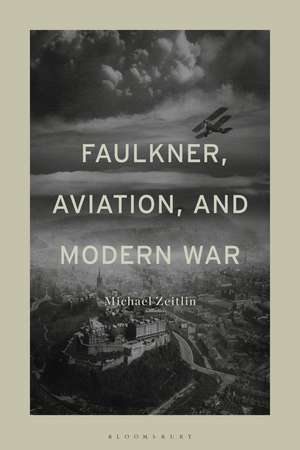
Faulkner, Aviation, and Modern War
Autor Dr. Michael Zeitlinen Limba Engleză Paperback – 27 iul 2023
Michael Zeitlin unpacks a broad selection of Faulkner's novels, stories, film treatments, essays, book reviews, and letters to outline Faulkner's complex and ambivalent relationship to the ideologies of masculine performance and martial heroism in an age dominated by industrialism and military technology.
Preț: 205.35 lei
Preț vechi: 279.32 lei
-26%
Puncte Express: 308
Carte tipărită la comandă
Livrare economică 11-25 noiembrie
Livrare prin curier în România Termenul estimat este afișat lângă disponibilitate.
Transport gratuit de la 400.00 lei Plată online sau ramburs, în funcție de opțiunile comenzii.
Retur gratuit în 14 zile Comandă securizată și suport în română.
Specificații
ISBN-13: 9781501376054
ISBN-10: 1501376055
Pagini: 246
Ilustrații: 10 bw illus
Dimensiuni: 148 x 226 x 16 mm
Greutate: 0.36 kg
Editura: Bloomsbury Publishing
Colecția Bloomsbury Academic
Locul publicării:New York, United States
ISBN-10: 1501376055
Pagini: 246
Ilustrații: 10 bw illus
Dimensiuni: 148 x 226 x 16 mm
Greutate: 0.36 kg
Editura: Bloomsbury Publishing
Colecția Bloomsbury Academic
Locul publicării:New York, United States
Cuprins
List of Figures
Preface
Acknowledgments
Abbreviations
1. The Original Accident
2. New Haven, Spring 1918: The War and the Newspapers
3. Transfiguration: Chapman, Guynemer, Lufbery
4. Faulkner and the Royal Air Force
5. The Embryo Pilot
6. Wounded Flyer
7. "Love," Manservant, and Faulkner's First Screenplay
8. Pylon: The Last War and the Next
Coda: Faulkner and Jimmy McCudden at the Savoy: A Fable
Works Cited
Index
Preface
Acknowledgments
Abbreviations
1. The Original Accident
2. New Haven, Spring 1918: The War and the Newspapers
3. Transfiguration: Chapman, Guynemer, Lufbery
4. Faulkner and the Royal Air Force
5. The Embryo Pilot
6. Wounded Flyer
7. "Love," Manservant, and Faulkner's First Screenplay
8. Pylon: The Last War and the Next
Coda: Faulkner and Jimmy McCudden at the Savoy: A Fable
Works Cited
Index
Recenzii
Michael Zeitlin has written a book that will change the way Faulkner scholars understand the author's life-long obsession with airplanes, pilots, and flying. An astonishing amount of research into World War I aviation is skillfully woven together to provide a rich context for understanding Faulkner's novels and short stories as part of Faulkner's life and times in important new ways.
Stunning insight, beautifully written. Zeitlin's work changes the meaning of perspective in Faulkner's vision: his ways of seeing. Engaging modernity in Modernism, Faulkner, Aviation and Modern War speaks to a waiting audience about flight itself to capture meaning through this incisive turn in Euro-western mythos and masculinity.
Overall, Faulkner, Aviation, and Modern War is carefully researched, convincingly argued, and critically engaged. It will be invaluable to Faulkner scholars and readers interested in modernist literature and the cultural history of aviation. In this regard, Zeitlin's work will soar as a landmark study for years.
William Faulkner's idolatry of the aeroplane, and of the crazy bold pilots who cut the skies to ribbons with one in the 1920s and 30s, is one of those happy freaks of literary modernism that seemed never to achieve its critical reckoning. Well, here it is. Michael Zeitlin's exhaustive research has deftly negotiated all the pylons, and in his high-octane thrill-ride alongside military aviators, barnstormers, commercial aces and all the dead pilots, we glimpse an aerial map of Faulkner's stylistic physiognomy. That quixotic desire to lift his poly-clausal periods above the turbulence of ideological conflict and draw in the gravid air his stately figures of torque made Faulkner's flyboy dreaming into art. With this book, Zeitlin has plotted the great author's death-drag dromology as the weightless career of a Sopwith Camel along the border between myth and metal.
Michael Zeitlin's new book is a singular achievement. He is the first Faulkner scholar to take on the whole of the author's flying corpus, and Zeitlin shrewdly analyzes the role of aviation, and, in particular, wartime flight in Faulkner's writing and thought...All of this comes to us in a prose as graceful as those pilots' soaring and dipping as well as through a writerly voice as unassuming and assured as that of men like Chapman, George Guynemar, and Raoul Lufbery were in flight.
Michael Zeitlin's extraordinary study is an attempt to get at the multilayered meaning of Faulkner and flight as it evolved during the First World War and the decades following. He lays out in elaborate detail Faulkner's service as a twenty-one-year-old cadet [and] quotes liberally from Faulkner's letters home to his parents during this period.
Stunning insight, beautifully written. Zeitlin's work changes the meaning of perspective in Faulkner's vision: his ways of seeing. Engaging modernity in Modernism, Faulkner, Aviation and Modern War speaks to a waiting audience about flight itself to capture meaning through this incisive turn in Euro-western mythos and masculinity.
Overall, Faulkner, Aviation, and Modern War is carefully researched, convincingly argued, and critically engaged. It will be invaluable to Faulkner scholars and readers interested in modernist literature and the cultural history of aviation. In this regard, Zeitlin's work will soar as a landmark study for years.
William Faulkner's idolatry of the aeroplane, and of the crazy bold pilots who cut the skies to ribbons with one in the 1920s and 30s, is one of those happy freaks of literary modernism that seemed never to achieve its critical reckoning. Well, here it is. Michael Zeitlin's exhaustive research has deftly negotiated all the pylons, and in his high-octane thrill-ride alongside military aviators, barnstormers, commercial aces and all the dead pilots, we glimpse an aerial map of Faulkner's stylistic physiognomy. That quixotic desire to lift his poly-clausal periods above the turbulence of ideological conflict and draw in the gravid air his stately figures of torque made Faulkner's flyboy dreaming into art. With this book, Zeitlin has plotted the great author's death-drag dromology as the weightless career of a Sopwith Camel along the border between myth and metal.
Michael Zeitlin's new book is a singular achievement. He is the first Faulkner scholar to take on the whole of the author's flying corpus, and Zeitlin shrewdly analyzes the role of aviation, and, in particular, wartime flight in Faulkner's writing and thought...All of this comes to us in a prose as graceful as those pilots' soaring and dipping as well as through a writerly voice as unassuming and assured as that of men like Chapman, George Guynemar, and Raoul Lufbery were in flight.
Michael Zeitlin's extraordinary study is an attempt to get at the multilayered meaning of Faulkner and flight as it evolved during the First World War and the decades following. He lays out in elaborate detail Faulkner's service as a twenty-one-year-old cadet [and] quotes liberally from Faulkner's letters home to his parents during this period.