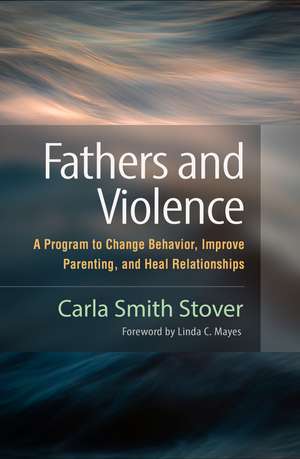
Fathers and Violence: A Program to Change Behavior, Improve Parenting, and Heal Relationships
Autor Carla Smith Stoveren Limba Engleză Paperback – 27 oct 2023
Preț: 286.48 lei
Preț vechi: 301.55 lei
-5%
Puncte Express: 430
Carte disponibilă
Livrare economică 17 iunie-01 iulie
Livrare express 03-09 iunie pentru 42.19 lei
Livrare prin curier în România Termenul estimat este afișat lângă disponibilitate.
Transport gratuit de la 400.00 lei Plată online sau ramburs, în funcție de opțiunile comenzii.
Retur gratuit în 14 zile Comandă securizată și suport în română.
Specificații
ISBN-13: 9781462552986
ISBN-10: 1462552986
Pagini: 256
Dimensiuni: 152 x 229 x 20 mm
Greutate: 0.38 kg
Ediția:1
Editura: Guilford Publications
Colecția Guilford Press
ISBN-10: 1462552986
Pagini: 256
Dimensiuni: 152 x 229 x 20 mm
Greutate: 0.38 kg
Ediția:1
Editura: Guilford Publications
Colecția Guilford Press
V-ar putea interesa
-
 -24%Preț: 170.11 lei222.41 lei
 -
 Healing Relational Trauma WorkbookDaniel A. HughesPreț: 264.72 lei
 -
 The Stop Program for Women Who AbuseDavid B. WexlerPreț: 260.77 lei
 -
 The Stop Program for WomenDavid B. WexlerPreț: 109.73 lei
 -
 Couples Therapy for Domestic ViolenceSandra M StithPreț: 436.53 lei
 -
 -5%Preț: 339.74 lei357.62 lei
 -
 Preț: 258.40 lei
 -
 Handbook of Attachment-Based InterventionsHoward Steele-5%Preț: 444.42 lei467.81 lei
 -
 -27%Preț: 115.95 lei157.83 lei
 -
 -27%Preț: 97.81 lei133.21 lei
 -
 -5%Preț: 223.24 lei235.00 lei
 -
 The Co-Parenting MethodMarcie ShaoulPreț: 133.47 lei
 -
 -26%Preț: 211.91 lei285.49 lei
 -
 Preț: 231.96 lei
 -
 The FathersJohn NivenPreț: 135.72 lei
 -
 Reconnected ParentingEleanor Mann-20%Preț: 89.98 lei113.14 lei
 -
 -21%Preț: 118.47 lei149.72 lei
 -
 -26%Preț: 240.28 lei322.97 lei
 -
 Preț: 163.17 lei
Cuprins
Foreword, Linda C. Mayes
1. Family Violence: Theories and Intervention Approaches for Men
2. Parenting by Men Who Have Caused Harm
3. Needs of Children Following Violence and Research on Fathers for Change
4. Theoretical Rationale for the Fathers for Change Intervention
5. Assessment for Case Selection and Treatment Planning
6. Phase 1: Engagement and Motivational Enhancement
7. Phase 2: Reflective Functioning and Skills Building
8. Phase 3: Coparenting Communication
9. Phase 4: Father–Child Restorative Parenting
10. Ending Treatment and Other Considerations
Epilogue
Appendix A. F4C Forms, Worksheets, and Handouts
Appendix B. Suggested Readings and Resources
References
Index
1. Family Violence: Theories and Intervention Approaches for Men
2. Parenting by Men Who Have Caused Harm
3. Needs of Children Following Violence and Research on Fathers for Change
4. Theoretical Rationale for the Fathers for Change Intervention
5. Assessment for Case Selection and Treatment Planning
6. Phase 1: Engagement and Motivational Enhancement
7. Phase 2: Reflective Functioning and Skills Building
8. Phase 3: Coparenting Communication
9. Phase 4: Father–Child Restorative Parenting
10. Ending Treatment and Other Considerations
Epilogue
Appendix A. F4C Forms, Worksheets, and Handouts
Appendix B. Suggested Readings and Resources
References
Index
Notă biografică
Carla Smith Stover, PhD, is Director of the Fathers for Change Program at the Yale University School of Medicine Child Study Center. Dr. Stover received a Career Award from the National Institute on Drug Abuse that initiated her research on interventions for fathers with intimate partner violence (IPV) behaviors. She developed Fathers for Change and has continued to conduct studies of the intervention. She has published widely on the topics of trauma, IPV, and substance misuse, and has presented trainings internationally on the topics of family conflict, healthy relationships, family violence, engaging and treating fathers, and interventions for childhood trauma. Dr. Stover serves on the editorial board of the journal Advances in Dual Diagnosis.
Recenzii
"Stover provides clear, definitive guidance for working with fathers who have engaged in violent behavior and who seek to heal their relationships with their children. Complex concepts are made more approachable by helpful, varied case examples, as well as worksheets and homework prompts. In addition to describing core aspects of assessment and treatment, Stover provides a foundational review of the literature on family violence, long-term effects of child maltreatment, and the importance of fathers in children's lives. Thoughtful discussions of legal and safety concerns and aftercare considerations are included. This book presents an inclusive and sensitive approach to the important issue of healing following family violence."--Jill D. Stinson, PhD, Department of Psychology, East Tennessee State University
"The book includes a detailed description of the F4C program, helpful examples of therapist–client dialogue, and multiple case studies. It provides a roadmap of the knowledge, skills, and strategies that mental health service providers need for critical conversations with fathers who have used violence in their families."--Katreena Scott, PhD, CPsych, Professor and Academic Director, Center for Research and Education on Violence Against Women and Children, Western University, London, Ontario, Canada
"Stover presents a much-needed, encouraging clinical approach that contrasts with more stigmatizing traditional interventions. Using careful screening and continuous monitoring to exclude individuals who pose a continuing risk of violence, F4C offers tailored interventions for those men who demonstrate a strong desire to be nurturing, successful parents. The book walks clinicians through phases of intervention focused on taking responsibility, motivation for change, understanding children’s needs, empathy, emotion regulation, making amends, and positive father–child and coparent interactions. Rich case examples, sample scripts for introducing interventions, and client handouts make this an invaluable guide for graduate classes and internship training settings, as well as for experienced clinicians."--Norman B. Epstein, PhD, Department of Family Science (Emeritus), School of Public Health, University of Maryland, College Park
"This well-written book comprehensively presents the F4C program, integrating research evidence with extensive, richly evocative clinical case studies and dozens of program tools and handouts. Stover effectively engages both scholars and practitioners in the field. She succinctly describes the history of interventions that address intimate partner abuse and family violence, and compellingly argues for the value of incorporating men’s identities and roles as fathers into these interventions."--Eric Mankowski, PhD, Department of Psychology, Portland State University-
Stover provides clear, definitive guidance for working with fathers who have engaged in violent behavior and who seek to heal their relationships with their children. Complex concepts are made more approachable by helpful, varied case examples, as well as worksheets and homework prompts. In addition to describing core aspects of assessment and treatment, Stover provides a foundational review of the literature on family violence, long-term effects of child maltreatment, and the importance of fathers in children's lives. Thoughtful discussions of legal and safety concerns and aftercare considerations are included. This book presents an inclusive and sensitive approach to the important issue of healing following family violence.--Jill D. Stinson, PhD, Department of Psychology, East Tennessee State University
The book includes a detailed description of the F4C program, helpful examples of therapist–client dialogue, and multiple case studies. It provides a roadmap of the knowledge, skills, and strategies that mental health service providers need for critical conversations with fathers who have used violence in their families.--Katreena Scott, PhD, CPsych, Professor and Academic Director, Center for Research and Education on Violence Against Women and Children, Western University, London, Ontario, Canada
This well-written book comprehensively presents the F4C program, integrating research evidence with extensive, richly evocative clinical case studies and dozens of program tools and handouts. Stover effectively engages both scholars and practitioners in the field. She succinctly describes the history of interventions that address intimate partner abuse and family violence, and compellingly argues for the value of incorporating men’s identities and roles as fathers into these interventions.--Eric Mankowski, PhD, Department of Psychology, Portland State University
-
"The book includes a detailed description of the F4C program, helpful examples of therapist–client dialogue, and multiple case studies. It provides a roadmap of the knowledge, skills, and strategies that mental health service providers need for critical conversations with fathers who have used violence in their families."--Katreena Scott, PhD, CPsych, Professor and Academic Director, Center for Research and Education on Violence Against Women and Children, Western University, London, Ontario, Canada
"Stover presents a much-needed, encouraging clinical approach that contrasts with more stigmatizing traditional interventions. Using careful screening and continuous monitoring to exclude individuals who pose a continuing risk of violence, F4C offers tailored interventions for those men who demonstrate a strong desire to be nurturing, successful parents. The book walks clinicians through phases of intervention focused on taking responsibility, motivation for change, understanding children’s needs, empathy, emotion regulation, making amends, and positive father–child and coparent interactions. Rich case examples, sample scripts for introducing interventions, and client handouts make this an invaluable guide for graduate classes and internship training settings, as well as for experienced clinicians."--Norman B. Epstein, PhD, Department of Family Science (Emeritus), School of Public Health, University of Maryland, College Park
"This well-written book comprehensively presents the F4C program, integrating research evidence with extensive, richly evocative clinical case studies and dozens of program tools and handouts. Stover effectively engages both scholars and practitioners in the field. She succinctly describes the history of interventions that address intimate partner abuse and family violence, and compellingly argues for the value of incorporating men’s identities and roles as fathers into these interventions."--Eric Mankowski, PhD, Department of Psychology, Portland State University-
Stover provides clear, definitive guidance for working with fathers who have engaged in violent behavior and who seek to heal their relationships with their children. Complex concepts are made more approachable by helpful, varied case examples, as well as worksheets and homework prompts. In addition to describing core aspects of assessment and treatment, Stover provides a foundational review of the literature on family violence, long-term effects of child maltreatment, and the importance of fathers in children's lives. Thoughtful discussions of legal and safety concerns and aftercare considerations are included. This book presents an inclusive and sensitive approach to the important issue of healing following family violence.--Jill D. Stinson, PhD, Department of Psychology, East Tennessee State University
The book includes a detailed description of the F4C program, helpful examples of therapist–client dialogue, and multiple case studies. It provides a roadmap of the knowledge, skills, and strategies that mental health service providers need for critical conversations with fathers who have used violence in their families.--Katreena Scott, PhD, CPsych, Professor and Academic Director, Center for Research and Education on Violence Against Women and Children, Western University, London, Ontario, Canada
This well-written book comprehensively presents the F4C program, integrating research evidence with extensive, richly evocative clinical case studies and dozens of program tools and handouts. Stover effectively engages both scholars and practitioners in the field. She succinctly describes the history of interventions that address intimate partner abuse and family violence, and compellingly argues for the value of incorporating men’s identities and roles as fathers into these interventions.--Eric Mankowski, PhD, Department of Psychology, Portland State University
-
Descriere
This highly accessible book presents a new approach to treating men who use violence against their partners and/or children.