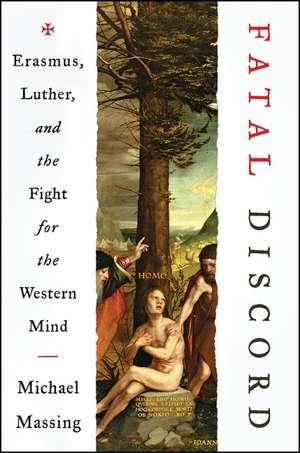
Fatal Discord
Autor Michael Massingen Limba Engleză Paperback – 22 mar 2022
În peisajul academic actual, studiile despre Reformă tind adesea să izoleze figurile centrale, tratând separat teologia lui Martin Luther și umanismul lui Desiderius Erasmus. Această abordare fragmentată lasă o lacună în înțelegerea modului în care ciocnirea lor directă a definit structura gândirii occidentale moderne. În Fatal Discord, Michael Massing propune o sinteză monumentală, o biografie duală care refuză să îi separe pe cei doi titani, demonstrând că nu putem înțelege prezentul Europei sau al Americii fără a analiza scânteia conflictului dintre ei. Găsim în această carte o reconstrucție meticuloasă a Europei secolului al XVI-lea, un spațiu în care arta lui Leonardo sau Michelangelo coexista cu tensiuni religioase explozive. Michael Massing navighează cu precizie jurnalistică prin complexitatea teologică a epocii, punând accent pe momentul 1516, când Erasmus publică Noul Testament în limba greacă, un act de curaj intelectual care a precedat și alimentat, paradoxal, revolta lui Luther. Ne-a atras atenția modul în care autorul trasează linii de demarcație clare între dorința lui Erasmus de a reforma Biserica din interior și nevoia radicală a lui Luther de a dărâma vechile ierarhii. Fatal Discord acoperă aceeași arie tematică precum volumul Discourse on Free Will de Desiderius Erasmus, dar cu o abordare mult mai vastă și narativă. În timp ce textele clasice se concentrează pe argumentul filosofic pur, Massing integrează contextul social și politic, oferind o perspectivă interdisciplinară asupra modului în care aceste idei au fracturat unitatea creștinătății. Ediția de față, de dimensiuni considerabile (peste 1000 de pagini), include un insert de 16 pagini color care ajută la vizualizarea epocii, transformând o analiză densă într-o experiență de lectură captivantă și riguroasă.
Preț: 163.14 lei
Carte disponibilă
Livrare economică 29 octombrie-12 noiembrie
Livrare express 15-21 octombrie pentru 72.62 lei
Specificații
ISBN-10: 0063143437
Pagini: 1008
Ilustrații: 16-page color insert
Dimensiuni: 156 x 228 x 50 mm
Greutate: 0.95 kg
Editura: Harper Collins Publ. USA
Colecția HarperPerennial
De ce să citești această carte
Această carte este esențială pentru cititorii pasionați de istoria ideilor și teologie. Oferă o perspectivă clară asupra modului în care disputa dintre un erudit și un călugăr a pus bazele celor două mari tradiții ale Occidentului: umanismul laic și individualismul religios. Veți câștiga o înțelegere profundă a rădăcinilor culturale europene dintr-o lucrare premiată, care îmbină rigoarea academică cu un stil narativ accesibil.
Despre autor
Michael Massing este un distins jurnalist american și fost editor la „Columbia Journalism Review”, fiind colaborator frecvent al prestigioasei publicații „New York Review of Books”. Recunoscut pentru profunzimea cercetărilor sale, a fost numit MacArthur Fellow în 1992. Deși cariera sa a inclus reportaje extinse despre politici sociale și actualitate, în Fatal Discord el își demonstrează erudiția în istorie intelectuală. Abilitatea sa de a sintetiza surse complexe și de a le prezenta într-un format accesibil publicului larg i-a adus aprecieri critice la nivel internațional.
Textul de pe ultima copertă
Erasmus was the leading figure of the Northern Renaissance. At a time when Leonardo, Michelangelo, and Raphael were revolutionizing Western art and culture, Erasmus was helping transform Europe’s intellectual and religious life, developing a new design for living for a continent rebelling against the hierarchical constraints of the Roman Church. When he came out with a revised edition of the New Testament in 1516 based on the original Greek, he was hailed as the prophet of a new enlightened age. Today, however, Erasmus is largely forgotten, and the reason can be summed up in two words: Martin Luther. As a young friar in remote Wittenberg, Luther was initially a great admirer of Erasmus and his diagnosis of what ailed the Catholic Church, but while Erasmus sought to reform that institution from within, Luther favored a more radical transformation. Eventually, the differences between them flared into a rancorous competition, with each trying to win over Europe to his vision.
In Fatal Discord, Michael Massing seeks to restore Erasmus to his proper place in the Western tradition. The conflict between him and Luther, he argues, represents not just the clash of two headstrong individuals but also of two distinct worldviews—Erasmus the humanist, embracing the brotherhood of man and the diversity of cultures within it, and Luther the evangelical, stressing God’s power and Christ’s divinity and insisting that all recognize those beliefs as absolute and binding. Massing argues that their conflict forms a fault line in
Western thinking—the moment when two central schools of thought, Christian humanism and evangelical Christianity, took shape. A seasoned journalist who has reported on war and peace, political and social issues, Massing here travels back to the early sixteenth century to recover a story that helps explain our current fractured world—a moment when the introduction of new ways of reading the Bible set loose social and cultural forces that helped shatter the millennial unity of Christendom and whose echoes still resound. Massing concludes that Europe has gravitated toward a form of Erasmian humanism, while America has been shaped by Luther-inspired individualism.
Recenzii
“Fatal Discord is a striking departure for Mr. Massing, a distinguished journalist whose work has appeared in outlets like the New York Review of Books and the Columbia Journalism Review. . . . Mr. Massing has read widely and intelligently, and he writes superbly. Fatal Discord is surely the only book on either Erasmus or Luther that general readers will ever require. It reads like a lively lecture series in that most beleaguered of university subjects, Western civilization.” — Wall Street Journal
“Massing superbly accomplishes the mammoth task of writing a dual biography of Desiderus Erasmus (1466–1536) and Martin Luther (1483–1546) that places the pair within their historical context...this is a masterly work. Massing manages to juggle the complicated biographies and life work of both Erasmus and Luther while giving the reader a well-written, comprehensive background of pre-Reformation theology.” — Publishers Weekly (starred review)
“In this riveting narrative, Massing recounts how the incendiary friar [Martin Luther] eventually quarrels with and finally repudiates his erstwhile leader, so sundering the church that Erasmus hopes to reform from within, and opening up an epoch-defining gap between Protestant evangelism and cosmopolitan humanism.” — Booklist (starred review)
“In this dual biography, Massing deftly treats the lives of both [Erasmus and Luther], setting them in the context of the times… this engaging tale of the contentious relationship between two precursors of the modern world… provides much-needed historical background and reflection on a major period in church and world history.” — Library Journal (starred review)
“A riveting dual biography [that] reveals the social, political, and religious tensions roiling 16th-century Europe. Massing focuses on the well-known rivalry between the Dutch humanist Desiderius Erasmus and the German reformer Martin Luther to create a majestic, deeply informed portrait of their tempestuous times… [Fatal Discord is] an impressive, powerful intellectual history.” — Kirkus Reviews (starred review)
“Michael Massing, a former executive editor of the Columbia Journalism Review, thinks these theological differences fatefully divided Christianity in ways that reverberate now in American evangelicalism. In his new book Fatal Discord, he brilliantly chronicles how the rift between both men deepened.” — Financial Times