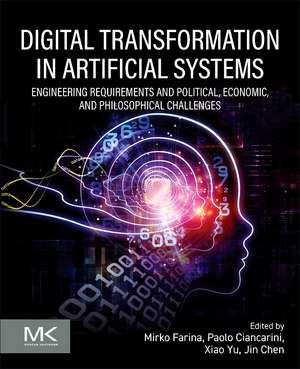
Farina - Digital Transformation: Engineering Requirements and Political, Economic, and Philosophical Challenges
Editat de Mirko Farina, Paolo Ciancarini, Xiao Yu, Jin Chenen Limba Engleză Paperback – 13 feb 2026
- Provides a thorough exploration of digital transformation within artificial systems, covering key concepts, methodologies, and emerging trends
- Shows practical insights into implementing digital transformation strategies in artificial systems, with real-world examples and case studies illustrating successful applications
- Caters to a broad audience, including professionals, researchers, and students interested in understanding and implementing digital transformation in artificial systems
Preț: 822.99 lei
Preț vechi: 1371.98 lei
-40%
Puncte Express: 1234
Carte tipărită la comandă
Livrare economică 12-26 noiembrie
Livrare prin curier în România Termenul estimat este afișat lângă disponibilitate.
Transport gratuit pentru acest produs Plată online sau ramburs, în funcție de opțiunile comenzii.
Retur gratuit în 14 zile Comandă securizată și suport în română.
Specificații
ISBN-13: 9780443329647
ISBN-10: 0443329648
Pagini: 414
Dimensiuni: 191 x 235 mm
Editura: ELSEVIER SCIENCE
ISBN-10: 0443329648
Pagini: 414
Dimensiuni: 191 x 235 mm
Editura: ELSEVIER SCIENCE
V-ar putea interesa
-
 -16%Preț: 80.33 lei96.17 lei
 -
 Building a Thriving FuturePaola Cecchi-DimeglioPreț: 203.01 lei
 -
 AI 2041Kai-Fu Lee-29%Preț: 77.08 lei108.09 lei
 -
 Moonshot MomentsMilan KordestaniPreț: 95.10 lei
 -
 -20%Preț: 394.12 lei492.64 lei
 -
 Preț: 485.25 lei
 -
 Skinner, C: Digital HumanChris (Balatro ltd) SkinnerPreț: 226.07 lei
 -
 Our Planet Powered by AIMark Minevich-20%Preț: 132.99 lei166.23 lei
 -
 -42%Preț: 56.60 lei97.70 lei
 -
 Cybernetic Circulation ComplexNick Dyer-WithefordPreț: 129.05 lei
 -
 Preț: 189.87 lei
 -
 Digital SustainabilityTheo LynnPreț: 325.69 lei
 -
 Ethics and the Digital Transformation of Human WorkPeter G. KirchschlägerPreț: 314.81 lei
 -
 -20%Preț: 609.91 lei762.39 lei
 -
 Digital TransformationBirgit Vogel-Heuser-20%Preț: 419.84 lei524.80 lei
 -
 Empire of AIKaren HaoPreț: 144.98 lei
 -
 Transcend: Unlocking Humanity in the Age of AIFaisal Hoque-18%Preț: 128.32 lei157.10 lei
Cuprins
PART A Engineering and politics
1. The digital transformation of the public sector: The roles of the product owner
2. Exploring new formulations for distributive fairness in intelligent decision-making
3. The coevolution dilemma and the artificial intelligence paradox
4. Navigating digital sovereignty within regional integration: A conceptual framework
5. The reality of digital states
6. Navigating the nexus of international order and artificial intelligence regulation: Divergent approaches and global governance implications
PART B – Economy and philosophy
7. Key factors for successful digital transformation in business organizations
8. Unilateral sanctions in the cyber age: The impact on state sovereignty and human rights
9. Digital transformation as a tool for integration in the Eurasian Economic Union
10. From innovation to inaction: Why digital energy fails to empower citizens
11. Balancing the scales: Understanding and addressing algorithmic gender discrimination
12. Digital transformation and identity
13. The critique of human-centered artificial intelligence: Why it is questionable and why it calls for a radical transformation of the human—artificial intelligence relation
PART C - New frontiers
14. The digitalization of the humanities: Recent trends and future prospects
15. Digital transformation and propaganda in the large language models era
16. Digital transformation in education: Higher education for everyone
17. Criminal justice and artificial intelligence: A defense of the restricted application model for algorithmic sentencing support
1. The digital transformation of the public sector: The roles of the product owner
2. Exploring new formulations for distributive fairness in intelligent decision-making
3. The coevolution dilemma and the artificial intelligence paradox
4. Navigating digital sovereignty within regional integration: A conceptual framework
5. The reality of digital states
6. Navigating the nexus of international order and artificial intelligence regulation: Divergent approaches and global governance implications
PART B – Economy and philosophy
7. Key factors for successful digital transformation in business organizations
8. Unilateral sanctions in the cyber age: The impact on state sovereignty and human rights
9. Digital transformation as a tool for integration in the Eurasian Economic Union
10. From innovation to inaction: Why digital energy fails to empower citizens
11. Balancing the scales: Understanding and addressing algorithmic gender discrimination
12. Digital transformation and identity
13. The critique of human-centered artificial intelligence: Why it is questionable and why it calls for a radical transformation of the human—artificial intelligence relation
PART C - New frontiers
14. The digitalization of the humanities: Recent trends and future prospects
15. Digital transformation and propaganda in the large language models era
16. Digital transformation in education: Higher education for everyone
17. Criminal justice and artificial intelligence: A defense of the restricted application model for algorithmic sentencing support