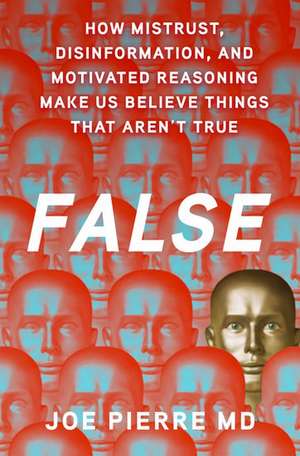
False: How Mistrust, Disinformation, and Motivated Reasoning Make Us Believe Things that Aren't True
Autor Joe Pierre MDen Limba Engleză Hardback – 3 iun 2025
Preț: 179.92 lei
Preț vechi: 211.53 lei
-15%
Puncte Express: 270
Carte disponibilă
Livrare economică 06-11 noiembrie
Livrare express 22-28 octombrie pentru 63.40 lei
Livrare prin curier în România Termenul estimat este afișat lângă disponibilitate.
Transport gratuit de la 400.00 lei Plată online sau ramburs, în funcție de opțiunile comenzii.
Retur gratuit în 14 zile Comandă securizată și suport în română.
Specificații
ISBN-13: 9780197765272
ISBN-10: 0197765270
Pagini: 256
Dimensiuni: 162 x 240 x 23 mm
Greutate: 0.5 kg
Editura: Oxford University Press
Colecția OUP USA
Locul publicării:New York, United States
ISBN-10: 0197765270
Pagini: 256
Dimensiuni: 162 x 240 x 23 mm
Greutate: 0.5 kg
Editura: Oxford University Press
Colecția OUP USA
Locul publicării:New York, United States
Recenzii
The most consequential riddle in human psychology is why so many people believe such incredibly wrong and dangerous things. Joe Pierre, master of this mystery, has written a fascinating book that best describes and explains the seductive appeal of lies, misinformation, and conspiracy theory. Only by plumbing the depths of gullibility can we hope to neutralize its increasingly corrosive effects on our ever more fragile democracy
As a psychiatrist, Pierre brings a fresh perspective to the problems of fake news and misinformation, and why people can be led to believe things that are false or misleading. From delusions to faith, and science and probabilities, Pierre takes the reader on a fascinating tour of the kaleidoscopic diversity of human belief formation and its pitfalls.
Many books address our common fallacies, biases, and cognitive errors, but Pierre's False shows how these psychological quirks have fueled many of our contemporary delusions, including 'Pizzagate', QAnon, flat Earth belief, and the Covid lab leak and anti-vaccination conspiracies. The writing is lively, accessible, and filled with illustrative examples drawn from our contemporary world. Highly recommended.
In this up-to-date research on the increasing amount of disinformation plaguing society, psychiatrist and cognitive scientist Pierre (Univ. of California) makes a compelling case for the view that susceptibility to misinformation is not confined to people with a low IQ or low social rank.
False offers school leaders the opportunity to understand the public we serve a bit more and, perhaps more importantly, encourages us to hold the mirror up to our own ideologies and beliefs as we attempt to be balanced leaders within our schools and local communities.
As a psychiatrist, Pierre brings a fresh perspective to the problems of fake news and misinformation, and why people can be led to believe things that are false or misleading. From delusions to faith, and science and probabilities, Pierre takes the reader on a fascinating tour of the kaleidoscopic diversity of human belief formation and its pitfalls.
Many books address our common fallacies, biases, and cognitive errors, but Pierre's False shows how these psychological quirks have fueled many of our contemporary delusions, including 'Pizzagate', QAnon, flat Earth belief, and the Covid lab leak and anti-vaccination conspiracies. The writing is lively, accessible, and filled with illustrative examples drawn from our contemporary world. Highly recommended.
In this up-to-date research on the increasing amount of disinformation plaguing society, psychiatrist and cognitive scientist Pierre (Univ. of California) makes a compelling case for the view that susceptibility to misinformation is not confined to people with a low IQ or low social rank.
False offers school leaders the opportunity to understand the public we serve a bit more and, perhaps more importantly, encourages us to hold the mirror up to our own ideologies and beliefs as we attempt to be balanced leaders within our schools and local communities.
Notă biografică
Joe Pierre MD is a Health Sciences Clinical Professor in the Department of Psychiatry and Behavioral Sciences at the University of California, San Francisco. As a full-time clinician, he has extensive experience treating people with psychotic disorders such as schizophrenia, delusional disorder, and substance-induced psychosis. His academic work focuses on the grey area between psychopathology and normality, with an emphasis on delusion-like beliefs including conspiracy theories. He also serves as an expert witness consultant in forensic cases involving the intersection of psychosis, religion, and ideological belief. He has been featured in over 100 news articles and media interviews, appearing in The New York Times, The Guardian, Vanity Fair, Slate, and the award-winning documentary Behind the Curve as well as on CNN, BBC, NPR, and VICE News. His blog Psych Unseen has attracted over 3 million views.
Cuprins
- Preface
- Chapter 1: Delusions, Distortions, and Misbeliefs, Oh My!
- Chapter 2: The Psychology of Overconfidence
- Chapter 3: Confirmation Bias on Steroids
- Chapter 4: The Flea Market of Opinion
- Chapter 5: The Disinformation Industrial Complex
- Chapter 6: Conspiracy Theories Gone Wild
- Chapter 7: Falling for Bullshit
- Chapter 8: Divided States
- Chapter 9: We Are Not Our Beliefs
- Chapter 10: A Prescription for a Post-Truth World
- Bibliography