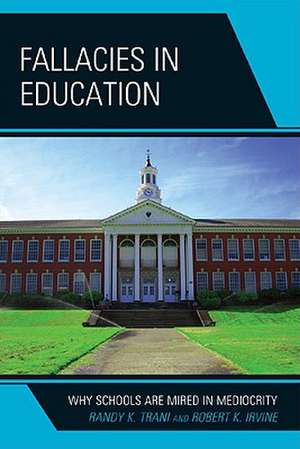
Fallacies in Education: Why Schools Are Mired in Mediocrity
Autor Randy K. Trani, Robert K. Irvineen Limba Engleză Paperback – 16 ian 2010
Fallacies in Education is purposefully written to support community-based changes to schools that encourage superior achievement and educational results. This book provides a pathway for concerned parents, administrators, teachers and citizens to improve their schools with their current resources. The techniques used in Corbett to produce an academic renaissance can be used everywhere and this book provides a starting point for schools to strive for academic achievement and excellence in education. The book demonstrates how every school can better serve their students and deliver a better education without increasing costs or incurring new ones.
Preț: 363.54 lei
Preț vechi: 462.13 lei
-21%
Puncte Express: 545
Carte tipărită la comandă
Livrare economică 30 noiembrie-14 decembrie
Livrare prin curier în România Termenul estimat este afișat lângă disponibilitate.
Transport gratuit de la 400.00 lei Plată online sau ramburs, în funcție de opțiunile comenzii.
Retur gratuit în 14 zile Comandă securizată și suport în română.
Specificații
ISBN-13: 9781607094685
ISBN-10: 1607094681
Pagini: 227
Dimensiuni: 150 x 228 x 18 mm
Greutate: 0.36 kg
Editura: Bloomsbury Publishing
Colecția R&L Education
Locul publicării:New York, United States
ISBN-10: 1607094681
Pagini: 227
Dimensiuni: 150 x 228 x 18 mm
Greutate: 0.36 kg
Editura: Bloomsbury Publishing
Colecția R&L Education
Locul publicării:New York, United States
V-ar putea interesa
-
 Educational Leadership PreparationG. Jean-Marie-8%Preț: 409.17 lei444.74 lei
 -
 -15%Preț: 490.46 lei577.01 lei
 -
 Preț: 263.76 lei
 -
 Preț: 391.11 lei
 -
 -15%Preț: 444.73 lei523.22 lei
 -
 Developing Equitable Education SystemsMel Ainscow-15%Preț: 451.35 lei531.00 lei
 -
 -15%Preț: 418.85 lei492.76 lei
 -
 Engaging StudentsSchlechtyPreț: 229.37 lei
 -
 Wasted: Why Education Isn't EducatingProfessor Frank Furedi-40%Preț: 82.98 lei138.39 lei
 -
 -27%Preț: 1218.59 lei1660.24 lei
 -
 -20%Preț: 109.63 lei137.35 lei
 -
 -18%Preț: 111.52 lei136.73 lei
 -
 Preț: 81.05 lei
 -
 Second International Handbook of Educational ChangeAndy Hargreaves-18%Preț: 5884.29 lei7175.96 lei
Recenzii
This is the ultimate plan for a final crusade guaranteed to serve those who need it the most?our students! No doubt Trani and Irvine's Fallacies in Education will revitalize our schools and reenergize our teachers. A must read by those encumbered bythe omnipresent malaise of the ubiquitous grade level model and all its tyrannies. This call for action can revolutionize learning in our schools and put joy and excitement back on the faces of our children and youth. No stronger or more articulate argument on behalf of the multi-age classroom and continuous progress model has ever been made. If education decision-makers adopted these success-proven strategies today, American education would be revolutionized, reenergized, and the envy of the world. Most importantly, our children and youth might once again find joy in learning..
Trani and Irvine offer a hard-hitting argument for fundamentally changing the pedogogical and operational aspects of our schools in order to more effectively serve students. Motivated by a passion to see more students achieving at their highest levels, the authors go beyond conventional wisdom as they present a compelling case for change. Through specific examples and insightful case studies,they provide principles of school leadership and management that can be applied at all grade levels. As a former superintendent of a large urban school district in California, I highly recommend this thought-provoking book to other school practitioners.
In this fascinating book, Trani and Irvine initiate an important conversation about conditions that promote excellence in education. They challenge educators to break away from firmly entrenched practices-large districts and schools-and call for small learning environments to foster academic achievement. Drawing on their experience with a highly effective small school system, they advance a continuous progress model for small K-12 districts and schools with a refreshing emphasis on educating individual students at every level.
Trani and Irvine present a straightforward critique of US schools. The authors' position is based largely upon "common knowledge" views of what schools should be-how they should be organized, what they should accomplish, and how they should operate. These views, the authors say, are distortions that perpetuate school mediocrity. For example, they point out the problems with school size-believing that bigger is better; grade-level configuration-locking students into blocks by age and time; and middle school-placing students into complex schedules and surroundings at the time when they most need predictability. The authors present a strong argument for alternatives to this common knowledge. They delineate possibilities for funding and utilizing community resources to create excellent schools. Their suggestions for parents, teachers, school administrators, and board members are reasonable and full of promise. For example, become informed about school district needs and their limitations. Become an advocate, attend board meetings, speak up, ask questions, work to establish change. Achieving excellent schools entails facing skepticism and criticism because "common knowledge" views of schools are deeply imbedded in US culture and will take patience and perseverance to replace. Summing Up: Recommended.
Trani and Irvine offer a hard-hitting argument for fundamentally changing the pedogogical and operational aspects of our schools in order to more effectively serve students. Motivated by a passion to see more students achieving at their highest levels, the authors go beyond conventional wisdom as they present a compelling case for change. Through specific examples and insightful case studies,they provide principles of school leadership and management that can be applied at all grade levels. As a former superintendent of a large urban school district in California, I highly recommend this thought-provoking book to other school practitioners.
In this fascinating book, Trani and Irvine initiate an important conversation about conditions that promote excellence in education. They challenge educators to break away from firmly entrenched practices-large districts and schools-and call for small learning environments to foster academic achievement. Drawing on their experience with a highly effective small school system, they advance a continuous progress model for small K-12 districts and schools with a refreshing emphasis on educating individual students at every level.
Trani and Irvine present a straightforward critique of US schools. The authors' position is based largely upon "common knowledge" views of what schools should be-how they should be organized, what they should accomplish, and how they should operate. These views, the authors say, are distortions that perpetuate school mediocrity. For example, they point out the problems with school size-believing that bigger is better; grade-level configuration-locking students into blocks by age and time; and middle school-placing students into complex schedules and surroundings at the time when they most need predictability. The authors present a strong argument for alternatives to this common knowledge. They delineate possibilities for funding and utilizing community resources to create excellent schools. Their suggestions for parents, teachers, school administrators, and board members are reasonable and full of promise. For example, become informed about school district needs and their limitations. Become an advocate, attend board meetings, speak up, ask questions, work to establish change. Achieving excellent schools entails facing skepticism and criticism because "common knowledge" views of schools are deeply imbedded in US culture and will take patience and perseverance to replace. Summing Up: Recommended.