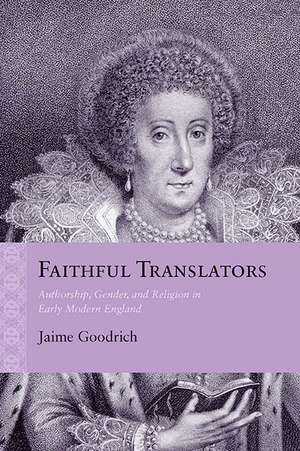
Faithful Translators: Authorship, Gender, and Religion in Early Modern England: Rethinking the Early Modern
Autor Jaime Goodrichen Limba Engleză Hardback – 31 dec 2013




Preț: 541.27 lei
Preț vechi: 644.37 lei
-16%
Puncte Express: 812
Preț estimativ în valută:
95.69€ • 114.76$ • 83.18£
95.69€ • 114.76$ • 83.18£
Carte indisponibilă temporar
Doresc să fiu notificat când acest titlu va fi disponibil:
Se trimite...
Specificații
ISBN-13: 9780810129696
ISBN-10: 0810129698
Pagini: 272
Ilustrații: 8 b-w
Dimensiuni: 152 x 229 x 20 mm
Greutate: 0.51 kg
Editura: Northwestern University Press
Colecția Northwestern University Press
Seria Rethinking the Early Modern
ISBN-10: 0810129698
Pagini: 272
Ilustrații: 8 b-w
Dimensiuni: 152 x 229 x 20 mm
Greutate: 0.51 kg
Editura: Northwestern University Press
Colecția Northwestern University Press
Seria Rethinking the Early Modern
Notă biografică
JAMIE GOODRICH is an Assistant Professor of English at Wayne State University
Descriere
With Faithful Translators Jaime Goodrich offers the first in-depth examination of women’s devotional translations and of religious translations in general within early modern England. Placing female translators such as Queen Elizabeth I and Mary Sidney Herbert, Countess of Pembroke, alongside their male counterparts, such as Sir Thomas More and Sir Philip Sidney, Goodrich argues that both male and female translators constructed authorial poses that allowed their works to serve four distinct cultural functions: creating privacy, spreading propaganda, providing counsel, and representing religious groups.