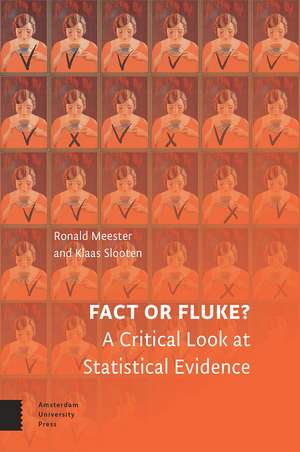
Fact or Fluke?: A Critical Look at Statistical Evidence
Autor Ronald Meester, Klaas Slootenen Limba Engleză Paperback – 28 iun 2022
Ronald Meester and Klaas Slooten use a variety of examples - from court cases to theoretical physics - to present different views on statistics and provide arguments for what they think is the best point of view. This book is meant for anyone who is in some way concerned with, or interested in, statistical evidence: scientific researchers, students, teachers, mathematicians, philosophers, lawyers, managers, and no doubt many others.
Preț: 214.92 lei
Puncte Express: 322
Carte disponibilă
Livrare economică 28 octombrie-11 noiembrie
Livrare prin curier în România Termenul estimat este afișat lângă disponibilitate.
Transport gratuit de la 400.00 lei Plată online sau ramburs, în funcție de opțiunile comenzii.
Retur gratuit în 14 zile Comandă securizată și suport în română.
Specificații
ISBN-13: 9789463723497
ISBN-10: 9463723498
Pagini: 184
Dimensiuni: 156 x 234 x 10 mm
Greutate: 0.34 kg
Ediția:1
Editura: Amsterdam University Press
Colecția Amsterdam University Press
Locul publicării:Oxford, United Kingdom
ISBN-10: 9463723498
Pagini: 184
Dimensiuni: 156 x 234 x 10 mm
Greutate: 0.34 kg
Ediția:1
Editura: Amsterdam University Press
Colecția Amsterdam University Press
Locul publicării:Oxford, United Kingdom
V-ar putea interesa
-
 Preț: 262.74 lei
 -
 Continuum PercolationRonald MeesterPreț: 441.77 lei
 -
 Random Networks for CommunicationMassimo Franceschetti-11%Preț: 632.30 lei710.46 lei
 -
 Genetic Glass CeilingsJonathan Gressel-19%Preț: 459.73 lei567.57 lei
 -
 The Waning of the Mediterranean, 1550-1870Faruk TabakPreț: 516.22 lei
 -
 Dressing Modern FrenchwomenMary Lynn StewartPreț: 486.26 lei
 -
 Preț: 233.84 lei
 -
 Emptiness and Temporality: Buddhism and Medieval Japanese PoeticsEsperanza Ramirez-Christensen-19%Preț: 447.67 lei552.68 lei
 -
 -23%Preț: 731.05 lei949.41 lei
 -
 Preț: 516.82 lei
 -
 Preț: 525.53 lei
 -
 Preț: 483.11 lei
 -
 Preț: 487.76 lei
 -
 Preț: 486.39 lei
 -
 -23%Preț: 733.58 lei952.69 lei
 -
 -19%Preț: 592.16 lei731.07 lei
 -
 Getting PlayedJody Miller-23%Preț: 633.69 lei822.97 lei
 -
 Linked Labor HistoriesAviva ChomskyPreț: 292.58 lei
 -
 Summers with LincolnJames A. Percoco-19%Preț: 460.02 lei567.92 lei
 -
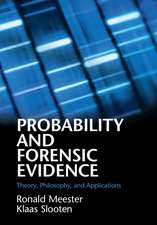 Probability and Forensic EvidenceRonald MeesterPreț: 384.69 lei
 -
 Transformation of GovernanceDonald F KettlPreț: 202.66 lei
 -
 Roads and Ecological InfrastructureKimberly M Andrews-19%Preț: 451.41 lei557.30 lei
 -
 Making Computers AccessibleElizabeth R PetrickPreț: 380.85 lei
 -
 Entfaltung einer PlanungsideeLudwig HilberseimerPreț: 200.60 lei
Public țintă
Undergraduate AdvancedNotă biografică
Ronald Meester is full professor in Probability Theory at the Vrije Universiteit in Amsterdam. The last 15 years he has mainly worked on forensic probability and statistics.
Klaas Slooten is a statistician and DNA-kinship expert at the Netherlands Forensic Institute. He is also professor by special appointment at the Vrije Universiteit in Amsterdam.
Klaas Slooten is a statistician and DNA-kinship expert at the Netherlands Forensic Institute. He is also professor by special appointment at the Vrije Universiteit in Amsterdam.
Cuprins
Preface, Prologue, Part I Classical Statistics 1. Significance Testing 1.1 Testing the Null Hypothesis and Statistical Significance 1.2 The Logic of Significance Testing: In the Words of Fisher 1.3 Significance Testing Ignores the Context 1.4 Back to Sally Clark 2. p-Values 2.1 What Is a p-value? 2.2 The Main Problem with p-Values 2.3 Publication Bias 2.4 One-Tailed Versus Two-Tailed: A Paradox 2.5 The p-Value in Adaptive Sampling Studies 2.6 More on Adaptive Sampling Studies 3. Confidence Intervals 3.1 What Is a Confidence Interval? 3.2 Confidence Intervals, p-Values, and Effect Size 3.3 Dependence on the Experimental Setup 3.4 Strange (and Amusing) Confidence Intervals Part II A Bayesian Approach 4. What Is Statistical Evidence? 4.1 The Likelihood Ratio 4.2 Likelihood Ratios for an Unknown Probability of Success 4.3 The Likelihood Ratio Solves Problems with p-Values 74.4 The Interpretation of the Likelihood Ratio 4.5 p-Values versus Likelihood Ratios 4.6 Likelihood Ratios and Power 5. Evidence and Belief 5.1 Alternative Hypotheses and Context 5.2 A Return to Ioannidis’ Argument 5.3 An Anecdotal Cards Example 5.4 A Philosophical Interlude 5.5 Worked-Out Examples – Credibility Intervals 5.6 Laypersons and the Prior 5.7 Objective Bayes? 5.8 A Few Conclusions 6. The Likelihood Ratio and the Experimental Setup 6.1 Error Probabilities and Misleading Evidence 6.2 How Often Does Misleading Evidence Occur? 6.3 Likelihood Ratios and Designing an Experimental Setup 6.4 Conclusions Part III Statistics in Practice 7. Two Worked-Out Examples 7.1 Face Masks 7.2 The Lucia de Berk Case 8. Sometimes p-Values Can Be Justified 8.1 Elementary Particles in Theoretical Physics 8.2 Model Validation, Appendix, Bibliography, Index
Descriere
The book aims to examine the philosophical foundations of statistics rather than teach statistical methods, focusing on the fundamental question of how and why statistics works, and what we can reasonably expect from statistical evidence.