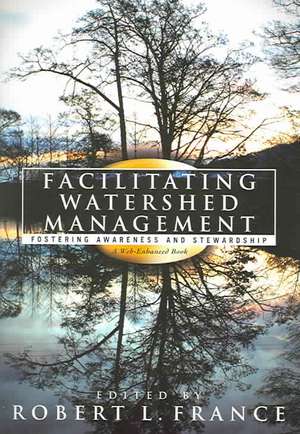
Facilitating Watershed Management: Fostering Awareness and Stewardship
Editat de Robert L. France Contribuţii de Robert M. Abbott, Carolyn A. Adams, Steven I. Apfelbaum, Sandra Brown, Joe Bonnell, Chester Bowling, Lisa Brukilacchio, Kathleen Bullard, Elizabeth Cavicchi, Mark Chandler, Betsy Damon, David F. Fletcher, Mags Harries, Lajos Héder, Jennifer Hill, James Landry, Ruth Lansford, Anne H. Mavor, David O. Mendelsohn, Suzanne Meyer, Peter H. North, Kathy Poole, Wendy Rains, Thomas Richman, Nancy Rottle, Hans Schreier, Robert J. Steedman, Paul Zandbergenen Limba Engleză Paperback – 21 mar 2005
Preț: 483.80 lei
Preț vechi: 691.89 lei
-30%
Puncte Express: 726
Carte tipărită la comandă
Livrare economică 28 noiembrie-12 decembrie
Livrare prin curier în România Termenul estimat este afișat lângă disponibilitate.
Transport gratuit pentru acest produs Plată online sau ramburs, în funcție de opțiunile comenzii.
Retur gratuit în 14 zile Comandă securizată și suport în română.
Specificații
ISBN-13: 9780742533646
ISBN-10: 0742533646
Pagini: 400
Dimensiuni: 174 x 252 x 24 mm
Greutate: 0.69 kg
Ediția:New.
Editura: Bloomsbury Publishing
Colecția Rowman & Littlefield
Locul publicării:New York, United States
ISBN-10: 0742533646
Pagini: 400
Dimensiuni: 174 x 252 x 24 mm
Greutate: 0.69 kg
Ediția:New.
Editura: Bloomsbury Publishing
Colecția Rowman & Littlefield
Locul publicării:New York, United States
Cuprins
Part 1 Part I: Environmental Communication
Chapter 2 Overview: The Sociology of Watershed Stewardship and Management
Chapter 3 1 Buzzwords and Benchmarks: Ecosystem Health as a Management Goal
Chapter 4 Response: Integrating Human and Environmental Aspirations
Chapter 5 2 Into the Great Wide Open: Rethinking Design in an Era of Economic, Social, and Environmental Change
Chapter 6 Response: Watershed Health as Wealth and Other "Capital" Ideas
Chapter 7 3 Innovation Diffusion and Water-Sensitive Design
Chapter 8 Response: Making Sure Paradigm Shift Happens
Chapter 9 4 Agency-Sponsored Alternative Dispute Resolution Process in Urban River Management
Chapter 10 Response: Managing Watersheds by Managing People
Chapter 11 5 Watershed Management-The Never-Ending Story
Chapter 12 Response: The Art of Watershed Gardening
Chapter 13 6 WatershedAtlas.com: Educating the Public
Chapter 14 Response: Virtual, Spatial, and Temporal Tours
Chapter 15 7 Watermarks: Imprinting Water(shed) Awareness through Environmental Literature and Art
Chapter 16 Response: Engaging the Aquatic Muse
Part 17 Part II: Education Outreach
Chapter 18 Overview: The Pedagogy of Watershed Stewardship and Management
Chapter 19 8 Watershed Management Education and Training CD-ROMs
Chapter 20 Response: Electronically Expanding Watersheds through Distance Learning
Chapter 21 9 A New Role for University Extension in Water Resources Management
Chapter 22 Response: Participatory Education
Chapter 23 10 Saving Species by Saving Watersheds: Poster Development and Community Participation
Chapter 24 Response: Information Transfer and Local Empowerment
Chapter 25 11 Exploring Water: Art and Physics in Teaching and Learning with Water
Chapter 26 Response: Intimate Liquid Encounters-Teaching the Teachers
Chapter 27 12 Taking It to the Streets: Mystic Watershed Awareness Efforts Merge with Public Art
Chapter 28 Response: Ripple Effects-Making Water Visible by Making Waves
Chapter 29 13 Developing a Public Education Toolbox for a Contested Wetland in Los Angeles
Chapter 30 Response: Multiple Educational Challenges for Nonprofit Stewardship Groups
Chapter 31 14 Applying the Theory: Design/Build Models for Water Harvesting and Watershed Awareness
Chapter 32 Response: Teaching and Learning by Doing
Part 33 Part III: Demonstration Projects
Chapter 34 Overview: The Phenomenology of Watershed Stewardship and Management
Chapter 35 15 The Touch of Water: Artists Working with Water and Communities
Chapter 36 Response: Establishing Environmental Awareness through Water Artistry
Chapter 37 16 Elevating Wetland Consciousness: Environmental Education and Art
Chapter 38 Response: Curing Cancer by Applying Bandages of Functional Art
Chapter 39 17 Combining Art and Science: The Living Water Garden in Chengdu, China
Chapter 40 Response: Role of High-Visibility Demonstration Projects
Chapter 41 18 Riparian Pocket Parks as a Means for Physically and Conceptually Connecting People to Urban Waters
Chapter 42 Response: Recognition on the Way to Restoration
Chapter 43 19 Stormwater Management: A Primer and Guidelines fro Future Programming and Innovative Demonstration Projects
Chapter 44 Response: Developing Cost-Effective and Integrative Water Management
Chapter 45 20 Watershed Management as Urban Design: The Civic Hydrology of Bellevue, Washington
Chapter 46 Response: Lives Linked by Liquid
Chapter 47 21 Message in the Medium: Watershed Awareness through Design of a Watershed Education Center
Chapter 48 Response: Practicing What Is Preached
Chapter 2 Overview: The Sociology of Watershed Stewardship and Management
Chapter 3 1 Buzzwords and Benchmarks: Ecosystem Health as a Management Goal
Chapter 4 Response: Integrating Human and Environmental Aspirations
Chapter 5 2 Into the Great Wide Open: Rethinking Design in an Era of Economic, Social, and Environmental Change
Chapter 6 Response: Watershed Health as Wealth and Other "Capital" Ideas
Chapter 7 3 Innovation Diffusion and Water-Sensitive Design
Chapter 8 Response: Making Sure Paradigm Shift Happens
Chapter 9 4 Agency-Sponsored Alternative Dispute Resolution Process in Urban River Management
Chapter 10 Response: Managing Watersheds by Managing People
Chapter 11 5 Watershed Management-The Never-Ending Story
Chapter 12 Response: The Art of Watershed Gardening
Chapter 13 6 WatershedAtlas.com: Educating the Public
Chapter 14 Response: Virtual, Spatial, and Temporal Tours
Chapter 15 7 Watermarks: Imprinting Water(shed) Awareness through Environmental Literature and Art
Chapter 16 Response: Engaging the Aquatic Muse
Part 17 Part II: Education Outreach
Chapter 18 Overview: The Pedagogy of Watershed Stewardship and Management
Chapter 19 8 Watershed Management Education and Training CD-ROMs
Chapter 20 Response: Electronically Expanding Watersheds through Distance Learning
Chapter 21 9 A New Role for University Extension in Water Resources Management
Chapter 22 Response: Participatory Education
Chapter 23 10 Saving Species by Saving Watersheds: Poster Development and Community Participation
Chapter 24 Response: Information Transfer and Local Empowerment
Chapter 25 11 Exploring Water: Art and Physics in Teaching and Learning with Water
Chapter 26 Response: Intimate Liquid Encounters-Teaching the Teachers
Chapter 27 12 Taking It to the Streets: Mystic Watershed Awareness Efforts Merge with Public Art
Chapter 28 Response: Ripple Effects-Making Water Visible by Making Waves
Chapter 29 13 Developing a Public Education Toolbox for a Contested Wetland in Los Angeles
Chapter 30 Response: Multiple Educational Challenges for Nonprofit Stewardship Groups
Chapter 31 14 Applying the Theory: Design/Build Models for Water Harvesting and Watershed Awareness
Chapter 32 Response: Teaching and Learning by Doing
Part 33 Part III: Demonstration Projects
Chapter 34 Overview: The Phenomenology of Watershed Stewardship and Management
Chapter 35 15 The Touch of Water: Artists Working with Water and Communities
Chapter 36 Response: Establishing Environmental Awareness through Water Artistry
Chapter 37 16 Elevating Wetland Consciousness: Environmental Education and Art
Chapter 38 Response: Curing Cancer by Applying Bandages of Functional Art
Chapter 39 17 Combining Art and Science: The Living Water Garden in Chengdu, China
Chapter 40 Response: Role of High-Visibility Demonstration Projects
Chapter 41 18 Riparian Pocket Parks as a Means for Physically and Conceptually Connecting People to Urban Waters
Chapter 42 Response: Recognition on the Way to Restoration
Chapter 43 19 Stormwater Management: A Primer and Guidelines fro Future Programming and Innovative Demonstration Projects
Chapter 44 Response: Developing Cost-Effective and Integrative Water Management
Chapter 45 20 Watershed Management as Urban Design: The Civic Hydrology of Bellevue, Washington
Chapter 46 Response: Lives Linked by Liquid
Chapter 47 21 Message in the Medium: Watershed Awareness through Design of a Watershed Education Center
Chapter 48 Response: Practicing What Is Preached
Recenzii
The book should serve to initiate and renew efforts toward better watershed management, but the text also has broader implications for other environmental issues. Students and professionals will find it a useful work, as will community organizations and the general public.
France brings together perspectives from innovators in watershed management to introduce the diversity of sociological, pedagogical, phenomenological tools needed to implement watershed management in the real world. The editor's section overviews and responses to each chapter link ideas presented to other chapters and sections of the book. Each chapter includes discussion questions and suggestions for activities, useful for both students and practitioners.
France brings together perspectives from innovators in watershed management to introduce the diversity of sociological, pedagogical, phenomenological tools needed to implement watershed management in the real world. The editor's section overviews and responses to each chapter link ideas presented to other chapters and sections of the book. Each chapter includes discussion questions and suggestions for activities, useful for both students and practitioners.