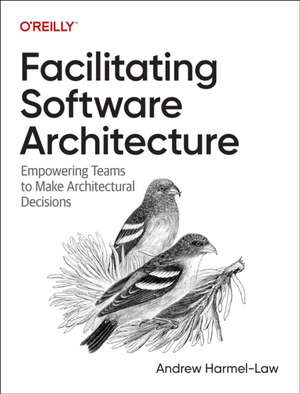
Facilitating Software Architecture
Autor Andrew Harmel-Lawen Limba Engleză Paperback – dec 2024
Adresăm acest volum arhitecților software, liderilor tehnici și managerilor de proiect care se confruntă cu realitatea sistemelor distribuite și a echipelor complexe. Observăm o schimbare de paradigmă în livrarea software-ului modern: rolul arhitectului nu mai poate fi unul centralizat, de control, fără a deveni un punct de blocaj. Andrew Harmel-Law, expert în cadrul Thoughtworks, propune în această lucrare publicată de O'Reilly o trecere radicală către facilitarea arhitecturii, unde responsabilitatea designului este partajată și integrată în fluxul zilnic de dezvoltare. Putem afirma că forța acestui text rezidă în abordarea pragmatică a interacțiunii dintre decizie, sfat și autonomie. Găsim în această carte nu doar concepte teoretice, ci instrumente concrete pentru a crea un sistem de constrângeri care să maximizeze beneficiile tehnice și să atenueze riscurile operaționale. Dacă Continuous Architecture in Practice v-a oferit cadrul teoretic necesar pentru adaptarea arhitecturii la DevOps și microservicii, Facilitating Software Architecture oferă instrumentele practice prin care puteți implementa o cultură de colaborare descentralizată. Autorul explorează modul în care arhitectura se împletește cu designul organizațional, oferind soluții pentru optimizarea feedback-ului și a fluxului rapid (fast flow). Este o resursă esențială pentru cei care doresc să construiască sisteme reziliente fără a sacrifica viteza de execuție a echipei.
Preț: 397.49 lei
Preț vechi: 432.06 lei
-8%
Carte disponibilă
Livrare economică 16-30 noiembrie
Livrare express 31 octombrie-06 noiembrie pentru 54.99 lei
Specificații
ISBN-10: 1098151860
Pagini: 400
Dimensiuni: 176 x 233 x 28 mm
Greutate: 0.87 kg
Editura: O'Reilly
V-ar putea interesa
-
 Designing Software ArchitecturesHumberto Cervantes-20%Preț: 313.58 lei391.97 lei
 -
 Clean ArchitectureRobert C. Martin-20%Preț: 231.92 lei289.90 lei
 -
 Preț: 291.45 lei
 -
 Software Architecture in PracticeLen Bass-20%Preț: 394.59 lei493.24 lei
 -
 Modern Software EngineeringDavid Farley-20%Preț: 224.19 lei280.23 lei
 -
 Khononov, V: Balancing Coupling in Software DesignVlad Khononov-20%Preț: 259.90 lei324.87 lei
 -
 -20%Preț: 258.34 lei322.93 lei
 -
 Effective Software ArchitectureOliver Goldman-20%Preț: 272.23 lei340.28 lei
 -
 Patterns of Enterprise Application ArchitectureMartin Fowler-20%Preț: 396.95 lei496.18 lei
 -
 Succeeding with AgileMike Cohn-20%Preț: 309.60 lei387.00 lei
 -
 -20%Preț: 280.89 lei351.10 lei
 -
 Code Complete: A practical handbook of software constructionSteve McConnell-20%Preț: 287.39 lei359.24 lei
 -
 Software ArchitectMichael BellPreț: 240.36 lei
 -
 Software Architecture FundamentalsMahbouba Gharbi-20%Preț: 245.98 lei307.47 lei
 -
 Microservice Patterns: With examples in JavaChris Richardson-20%Preț: 337.30 lei421.62 lei
 -
 Architecture ModernizationNick TunePreț: 339.57 lei
 -
 Collaborative Software DesignEvelyn Kelle-20%Preț: 291.77 lei364.71 lei
 -
 The Architect's EdgeGareth StapletonPreț: 145.50 lei
 -
 -20%Preț: 373.26 lei466.58 lei
 -
 Tech Leadership PlaybookAlexsandro Souza-20%Preț: 235.36 lei294.21 lei
De ce să citești această carte
Recomandăm această carte liderilor tehnici care doresc să depășească modelul arhitectului „turn de fildeș”. Cititorul va câștiga un set de tehnici de facilitare care permit echipelor să ia decizii arhitecturale corecte în mod autonom. Este un ghid indispensabil pentru a transforma arhitectura dintr-o barieră birocratică într-un parteneriat strategic ce susține livrarea continuă și inovația tehnică.
Descriere scurtă
The software architect role is evolving. As systems and distributed teams become more complex, it's often impossible for architects to be everywhere they need to be. To be effective, consultants and in-house architects alike have to move constantly from client to client or team to team to collaborate and work with code. And the situation is reaching a breaking point.
There's a better way. Andrew Harmel-Law, tech principal at Thoughtworks, shows you how architects and development teams can collaborate effectively and efficiently on the architectures of their systems. Techniques in this book help you ensure that everyone and everything is working toward the same goal. You'll learn how to create a collaborative, decentralized mindset that allows everyone to do architecture and build the best systems they've ever experienced.
With this book, you will:
- Understand the new dynamics that affect modern software delivery and how to take advantage of them to optimize for fast flow and continuous feedback
- Learn a methodology that brings software architecture and development together in partnership
- Nurture the fundamental interplay of decisions, advice, autonomy, and architecture
- Initiate practices and constraints that maximize benefits and mitigate risks
- Create an approach tuned to your skill sets, architecture, and your organization's engineering culture
- Identify and work to prevent failure modes when they threaten to arise
Contributor Bio:Harmel-Law, Andrew
Andrew Harmel-Law is an enthusiastic tech principal at Thoughtworks, where he specializes in domain-driven design, Java/JVM technologies, Agile delivery, build tools and automation, and organization design. Andrew's experience spans the software development lifecycle across many sectors, including government, banking, and ecommerce. What motivates him is the efficient delivery of large-scale software solutions to fulfill complex user needs, and he understands that people, architecture, process, and tooling all have key roles to play in achieving this. Andrew has a passion for open source software and its communities. He's been involved with OSS to a greater or lesser extent since his career began, as a user, contributor, expert group member, and paid advocate--most famously as one of the Jenkins Job DSL originators. Andrew enjoys sharing his experience as much as possible, in formal consulting engagements but also informally through mentoring, writing blog posts, speaking at and organizing conferences, and open-sourcing his code.