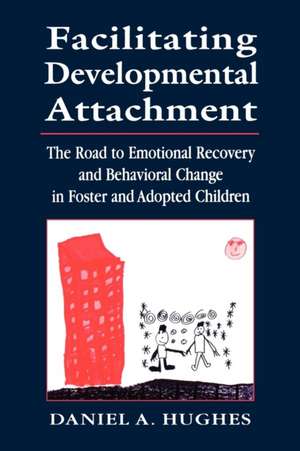
Facilitating Developmental Attachment: The Road to Emotional Recovery and Behavioral Change in Foster and Adopted Children
Autor Daniel A. Hughesen Limba Engleză Paperback – iun 2000
Destinată nivelului de licență și master în psihologie sau asistență socială, precum și ca referință profesională pentru terapeuți, această lucrare abordează dificultățile emoționale ale copiilor din sistemul de protecție socială. Remarcăm o schimbare de paradigmă față de intervențiile tradiționale: Daniel A. Hughes demonstrează că schimbarea comportamentală sustenabilă este imposibilă fără reconstrucția legăturilor de atașament deficitare. Descoperim aici un plan de tratament riguros, în care părintele nu este doar un observator, ci devine un participant activ în terapia copilului.
Structura volumului este una progresivă, debutând cu fundamentele teoretice ale atașamentului sănătos (capitolele 2-5) și avansând rapid către simptomatologia atașamentului slab și a traumei (capitolele 6-8). Considerăm că forța acestui text rezidă în secțiunile dedicate psihoterapiei integrative, unde Hughes detaliază principii precum acordajul emoțional și empatia directivă. Cartea completează perspectiva oferită de Nurturing Attachments de Kim S. Golding; în timp ce Golding se concentrează pe un model de parenting pas cu pas ilustrat prin studii de caz fictive, Hughes oferă o fundamentare clinică mai densă asupra modului în care terapeutul trebuie să ghideze interacțiunea dintre părinte și copil.
În contextul operei sale, Facilitating Developmental Attachment reprezintă piatra de temelie pentru lucrările ulterioare, precum Attachment-Focused Parenting sau Healing Relational Trauma with Attachment-Focused Interventions. Dacă lucrările mai recente rafinează metodologia DDP (Dyadic Developmental Psychotherapy), acest volum stabilește cadrul conceptual esențial pentru înțelegerea modului în care disciplina poate fi reîncadrată ca instrument de învățare a încrederii, nu ca abuz. Este un ghid tehnic despre cum se poate facilita acea legătură crucială care permite vindecarea și creșterea psihologică.
Preț: 369.22 lei
Preț vechi: 553.07 lei
-33%
Carte tipărită la comandă
Livrare economică 27 noiembrie-11 decembrie
Specificații
ISBN-10: 0765702703
Pagini: 264
Ilustrații: illustrations
Dimensiuni: 156 x 234 x 16 mm
Greutate: 0.4 kg
Editura: Bloomsbury Publishing
Colecția Jason Aronson Inc
Locul publicării:New York, United States
V-ar putea interesa
-
 The Highly Sensitive ChildElaine N. AronPreț: 108.84 lei
 -
 Autism Spectrum DisordersChantal Sicile-KiraPreț: 116.24 lei
 -
 The End of AverageTodd Rose-45%Preț: 49.84 lei91.04 lei
 -
 -33%Preț: 706.30 lei1051.45 lei
 -
 The Dyslexia Empowerment PlanBen FossPreț: 110.19 lei
 -
 Spirit GamesBarbara SherPreț: 91.65 lei
 -
 Preț: 114.64 lei
 -
 Preț: 111.90 lei
 -
 Exploring Developmental PsychologyMargaret Harris-15%Preț: 449.31 lei528.59 lei
 -
 Theories of Developmental PsychologyPatricia H. Miller-41%Preț: 518.94 lei879.74 lei
 -
 Childhood Disrupted: How Your Biography Becomes Your Biology, and How You Can HealDonna Jackson Nakazawa-18%Preț: 65.48 lei79.80 lei
 -
 Raising Confident Girls: 100 Tips For Parents And TeachersElizabeth Hartley-BrewerPreț: 112.37 lei
 -
 -19%Preț: 134.49 lei166.60 lei
De ce să citești această carte
Recomandăm această carte profesioniștilor care lucrează în adopție și plasament, dar și părinților adoptivi care caută soluții dincolo de metodele clasice de disciplină. Cititorul câștigă o înțelegere profundă a modului în care trauma relațională afectează biologia și emoțiile copilului, primind instrumente concrete pentru a transforma conflictele zilnice în oportunități de conectare și siguranță emoțională.
Despre autor
Daniel A. Hughes, PhD, este un specialist de renume în domeniul atașamentului și psihoterapeut cu vastă experiență clinică. Este fondatorul Terapiei Diadice de Dezvoltare (DDP) și președintele institutului dedicat acestei metode. Cu un doctorat în psihologie clinică la Ohio University, Hughes a coordonat timp de peste un deceniu serviciile pentru copii la Kennebec Valley Mental Health Center. Expertiza sa este recunoscută internațional, fiind autorul unor lucrări fundamentale care integrează neuroștiința și teoria atașamentului în practica terapeutică și în parentingul specializat pentru copiii traumatizați.
Descriere
Cuprins
Chapter 2 Attachment: Theory and Research Healthy Attachment
Chapter 3 Attachment as Dancing
Chapter 4 Developmental Attachment Patterns
Chapter 5 Attachment into Adulthood
Chapter 6 Weak Attachment
Chapter 7 Trauma & Neglect and Weak Attachment
Chapter 8 Specific Symptoms of a Weak Attachment
Chapter 9 Children, Therapists, and Parents
Chapter 10 Children
Chapter 11 Therapists
Chapter 12 Parents
Chapter 13 Integrative Psychotherapy for Developmental Attachment in Children
Chapter 14 Principles
Chapter 15 Directive and Empathic
Chapter 16 Relationship-Centered
Chapter 17 Emotional Richness
Chapter 18 Focused on Attachment Sequences
Chapter 19 Goals of Differentiation and Integration
Chapter 20 Past, Present, and Future
Chapter 21 Cognition, Affect, and Behavior
Chapter 22 Self?Other Duality
Chapter 23 Problems and Skills
Chapter 24 Parental Participation
Chapter 25 Reasons
Chapter 26 Emotional Attunement
Chapter 27 Emotional Support and Empathy
Chapter 28 Differentiation
Chapter 29 Increased Similarity between Therapy and Home
Chapter 30 Expert Knowledge
Chapter 31 Parental Authority
Chapter 32 Safety
Chapter 33 Specifics
Chapter 34 Emotional Attunement
Chapter 35 Directives
Chapter 36 Differentiation
Chapter 37 Parental Authority and Knowledge
Chapter 38 Homework
Chapter 39 Regression
Chapter 40 Therapeutic Interventions
Chapter 41 Engagement and Leading
Chapter 42 Contract
Chapter 43 Holding
Chapter 44 Attachment Sequences
Chapter 45 Confrontations
Chapter 46 Information and Education
Chapter 47 Verbal Directives
Chapter 48 Psychodrama
Chapter 49 Paradoxical Interventions
Chapter 50 Illustrated Stories
Chapter 51 Additional Props: Children's Books-Photographs, Stuffed Animals, Music, Miscellaneous
Chapter 52 Matthew
Chapter 53 Melinda
Chapter 54 Bill
Chapter 55 Jenny
Chapter 56 Principles of Parenting
Chapter 57 Family Atmosphere and Interactions
Chapter 58 Attunement and Empathy
Chapter 59 Choices and Consequences
Chapter 60 Attachment Sequences
Chapter 61 Behavior, Emotion, and Thought
Chapter 62 Reciprocal Enjoyment
Chapter 63 Regression
Chapter 64 Parental Self-Care
Chapter 65 Day-To-Day Parenting
Chapter 66 Moving In
Chapter 67 Day-To-Day Discipline
Chapter 68 Understanding the Child's Reinforcers
Chapter 69 Privileges and Practice
Chapter 70 Paradoxical Interventions
Chapter 71 Reframing
Chapter 72 Differentiating Thoughts and Feelings from Behavior Regression
Chapter 73 More Imaginative Parenting and Problem Solving
Chapter 74 Good Times: Fun and Love Facilitating Fun and Love
Chapter 75 Some Fun and Love Activities
Chapter 76 Conclusions
Recenzii
Dr. Hughes's deeply insightful book provides professionals as well as parents with a comprehensive understanding of the issues and of the types of interventions that succeed in resolving them. The scope of this brilliant work extends beyond the disturbances of foster and adoptive children. If all children were treated in the way Dr. Hughes describes, with his compassion, humanity, humor, and depth of understanding, there would be better outcomes. Even for therapists who do not practice in this manner, their grasp of a child's development and their approach to their young patients will be greatly enhanced by Dr. Hughes' theoretical framework of attunement and engagement...