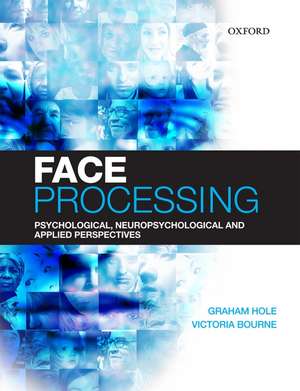
Face Processing: Psychological, Neuropsychological, and Applied Perspectives
Autor Graham Hole, Victoria Bourneen Limba Engleză Paperback – 17 iun 2010
Preț: 466.02 lei
Preț vechi: 587.72 lei
-21%
Puncte Express: 699
Carte disponibilă
Livrare economică 06-11 noiembrie
Livrare prin curier în România Termenul estimat este afișat lângă disponibilitate.
Transport gratuit pentru acest produs Plată online sau ramburs, în funcție de opțiunile comenzii.
Retur gratuit în 14 zile Comandă securizată și suport în română.
Specificații
ISBN-13: 9780199235704
ISBN-10: 0199235708
Pagini: 432
Ilustrații: 8 page 4-colour plate section | 165 black and white illustrations
Dimensiuni: 189 x 247 x 30 mm
Greutate: 0.83 kg
Ediția:1
Editura: Oxford University Press
Colecția OUP Oxford
Locul publicării:Oxford, United Kingdom
ISBN-10: 0199235708
Pagini: 432
Ilustrații: 8 page 4-colour plate section | 165 black and white illustrations
Dimensiuni: 189 x 247 x 30 mm
Greutate: 0.83 kg
Ediția:1
Editura: Oxford University Press
Colecția OUP Oxford
Locul publicării:Oxford, United Kingdom
V-ar putea interesa
-
 -31%Preț: 1125.62 lei1622.04 lei
 -
 -34%Preț: 653.53 lei984.09 lei
 -
 -28%Preț: 477.92 lei668.26 lei
 -
 -30%Preț: 501.08 lei719.35 lei
 -
 Zombies and ConsciousnessRobert Kirk-21%Preț: 385.58 lei490.14 lei
 -
 -28%Preț: 440.28 lei614.23 lei
 -
 Representing Direction in Language and SpaceEmile van der Zee-15%Preț: 162.88 lei191.53 lei
 -
 Understanding Vision: Theory, Models, and DataLi Zhaoping-32%Preț: 686.24 lei1004.81 lei
 -
 Basic Vision: An Introduction to Visual PerceptionRobert Snowden-20%Preț: 434.82 lei546.48 lei
 -
 -31%Preț: 797.12 lei1151.25 lei
 -
 Perception: Essays After FregeCharles Travis-31%Preț: 746.60 lei1079.91 lei
 -
 The Mind's EyeOliver Sacks-43%Preț: 50.52 lei89.11 lei
 -
 Attention, Perception and Memory: An Integrated IntroductionElizabeth StylesPreț: 422.78 lei
 -
 Living Sensationally: Understanding Your SensesWinnie DunnPreț: 146.46 lei
Recenzii
I don't believe there is a text that is comparable.
This book provides the most comprehensive and clearly written coverage of face perception that I have read to date.
Contains one of the most complete and understandable chapters on eye witness that I am aware of.
This book provides the most comprehensive and clearly written coverage of face perception that I have read to date.
Contains one of the most complete and understandable chapters on eye witness that I am aware of.
Notă biografică
Graham Hole is a senior lecturer at the University of Sussex. He has been researching face processing since 1994, and is the author or co-author of numerous journal articles on the topic. Most of his work has centred around investigating the nature of the 'configural' processing that we routinely use in order to recognize faces. Other interests include the development of face processing in children; the neuropsychology of face recognition; and how we estimate a person's age on the basis of their face. Victoria Bourne has been a lecturer at the University of Dundee since 2005. Her research interests centre around the development and determinants of cerebral hemispheric differences in cognitive processing, with particular expertise in the neural lateralisation of face recognition and the perception of emotional expression. Recently she was the guest editor of a special issue of the journal Laterality, on changes in emotional lateralisation throughout childhood.