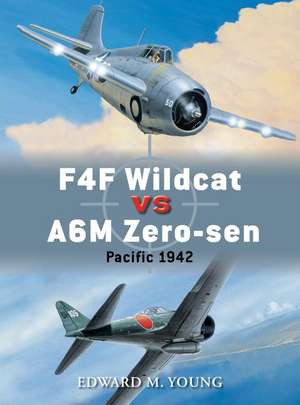
F4F Wildcat vs A6M Zero-sen: Pacific Theater 1942: Duel
Autor Edward M. Young Ilustrat de Jim Laurier, Gareth Hectoren Limba Engleză Paperback – 20 aug 2013
From Coral Sea to Midway to Guadalcanal and Santa Cruz, these fighters battled for air supremacy over the Pacific in World War II.
The Grumman F4F Wildcat and the Mitsubishi A6M Zero-sen were contemporaries, although designed to very different requirements. Ruggedly built so as to survive the rigors of carrier operations, the Wildcat was the best carrier fighter the US Navy had available when the USA entered World War II, and it remained the principal fighter for the US Navy and the US Marine Corps until the more capable F6F Hellcat and F4U Corsair entered service in 1942-43. Designed to meet a seemingly impossible requirement from the Imperial Japanese Navy (IJN) for an aeroplane with a speed greater than 300mph, exceptional maneuverability, long range, and an impressive armament - for the time - of two 7.7mm machine guns and two 20mm cannon, the Zero-sen could out-perform any Allied fighter in 1941-42.
In one-on-one combat the Zero-sen was clearly superior to the rugged Grumman F4F Wildcat in speed, climb, maneuverability, and service ceiling. The Wildcat, in turn, had better firepower and structural strength but was some 2,600lb heavier than its Japanese opponent, with only 250 additional horsepower; even so, the Wildcat pilots had no alternative but to take on their more capable Japanese opponents until superior American aircraft could be put into production. The battles between the Wildcat and the Zero-sen during 1942 represent a classic duel in which pilots flying a nominally inferior fighter successfully developed air combat tactics that negated the strengths of their opponent.
Din seria Duel
- 26%
 Preț: 73.91 lei
 - 27%
 Preț: 78.92 lei
 - 27%
 Preț: 78.88 lei
 - 28%
 Preț: 80.67 lei
 - 26%
 Preț: 74.35 lei
 - 27%
 Preț: 81.75 lei
 - 27%
 Preț: 78.81 lei
 - 27%
 Preț: 78.81 lei
 - 26%
 Preț: 73.91 lei
 - 36%
 Preț: 72.21 lei
 - 27%
 Preț: 78.70 lei
 - 40%
 Preț: 72.18 lei
 - 35%
 Preț: 74.81 lei
 - 24%
 Preț: 82.63 lei
 - 27%
 Preț: 81.72 lei
 - 27%
 Preț: 81.72 lei
 - 27%
 Preț: 81.92 lei
 - 27%
 Preț: 76.96 lei
 - 28%
 Preț: 80.63 lei
 - 27%
 Preț: 78.80 lei
 - 26%
 Preț: 73.91 lei
 - 27%
 Preț: 72.18 lei
 - 26%
 Preț: 74.04 lei
 - 40%
 Preț: 72.31 lei
 - 26%
 Preț: 74.05 lei
 - 27%
 Preț: 83.68 lei
 - 26%
 Preț: 73.91 lei
 - 27%
 Preț: 81.68 lei
 - 27%
 Preț: 81.75 lei
 - 27%
 Preț: 84.12 lei
 - 26%
 Preț: 73.94 lei
 - 27%
 Preț: 81.82 lei
 - 32%
 Preț: 78.20 lei
 - 27%
 Preț: 81.59 lei
 - 27%
 Preț: 81.88 lei
 - 27%
 Preț: 81.68 lei
 - 27%
 Preț: 78.98 lei
 - 27%
 Preț: 81.92 lei
 - 26%
 Preț: 74.57 lei
 - 27%
 Preț: 78.94 lei
 - 26%
 Preț: 73.91 lei
 - 27%
 Preț: 83.68 lei
 - 35%
 Preț: 73.91 lei
 - 26%
 Preț: 74.00 lei
 - 41%
 Preț: 83.65 lei
 - 28%
 Preț: 81.72 lei
 - 27%
 Preț: 78.80 lei
 - 31%
 Preț: 79.88 lei
 - 26%
 Preț: 74.35 lei
 - 27%
 Preț: 83.73 lei
Preț: 82.53 lei
Preț vechi: 121.18 lei
-32%
Carte tipărită la comandă
Livrare economică 30 noiembrie-14 decembrie
Specificații
ISBN-10: 178096322X
Pagini: 80
Ilustrații: 40 b/w; 24 col
Dimensiuni: 184 x 248 x 10 mm
Greutate: 0.3 kg
Editura: Bloomsbury Publishing
Colecția Osprey Publishing
Seria Duel
Locul publicării:London, United Kingdom
V-ar putea interesa
-
 Lockheed A-12: The CIA’s Blackbird and other variantsPaul F. Crickmore-32%Preț: 77.77 lei114.73 lei
 -
 F4U Corsair vs Ki-84 "Frank": Pacific Theater 1945Edward M. Young-36%Preț: 78.08 lei122.19 lei
 -
 Curtiss P-40: Snub-nosed Kittyhawks and WarhawksCarl Molesworth-32%Preț: 77.93 lei114.73 lei
 -
 The Apache in European Service: Love Is Like a RoseDarren Willmin-14%Preț: 88.33 lei102.18 lei
 -
 F6F Hellcat Aces of VF-9Edward M. Young-31%Preț: 90.29 lei131.09 lei
 -
 F6F Hellcat vs A6M Zero-sen: Pacific Theater 1943–44Edward M. Young-31%Preț: 84.99 lei123.40 lei
 -
 Victor Units of the Cold WarAndrew Brookes-31%Preț: 90.29 lei131.09 lei
 -
 B-24 Liberator Units of the CBIEdward M. Young-32%Preț: 88.18 lei129.05 lei
 -
 He 111 Kampfgeschwader in the WestJohn Weal-32%Preț: 88.18 lei128.82 lei
 -
 P-47 Thunderbolt Units of the Twelfth Air ForceJonathan Bernstein-32%Preț: 88.18 lei128.82 lei
 -
 American Aces against the KamikazeEdward M. Young-31%Preț: 90.29 lei131.09 lei
Descriere
The Grumman F4F Wildcat and the Mitsubishi A6M Zero-sen were contemporaries, although designed to very different requirements. The Wildcat, ruggedly built to survive the rigors of carrier operations, was the best carrier fighter the US Navy had available when the USA entered World War II, and it remained the principal fighter for the US Navy and the US Marine Corps until 1942-43. With a speed greater than 300mph, exceptional manoeuvrability, long range, and an impressive armament the slick Zero-sen could out-perform any Allied fighter in 1941-42.
This fully illustrated account of the battles between the Wildcat and the Zero-sen during 1942 represent a classic duel in which pilots flying a nominally inferior fighter successfully developed air-combat tactics that negated the strengths of their opponent.
Cuprins
Chronology
Design and Development
Technical Specifications
The Strategic Situation
The Combatants
Combat
Statistics and Analysis
Aftermath
Bibliography
Index