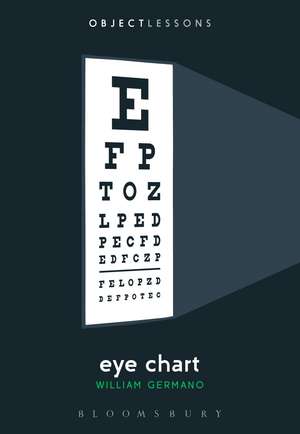
Eye Chart
Autor William Germano Editat de Ian Bogost, Christopher Schabergen Limba Engleză Paperback – 7 sep 2017
Evoluția studiilor culturale contemporane a demonstrat că obiectele banale care ne populează viața cotidiană ascund istorii complexe ale cunoașterii umane. În acest context, apreciem modul în care Eye Chart transformă un instrument medical standardizat într-un subiect de analiză interdisciplinară. Spre deosebire de lectura literară tradițională, care caută înțelesuri profunde, citirea unui tabel optometric este, după cum demonstrează autorul, un exercițiu de eșec: procesul devine relevant exact în momentul în care vederea ne trădează și nu mai putem descifra caracterele. Recomandăm această lucrare ca o alternativă la How to Use Your Eyes de James Elkins pentru cursurile de cultură vizuală, având avantajul unei focalizări stricte pe istoria designului informațional și a modului în care am învățat să ne măsurăm propriile limite senzoriale. Cartea este structurată cronologic și tematic în unsprezece capitole, pornind de la ghidurile renascentiste de testare a vederii (1623) și ajungând la subversiunile tabelului în publicitate și artă. William Germano aduce aici rigoarea editorială și analitică specifică lucrărilor sale anterioare, precum Getting It Published sau On Revision, dar aplică aceste instrumente asupra unui „text” non-literar. Rezultatul este o explorare a modului în care cele unsprezece linii de litere au devenit o icoană a modernității, situată la granița dintre obiectivitatea științifică și subiectivitatea percepută.
Preț: 51.32 lei
Preț vechi: 75.71 lei
-32%
Carte disponibilă
Livrare economică 12-26 noiembrie
Specificații
ISBN-10: 1501312340
Pagini: 192
Ilustrații: 38 b/w illustrations
Dimensiuni: 118 x 164 x 16 mm
Greutate: 0.18 kg
Editura: BLOOMSBURY ACADEMIC
Locul publicării:New York, United States
V-ar putea interesa
-
 Linguistic CriticismRoger Fowler-29%Preț: 363.79 lei509.07 lei
 -
 George Steiner: A ReaderGeorge Steiner-15%Preț: 191.21 lei225.65 lei
 -
 -28%Preț: 354.50 lei492.76 lei
 -
 -28%Preț: 355.22 lei493.17 lei
 -
 The Holocaust and the PostmodernRobert Eaglestone-19%Preț: 375.82 lei464.71 lei
 -
 -28%Preț: 509.37 lei702.99 lei
 -
 The Things We MeanStephen Schiffer-28%Preț: 369.05 lei510.41 lei
 -
 Literary Theory and Criticism: An Oxford GuidePatricia Waugh-9%Preț: 384.36 lei423.31 lei
 -
 Against Interpretation: And Other EssaysSusan SontagPreț: 104.42 lei
 -
 The Material Image: Art and the Real in FilmBrigitte PeuckerPreț: 202.59 lei
 -
 BookshelfLydia Pyne-31%Preț: 52.76 lei76.86 lei
 -
 Cigarette LighterJack Pendarvis-33%Preț: 50.64 lei75.31 lei
 -
 HoodAlison Kinney-32%Preț: 51.00 lei75.39 lei
 -
 Horror Plum'dMichael R CollingsPreț: 267.87 lei
De ce să citești această carte
Recomandăm această carte cititorilor pasionați de istoria ideilor și de designul grafic. Veți descoperi cum un simplu tabel cu litere a devenit un simbol cultural și un instrument de putere medicală. Este o lectură esențială pentru a înțelege cum s-a schimbat percepția noastră vizuală de la Renaștere până în prezent, oferind o perspectivă inedită asupra unui obiect pe care toți l-am privit, dar puțini l-am „citit” cu adevărat.
Despre autor
William Germano este decan al Facultății de Științe Umaniste și Sociale și profesor de literatură engleză la Cooper Union din New York. Cu o carieră de peste trei decenii în industria editorială academică, a servit ca editor-șef la Columbia University Press și director editorial la Routledge. Experiența sa vastă în modelarea textelor științifice se reflectă în abordarea sa asupra culturii materiale. Germano este recunoscut pentru ghidurile sale fundamentale dedicate scrierii academice și procesului de publicare, aducând în lucrarea de față o sensibilitate literară aplicată istoriei tehnologiei vizuale.
Descriere
Desert nomads tested their vision by distinguishing a pair of stars. But we have since created more disquieting ways to test the strength of the eyes.
Reading the eye chart is an exercise in failure, since it only gets interesting when you cannot read any further. It is the opposite of interpretative reading, like one does with literature. When you have finished reading an eye chart, what exactly have you even read? From a Spanish cleric's Renaissance guide to testing vision, to a Dutch ophthalmologist's innovation in optical tech, to the witty subversion of the eye chart in advertising and popular culture, William Germano's Eye Chart lets people see the eye chart at last.
Object Lessons is published in partnership with an essay series in The Atlantic.
Cuprins
Acknowledgments
1. What can you see?
2. Reading stars, reading stones
3. How to choose eyeglasses (circa 1623)
4. The persistence of memory
5. Eleven lines, nine letters
6. Reading close up
7. Looking for trouble
8. Eye terror
9. Eye poetry
10. Optical allusions
11. The bottom line
Notes
Index
Recenzii
I can see people in the ocular industry finding much that's new on these pages, and as for the average reader ... they have a veritable bijou box of delights ... It's a great little read about something you wouldn't expect to find fun in the exploration of.
William Germano's Eye Chart is a surprisingly compelling and at times quite poetic examination of this now ubiquitous technological innovation . Germano begins his exploration of the eye chart with a simple question: "What can you see?" Soon, though, the reader understands that things are more complex than simply providing a concrete response to a clear question. It's not just about identifying objects near and far. It's also about why we see, when we see, how clearly we see, and what we understand about the things we see . If this medical innovation has ever been intimidating, or a measure of increasing failure as you slip into your final years, Germano's Eye Chart should be a graceful reminder that the art of vision has many levels.
As one who has failed countless eye tests, I had no idea that my condition was metaphysical. Then I read William Germano's comprehensive and witty history of this amazing object. There it is, at the crossroads of vision and blindness, clarity and obscurity, scientific objectivity and subjectivity. Germano shows that the humble eye chart is everywhere, a central object, image, and text in the world of visual culture. His book is a feast of learning, precision, and humor.