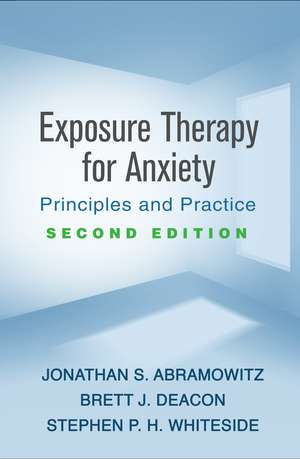
Exposure Therapy for Anxiety, Second Edition: Principles and Practice
Autor Jonathan S. Abramowitz, Brett J. Deacon, Stephen P. H. Whitesideen Limba Engleză Paperback – 14 aug 2019
Sursa datelor pentru această lucrare fundamentală rezidă în studii clinice recente și meta-analize care validează eficacitatea terapiei prin expunere ca pilon al tratamentelor bazate pe dovezi. Remarcăm faptul că Exposure Therapy for Anxiety, Second Edition nu este doar o actualizare a ediției anterioare, ci o redefinire a practicii clinice, integrând pentru prima dată mecanismele învățării inhibitorii. Această abordare pune accentul pe tolerarea incertitudinii și a anxietății pentru a maximiza rezultatele pe termen lung, depășind modelul clasic al obișnuinței.
Structura volumului este riguros organizată în trei secțiuni. Prima parte stabilește fundamentul teoretic și planificarea tratamentului prin evaluare funcțională. Secțiunea a doua oferă protocoale clinice specifice pentru o gamă largă de fobii, de la cele de mediu și animale, până la contaminare și gânduri intruzive nedorite. Ultima parte abordează complexitatea cazurilor clinice, incluzând lucrul cu copiii și integrarea medicației. Ca alternativă la Handbook of Exposure Therapies de David C.S. Richard, acest volum se distinge prin focalizarea pe tehnologiile emergente, precum instrumentele de realitate virtuală, și prin capitolele dedicate tehnicilor ACT.
Credem că experiența de lectură este facilitată de echilibrul dintre rigoarea științifică și utilitatea practică. Autorii, conduși de Jonathan S. Abramowitz, transpun cercetarea de ultimă oră în exerciții concrete și fișe de lucru reproductibile, esențiale pentru personalizarea intervențiilor în funcție de nevoile specifice ale fiecărui pacient.
Preț: 396.01 lei
Preț vechi: 416.86 lei
-5%
Carte disponibilă
Livrare economică 11-25 mai
Livrare express 25 aprilie-01 mai pentru 45.40 lei
Specificații
ISBN-10: 1462539521
Pagini: 459
Dimensiuni: 152 x 229 x 27 mm
Greutate: 0.66 kg
Ediția:2nd edition
Editura: Guilford Publications
Colecția Guilford Press
V-ar putea interesa
-
 -22%Preț: 355.79 lei455.42 lei
 -
 Exposure Therapy for Child and Adolescent Anxiety and OCDStephen P. Whiteside-15%Preț: 349.23 lei412.49 lei
 -
 Mastery of Your Anxiety and Panic: WorkbookDavid H. Barlow-23%Preț: 270.86 lei350.85 lei
 -
 -29%Preț: 76.61 lei107.95 lei
 -
 -5%Preț: 505.88 lei532.51 lei
 -
 -5%Preț: 245.94 lei258.89 lei
 -
 Exposure Therapy with Children and AdolescentsMichael A. Southam-Gerow-5%Preț: 252.84 lei266.14 lei
 -
 Cognitive Behavior Therapy, Third Edition: Basics and BeyondJudith S. Beck-5%Preț: 463.75 lei488.16 lei
 -
 -28%Preț: 39.31 lei54.56 lei
 -
 -28%Preț: 48.83 lei68.03 lei
 -
 An Introduction to Cognitive Behaviour TherapyHelen Kennerley-5%Preț: 350.42 lei368.86 lei
 -
 -5%Preț: 289.08 lei304.30 lei
 -
 -5%Preț: 614.06 lei646.39 lei
 -
 Cognitive Therapy of Anxiety Disorders: Science and PracticeDavid A. Clark-5%Preț: 505.64 lei532.25 lei
 -
 -29%Preț: 276.38 lei388.13 lei
 -
 -26%Preț: 112.96 lei151.88 lei
 -
 The Anxiety and Phobia Workbook (8th Edition)Edmund J. Bourne-22%Preț: 118.54 lei151.45 lei
 -
 -5%Preț: 256.40 lei269.90 lei
 -
 The Anxiety and Phobia WorkbookEdmund J. Bourne-23%Preț: 121.07 lei156.74 lei
 -
 The Unwinding Anxiety WorkbookJudson BrewerPreț: 101.98 lei
Public țintă
Professional Practice & DevelopmentDe ce să citești această carte
Această ediție reprezintă standardul de aur pentru clinicienii care doresc să stăpânească terapia prin expunere. Cititorul câștigă competențe practice în aplicarea învățării inhibitorii și a tehnicilor de acceptare, elemente esențiale pentru tratarea cazurilor complexe de anxietate. Este o investiție necesară pentru psihologii clinicieni și rezidenții în psihiatrie care urmăresc să implementeze intervenții validate științific, susținute de materiale de lucru gata de utilizat în cabinet.
Despre autor
Jonathan S. Abramowitz, PhD, este o autoritate recunoscută la nivel internațional în domeniul tulburării obsesiv-compulsive (TOC) și al anxietății. Profesor și director al Clinicii de Anxietate și Stress din cadrul Universității North Carolina la Chapel Hill, acesta a publicat peste 10 cărți și 100 de articole de specialitate. Opera sa, care include titluri precum The Family Guide to Getting Over OCD și Treatments for Psychological Problems and Syndromes, reflectă o preocupare constantă pentru transformarea protocoalelor clinice rigide în abordări flexibile și empatice, adaptate contextului familial și individual al pacientului.
Cuprins
1. Overview and History of Exposure Therapy for Anxiety
2. How Well Does Exposure Therapy Work?
3. The Nature and Treatment of Clinical Anxiety
4. Treatment Planning I: Functional Assessment
5. Treatment Planning II: Treatment Engagement and Exposure List Development
6. Implementing Exposure Therapy
II. Implementing Exposure Therapy for Specific Types of Fears
7. Animal-Related Fears
8. Environmental Fears
9. Social Situations
10. Unwanted Intrusive Thoughts
11. Bodily Cues and Health Concerns
12. Contamination
13. Trauma-Focused Fear
14. Blood-, Injection-, and Injury-Related Stimuli
15. Incompleteness, Asymmetry, and "Not-Just-Right" Feelings
III. Special Considerations in the Use of Exposure Techniques
16. Exposure Therapy with Complex Cases
17. Exposure Therapy with Children
18. Involving Significant Others in Treatment
19. Combining Exposure Therapy with Medication
20. Maintaining Improvement after Treatment
21. Using Technology to Implement Exposure Therapy
22. Using Acceptance and Commitment Therapy with Exposure
23. A Risk–Benefit Analysis of Exposure Therapy
Notă biografică
Brett J. Deacon, PhD, is a clinical psychologist in private practice in Wollongong, Australia, and Conjoint Associate Professor at the University of New South Wales. He has published approximately 100 research articles and book chapters, served as Editor of The Behavior Therapistand Associate Editor of the Journal of Cognitive Psychotherapy, and is an editorial board member of numerous scientific journals. Dr. Deacon’s research examines the dissemination, optimal delivery, and acceptability of exposure therapy for anxiety. He is the recipient of numerous teaching, research, and student mentorship awards from the University of Wyoming, as well as the Golden Anniversary Alumni Award from Northern Illinois University College of Liberal Arts and Sciences. Dr. Deacon presents workshops around the world on exposure therapy.
Stephen P. H. Whiteside, PhD, ABPP, is Professor of Psychology and Director of the Pediatric Anxiety Disorders Program at the Mayo Clinic in Rochester, Minnesota. His research focuses on improving access to evidence-based care for pediatric anxiety disorders and obsessive–compulsive disorder through the development of effective and efficient treatments facilitated by technology. Dr. Whiteside serves on the editorial board of the Journal of Anxiety Disorders and on the Education and Training Committee of the Minnesota Psychological Association. He has published over 60 scientific articles and is the codeveloper of the Mayo Clinic Anxiety Coach, a smartphone app that aids in the delivery of exposure.
Recenzii
"This second edition remains the definitive book on exposure therapy for anxiety-related problems. It is comprehensive, clearly written, practical, and fully updated to reflect contemporary research and theory on exposure-based treatments. This book is an invaluable resource for novice and expert therapists alike, and it should be required reading for any student training in cognitive-behavioral therapy."--Martin M. Antony, PhD, ABPP, Department of Psychology, Toronto Metropolitan University, Canada
"The authors do an excellent job of dispelling therapists' common fears about implementing exposure therapy. They review the evidence base for the approach and separate facts from myths. Clinicians treating trauma may have concerns about retraumatizing patients; instead of dismissing these concerns, the authors validate them and provide solutions. I recommend this book as a 'must read' for clinicians at all levels of practice."--Johanna Kaplan, PhD, Director, Washington Anxiety Center of Capitol Hill, Washington, DC
“The authors do a splendid job of presenting the core clinical features that cut across all anxiety and trauma-related disorders. In so doing, they provide the reader a helpful heuristic for assisting in case formulation and treatment planning. Coverage of safety behaviors and their role in maintaining and exacerbating anxiety is particularly important, given that many clinicians still instruct anxiety patients to utilize safety behaviors to cope with their anxiety. I will assign this book as a required reading for my practicum course in evidence-based treatments."--Michael J. Telch, PhD, Professor of Psychology and Founding Director, Laboratory for the Study of Anxiety Disorders, The University of Texas at Austin
"Exposure has served as the treatment of choice for anxiety disorders for decades, despite many new therapies trying to take its mantle. Yet too many clinical practitioners either avoid using exposure or implement it suboptimally. Already the go-to resource on exposure therapy, this second edition elegantly balances the latest science and art of delivering this most effective therapy in the most effective manner."--Peter J. Norton, PhD, Cairnmillar Institute, Melbourne, Australia
"I have been training clinical psychology doctoral students in exposure-based CBT for all forms of anxiety for more than two decades, and have found this book to be invaluable in my advanced elective course on the topic. The authors are among the best in the field. The book has excellent coverage of the theory and science behind exposure, which is critical for my doctoral students to understand in order to implement the interventions successfully. There is also attention given to important 'in the trenches' issues for future clinicians. This is an outstanding graduate-level book."--Lisa Lilenfeld, PhD, Clinical Psychology Program, The Chicago School of Professional Psychology, Washington, DC
Descriere scurtă
New to This Edition
*Chapter on acceptance and commitment therapy (ACT) techniques.
*Reflects a shift in the field toward inhibitory learning--helping clients learn to tolerate anxiety and uncertainty to maximize long-term outcomes.
*Chapter on uses of technology, such as computer-based therapy and virtual reality tools.
*Conceptual, empirical, and clinical advances woven throughout.
See also the related client recommendation, The Anxiety and Worry Workbook, Second Edition, by David A. Clark and Aaron T. Beck.