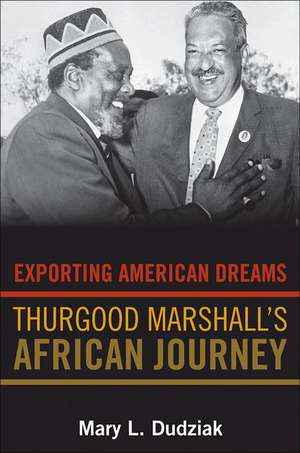
Exporting American Dreams
Autor Mary L Dudziaken Limba Engleză Paperback – 28 aug 2011
negotiations, as adversaries battled over rights and land--not with weapons, but with legal arguments. Set in the context of Marshall's civil rights work in the United States, this transnational history sheds light on legal reform and social change in the midst of violent upheavals in Africa and
America. While the struggle for rights on both continents played out on a global stage, it was a deeply personal journey for Marshall. Even as his belief in the equalizing power of law was challenged during his career as a Supreme Court justice, and in Kenya the new government sacrificed the rights
he cherished, Kenya's founding moment remained for him a time and place when all things had seemed possible.
Preț: 180.38 lei
Preț vechi: 210.21 lei
-14%
Puncte Express: 271
Carte indisponibilă temporar
Doresc să fiu notificat când acest titlu va fi disponibil:
Se trimite...
Specificații
ISBN-13: 9780691152448
ISBN-10: 0691152446
Pagini: 288
Ilustrații: 20 halftones.
Dimensiuni: 155 x 231 x 20 mm
Greutate: 0.41 kg
Ediția:Revizuită
Editura: Princeton University Press
Locul publicării:Princeton, United States
ISBN-10: 0691152446
Pagini: 288
Ilustrații: 20 halftones.
Dimensiuni: 155 x 231 x 20 mm
Greutate: 0.41 kg
Ediția:Revizuită
Editura: Princeton University Press
Locul publicării:Princeton, United States
V-ar putea interesa
-
 Imprisoned by the Past: Warren McCleskey, Race, and the American Death PenaltyJeffrey L. KirchmeierPreț: 307.98 lei
 -
 Unequal Justice: Lawyers and Social Change in Modern AmericaJerold S. Auerbach-12%Preț: 305.32 lei348.28 lei
 -
 Justice without Law: Resolving Disputes without LawyersJerold S. Auerbach-13%Preț: 248.18 lei286.37 lei
 -
 -31%Preț: 852.32 lei1239.07 lei
 -
 Anne Orthwood's Bastard: Sex and Law in Early VirginiaJohn Ruston PaganPreț: 278.27 lei
 -
 The Evolution of Resource Property RightsAnthony Scott-31%Preț: 829.47 lei1198.09 lei
 -
 -31%Preț: 742.71 lei1077.54 lei
 -
 Wisconsin and the Shaping of American LawJoseph A. RanneyPreț: 325.34 lei
 -
 European Legal History: Sources and InstitutionsO. F. Robinson-24%Preț: 578.80 lei761.99 lei
 -
 Owning IdeasOren BrachaPreț: 457.14 lei
 -
 Sovereignty, Property and Empire, 1500-2000Andrew FitzmauricePreț: 288.34 lei
 -
 Taming the PastRobert W. GordonPreț: 318.53 lei
 -
 The Art of Law in ShakespearePaul Raffield-34%Preț: 737.87 lei1113.69 lei
 -
 The Lawyers Who Made America: From Jamestown to the White HouseAnthony Arlidge-30%Preț: 375.62 lei533.98 lei
 -
 Granville Sharp's Cases on SlaveryDr Andrew Lyall-36%Preț: 559.44 lei870.31 lei
 -
 Fascism and Criminal Law: History, Theory, ContinuityDr Stephen Skinner-14%Preț: 234.90 lei273.26 lei
 -
 Preț: 316.22 lei
 -
 Judges, politics and the Irish ConstitutionLaura CahillanePreț: 268.56 lei
Descriere
Descriere de la o altă ediție sau format:
Thurgood Marshall became a living icon of civil rights when he argued Brown v. Board of Education before the Supreme Court in 1954. Six years later, he was at a crossroads. A rising generation of activists were making sit-ins and demonstrations rather than lawsuits the hallmark of the civil rights movement. What role, he wondered, could he now play? When in 1960 Kenyan independence leaders asked him to help write their constitution, Marshall threw himself into their cause. Here was a new arena in which law might serve as the tool with which to forge a just society. In Exporting American Dreams , Mary Dudziak recounts with poignancy and power the untold story of Marshall's journey to Africa. African Americans were enslaved when the U.S. constitution was written. In Kenya, Marshall could become something that had not existed in his own country: a black man helping to found a nation. He became friends with Kenyan leaders Tom Mboya and Jomo Kenyatta, serving as advisor to the Kenyans, who needed to demonstrate to Great Britain and to the world that they would treat minority races (whites and Asians) fairly once Africans took power. He crafted a bill of rights, aiding constitutional negotiations that helped enable peaceful regime change, rather than violent resistance. Marshall's involvement with Kenya's foundation affirmed his faith in law, while also forcing him to understand how the struggle for justice could be compromised by the imperatives of sovereignty. Marshall's beliefs were most sorely tested later in the decade when he became a Supreme Court Justice, even as American cities erupted in flames and civil rights progress stalled. Kenya's first attempt at democracy faltered, but Marshall's African journey remained a cherished memory of a time and a place when all things seemed possible.
Thurgood Marshall became a living icon of civil rights when he argued Brown v. Board of Education before the Supreme Court in 1954. Six years later, he was at a crossroads. A rising generation of activists were making sit-ins and demonstrations rather than lawsuits the hallmark of the civil rights movement. What role, he wondered, could he now play? When in 1960 Kenyan independence leaders asked him to help write their constitution, Marshall threw himself into their cause. Here was a new arena in which law might serve as the tool with which to forge a just society. In Exporting American Dreams , Mary Dudziak recounts with poignancy and power the untold story of Marshall's journey to Africa. African Americans were enslaved when the U.S. constitution was written. In Kenya, Marshall could become something that had not existed in his own country: a black man helping to found a nation. He became friends with Kenyan leaders Tom Mboya and Jomo Kenyatta, serving as advisor to the Kenyans, who needed to demonstrate to Great Britain and to the world that they would treat minority races (whites and Asians) fairly once Africans took power. He crafted a bill of rights, aiding constitutional negotiations that helped enable peaceful regime change, rather than violent resistance. Marshall's involvement with Kenya's foundation affirmed his faith in law, while also forcing him to understand how the struggle for justice could be compromised by the imperatives of sovereignty. Marshall's beliefs were most sorely tested later in the decade when he became a Supreme Court Justice, even as American cities erupted in flames and civil rights progress stalled. Kenya's first attempt at democracy faltered, but Marshall's African journey remained a cherished memory of a time and a place when all things seemed possible.
Notă biografică
Mary Dudziak is Professor of Law and History at the University of Southern California Law School. Her books include Cold War Civil Rights and September 11 in History. She is currently a Guggenheim Fellow and a Member of the Institute for Advanced Studies at Princeton.