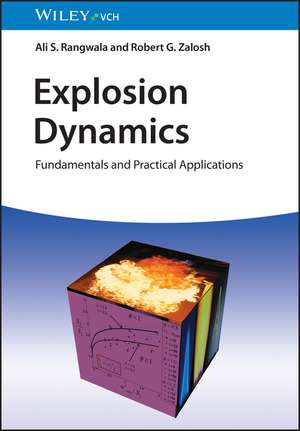
Explosion Dynamics
Autor Ali S. Rangwala, Robert G. Zaloshen Limba Engleză Hardback – 5 iul 2023
NIVEL DE STUDIU: Licență, Master și Referință profesională. Notăm cu interes apariția volumului Explosion Dynamics, o resursă pedagogică riguroasă publicată de Wiley-VCH GmbH care se distinge prin echilibrul dintre fundamentarea teoretică și aplicabilitatea industrială. Autorii, Ali S. Rangwala și Robert G. Zalosh, propun un cadru analitic esențial pentru înțelegerea fenomenelor fizice din spatele exploziilor, punând un accent deosebit pe variabilele critice: temperatura, presiunea și dinamica creșterii acesteia în timp. Subliniem structura logică a textului, care ghidează cititorul prin zece capitole progresive. Primele secțiuni fundamentează matematica sistemelor neliniare și cinetica chimică, în timp ce capitolele intermediare (3-7) analizează tranziția de la deflagrații la detonații și propagarea turbulentă a flăcărilor. Finalul volumului este dedicat ingineriei de siguranță, tratând ventilația și suprimarea exploziilor, completate de studii de caz reale care ancorează teoria în realitatea pericolelor industriale. Cele 82 de ilustrații și seturile de date despre proprietățile materialelor periculoase facilitează rezolvarea problemelor propuse pentru studiu individual. Explosion Dynamics reprezintă o alternativă la Modeling Explosions and Blast Waves pentru cursurile de siguranță chimică sau dinamica fluidelor, cu avantajul unei abordări integrate care include nu doar modelarea undei de șoc, ci și mecanismele de formare a amestecurilor inflamabile de pulberi și vapori în procesele industriale. Spre deosebire de The Detonation Phenomenon, care se concentrează pe aspecte calitative și teorii idealizate, acest volum furnizează un instrumentar matematic complet, necesar pentru proiectarea măsurilor de protecție viabile.
Preț: 580.02 lei
Preț vechi: 651.70 lei
-11%
Carte disponibilă
Livrare economică 07-21 noiembrie
Livrare express 27-31 octombrie pentru 46.40 lei
Specificații
ISBN-10: 3527349383
Pagini: 320
Ilustrații: 82 schwarz-weiße Abbildungen
Dimensiuni: 174 x 248 x 21 mm
Greutate: 0.77 kg
Ediția:1
Editura: Wiley-VCH GmbH
Locul publicării:Weinheim, Germany
V-ar putea interesa
-
 -23%Preț: 1529.01 lei1985.73 lei
 -
 -23%Preț: 1636.73 lei2125.62 lei
 -
 Environmental Risk LandscapeKapustka-9%Preț: 775.89 lei852.62 lei
 -
 Assay DevelopmentGe Wu-5%Preț: 1139.37 lei1199.33 lei
 -
 Physical Inorganic ChemistryAndreja Bakac-9%Preț: 1207.22 lei1326.62 lei
 -
 Supramolecular ChemistryKnut Rurack-9%Preț: 1163.11 lei1278.14 lei
 -
 -9%Preț: 1188.45 lei1305.99 lei
 -
 Radionuclides in eh EnvironmentDavid A Atwood-9%Preț: 1594.84 lei1752.57 lei
 -
 Preț: 186.65 lei
 -
 General ChemistryDonald a McQuarrie-8%Preț: 610.59 lei663.68 lei
 -
 Das Handelsprodukt Zyklon BHorst LeipprandPreț: 385.17 lei
 -
 -19%Preț: 480.00 lei592.60 lei
 -
 Céramiques innovantes pour SOFC fonctionnant à température réduiteAnnabelle Brisse-8%Preț: 406.67 lei442.04 lei
 -
 Etude cinétique sur catalyseurs de postcombustion automobilePascal GRANGER-19%Preț: 552.72 lei682.37 lei
De ce să citești această carte
Această carte este indispensabilă studenților de la inginerie chimică și profesioniștilor responsabili cu siguranța industrială. Cititorul câștigă o înțelegere profundă a modului în care se pot preveni incidentele catastrofale prin aplicarea corectă a dinamicii presiunii și cineticii chimice. Este un manual practic care transformă fenomene complexe în date cuantificabile pentru proiectarea sistemelor de ventilație și suprimare.
Despre autor
Ali S. Rangwala și Robert G. Zalosh sunt specialiști recunoscuți în domeniul dinamicii exploziilor și siguranței proceselor industriale. Expertiza lor combinată acoperă cercetarea academică avansată și consultanța tehnică în sectoarele chimic și alimentar. Ambii autori au contribuit semnificativ la dezvoltarea standardelor de protecție împotriva exploziilor de praf și gaze, aducând în acest volum o perspectivă care îmbină rigoarea matematică a ecuațiilor diferențiale cu necesitățile practice ale ingineriei de teren.
Notă biografică
Bob Zalosh has been a WPI Professor Emeritus of Fire Protection Engineering (FPE) since retiring from his position as FPE Professor in 2006. Professor Zalosh is a member of several National Fire Protection Association Technical Committees responsible for developing and revising consensus fire and explosion protection standards. He has authored several NFPA and Society of Fire Protection Engineering Handbook chapters and numerous journal articles. He serves on the U.S. Department of Energy Hydrogen Safety Panel and the Underwriters Laboratories Fire Council. He is the author of a textbook on Industrial Fire Protection Engineering published by John Wiley & Sons.
Professor Zalosh has consulted for various clients on industrial fire and explosion protection issues at manufacturing facilities that handle flammable gases, liquids, and combustible dust and powders. He has also investigated numerous fire and explosion incidents and has served as an expert witness in the litigation arising from those incidents. He has assisted the Occupational Safety and Health Administration (OSHA) in supporting negotiations with companies that have received citations for combustible dust hazard violations and provided pro bono consulting to the Boston Fire Department and the New York City Fire Department on special fire hazards and fire incident investigations.
Before joining the WPI faculty, Dr. Zalosh worked for 15 years at Factory Mutual Research Corporation (FMRC), where he held several positions, including the Manager of the Applied Research Department. While at FMRC, Dr. Zalosh conducted and managed fire and explosion research programs internally funded and funded by contracts with federal agencies, private companies, and trade associations. Several research projects led to advances in fire and explosion protection technology used today in various industrial facilities.
Professor Zalosh and Professor Rangwala have worked together on a research contract from ASTM involving fire and explosion hazards associated with portable gasoline containers. The work led to the development of flame arresters to prevent flame propagation into those containers and an ASTM standard apparatus related to the testing of flame mitigation devices.
Cuprins
Chapter 2: Explosion Pressure
Chapter 3: Pressure Rise as a Function of Time
Chapter 4: Impact of Pressure on a Structure
Chapter 5: Deflagrations with Dusts and Mists
Chapter 6: Detonations
Chapter 7: Flame Instabilities and Turbulent Flame Propagation
Chapter 8: Explosion Venting
Chapter 9: Explosion Suppression
Chapter 10: Examples of Explosions: A Few Case Studies