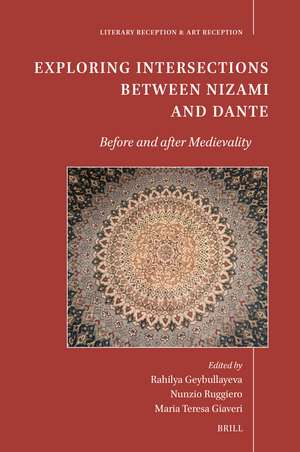
Exploring Intersections between Nizami and Dante: before and after medievality: Literary Reception & Art Reception, cartea 2
Rahilya Geybullayeva, Nunzio Ruggiero, Marina-Teresa Giaverien Limba Engleză Hardback – 9 dec 2025
Preț: 734.90 lei
Preț vechi: 896.21 lei
-18%
Puncte Express: 1102
Carte disponibilă
Livrare economică 30 octombrie-04 noiembrie
Livrare prin curier în România Termenul estimat este afișat lângă disponibilitate.
Transport gratuit pentru acest produs Plată online sau ramburs, în funcție de opțiunile comenzii.
Retur gratuit în 14 zile Comandă securizată și suport în română.
Specificații
ISBN-13: 9789004736924
ISBN-10: 9004736921
Pagini: 530
Dimensiuni: 155 x 235 mm
Greutate: 0.91 kg
Editura: Brill
Colecția Brill
Seria Literary Reception & Art Reception
ISBN-10: 9004736921
Pagini: 530
Dimensiuni: 155 x 235 mm
Greutate: 0.91 kg
Editura: Brill
Colecția Brill
Seria Literary Reception & Art Reception
Notă biografică
Rahilya Geybullayeva is PhD from Lomonosov Moscow State University (1989) and Full Professor at Baku Slavic University. She was a recipient of UNESCO, Carnegie, and Fulbright Fellowships and has been a visiting scholar at SOAS, University of Wisconsin-Madison, UC Berkeley, and Harvard University. Geybullayeva has authored numerous monographs and articles focusing on the intersections of comparative literature, culture, religion, literary historiography, and sociology. Among her recent publications are: chapter "Semiolinguistic look on mythology, cultural history and meanings of places in Azerbaijan" in Transcending Signs (2023) and The Interpretation of Nizami's Cultural Heritage in the Contemporary Period(2020).
Nunzio Ruggiero is Full Professor in Contemporary Italian Literature within the Humanities Department of the Suor Orsola Benincasa University in Naples (UniSOB). He teaches Italian Literature and Literary Criticism, in the Degree Courses in Foreign Languages, Cultural Heritage and Archaeology. His main area of research is the study of the Neapolitan cultural life in the XIX and XX centuries, within an international perspective which underlines the role of Naples as European capital. Among his recent publications: Paesaggio 1922-2022. Cent’anni della legge Croce, ed. by F. Mangone, N. Ruggiero (2022); Una capitale del XIX secolo. La cultura letteraria a Napoli tra Europa e nuova Italia (2020).
Maria Teresa Giaveri has been Professor of Comparative Literature and French Literature at different Italian Universities and at C.N.R.S (Paris). She is a member of the Accademia delle Scienze (Torino) and of the Accademia Peloritana (Palermo, Messina); she is Chevalier des Arts et des Lettres (France), editor of numerous scientific journals, vice-president of Pen Club Italia and of Società Italiana di Traduttologia. Among her books is “Meridiani Mondadori” Colette and Valéry (2000, 2014), the Correspondence Einstein - Valéry (2020) and the best-seller Lady Montagu e il Dragomanno. Viaggio avventuroso alle origini dei vaccini (2021).
Nunzio Ruggiero is Full Professor in Contemporary Italian Literature within the Humanities Department of the Suor Orsola Benincasa University in Naples (UniSOB). He teaches Italian Literature and Literary Criticism, in the Degree Courses in Foreign Languages, Cultural Heritage and Archaeology. His main area of research is the study of the Neapolitan cultural life in the XIX and XX centuries, within an international perspective which underlines the role of Naples as European capital. Among his recent publications: Paesaggio 1922-2022. Cent’anni della legge Croce, ed. by F. Mangone, N. Ruggiero (2022); Una capitale del XIX secolo. La cultura letteraria a Napoli tra Europa e nuova Italia (2020).
Maria Teresa Giaveri has been Professor of Comparative Literature and French Literature at different Italian Universities and at C.N.R.S (Paris). She is a member of the Accademia delle Scienze (Torino) and of the Accademia Peloritana (Palermo, Messina); she is Chevalier des Arts et des Lettres (France), editor of numerous scientific journals, vice-president of Pen Club Italia and of Società Italiana di Traduttologia. Among her books is “Meridiani Mondadori” Colette and Valéry (2000, 2014), the Correspondence Einstein - Valéry (2020) and the best-seller Lady Montagu e il Dragomanno. Viaggio avventuroso alle origini dei vaccini (2021).
Cuprins
Preface
Acknowledgements
List of Figures
1 The Philology and Philosophy Of Love: Before and During Medievality
Rahilya Geybullayeva
2 ‘Love That Moves the Sun and Stars’: Earthly and Divine Love in the Works of Nizami and Dante
Bella Musaeva
3 Love, Death and the Spiritual Quest in the Poetry of Dante and Neẓāmi
Nahid Norozi
4 Dante in the 20th Century: A Title, a Rhythm, a Love Denied
Maria Teresa Giaveri
5 ‘Io dico d’Amore come se fosse una cosa per sé’. The Personification of Love in the Vita Nova
Annarita Placella
6 Anna’s Love: Dante’s Journeys into Akhmatova’s Realm
Fatima Festić
7 The Recognition of the Beloved: Khusraw and Shririn Meet at the Palace
Giorgia Maffioli Brigatti
8 Synergetic Aspects of the Artistic Text Based on Nizami’s Iskandar-Nama
Parvana Isaeva
9 Alexander, the Biological Mutant of Nizami and Islamic Mythology: An Axiological Analysis
Aydin Talibzadeh
10 The Imaginative Pathway from Fire to Rocks: A Phenomenological Analysis of Matter in Nizami and Dante
Carlo Caccia
11 The Water Archetype in Nizami’s Iskandar-Nama and Dante’s Divine Comedy
Elnara Garagyezova
12 The Concept of ‘Soul’ as Interpreted by Nizami Ganjavi and Dante Alighieri
Rafig Novruzov
13 Comparison of Attitudes towards Religious Saints in the Work of Nizami and Dante
Tahira Mammad
14 Cross-Cultural Lines in the Works of Nizami Ganjavi and Dante Alighieri
Azizaga Najafzadeh
15 The Chronotope of the Encounter of Nizāmī’s and Dante’s Walking Heroes: The Strength of Human Reality in the Divine Order
Stefania Sini
16 Eight Stations on the Silk Road of World Literature: From Confucius to Pushkin: Confucius (6th Century BCE)—Firdausi (11th Century)—Nizami (12th Century)—Mevlana (13th Century)—Dante (14th Century)—Shakespeare (16th–17th Century)—Pushkin (19th Century)—Goethe (18th–19th Century)
Teymur Kerimli
17 Mi’raj (the Ascension): A Source of Spiritual Ascension for Nizami and Dante
Nasib Goyushov
18 The Divine Comedy of the Argentine Cultural Élite and the Divine Comedy of the People: From Bartolomeo Mitre to Palacio Barolo
Nicola Bottiglieri
19 Nizami’s Philosophy of History
Hamlet Isakhanli
20 1921: Dante on the Frontier: Notes on the Reception of The Divine Comedy between Italy and the Balkans
Nunzio Ruggiero
21 ‘O Great Father Alighier’: Intertextuality and Dante’s Suggestions during the Eighteenth Century
Carla Forno
22 From Nizami to Y. Vakhtangov: How an Oriental Princess Became a Symbol of the New Russian Theatre of the Twentieth Century
Marina Merkulova
23 ‘Melancholy, Thoughtful Face’: Dante by Henry Wadsworth Longfellow
Vincenzo Salerno
24 Nizami Ganjavi as a Connoisseur of Human Psychology Based on Parables in the Iskandar-Nama
Fidana Musayeva
25 Nizami’s Fairy Tale Language and the Place of Fairy Tales in Psychology Based on the Poem Seven Beauties
Ulkar Yusifova
26 The Heuristic Value of Nizami Ganjavi’s Ideas
Nizami Mammadov
27 Poetry and Theology in Dante and Nezāmi
Carlo Saccone
28 Real Life and the Human Being behind the Divine and Historical Layer in Nizami’s Khamsa and Dante’s Divine Comedy
Rafael Huseynov
29 In Search of Dantean / Religious Moments in Nezami Ganjavi’s ‘Story of Mahan’
Kamran Talattof
30 The Space of Dante’s Divine Comedy in the Semiotics of Yuri Lotman: A View from the 21st Century
Inna Merkulova
31 The Body of Translation: Le Roman de la Rose and the Formalization of the Embodied Experience of the Linguistic Act in the Italian and English Literary Traditions
Alberto Gabriele
Index
Acknowledgements
List of Figures
Part 1 The Concept of Love and Medievality
1 The Philology and Philosophy Of Love: Before and During Medievality
Rahilya Geybullayeva
2 ‘Love That Moves the Sun and Stars’: Earthly and Divine Love in the Works of Nizami and Dante
Bella Musaeva
3 Love, Death and the Spiritual Quest in the Poetry of Dante and Neẓāmi
Nahid Norozi
4 Dante in the 20th Century: A Title, a Rhythm, a Love Denied
Maria Teresa Giaveri
5 ‘Io dico d’Amore come se fosse una cosa per sé’. The Personification of Love in the Vita Nova
Annarita Placella
Part 2 The Semiotics of Love: Between Profane and Sacred
6 Anna’s Love: Dante’s Journeys into Akhmatova’s Realm
Fatima Festić
7 The Recognition of the Beloved: Khusraw and Shririn Meet at the Palace
Giorgia Maffioli Brigatti
8 Synergetic Aspects of the Artistic Text Based on Nizami’s Iskandar-Nama
Parvana Isaeva
Part 3 Semiotics of Archetypes
9 Alexander, the Biological Mutant of Nizami and Islamic Mythology: An Axiological Analysis
Aydin Talibzadeh
10 The Imaginative Pathway from Fire to Rocks: A Phenomenological Analysis of Matter in Nizami and Dante
Carlo Caccia
11 The Water Archetype in Nizami’s Iskandar-Nama and Dante’s Divine Comedy
Elnara Garagyezova
Part 4 Semiotics at the Crossroads of Religions
12 The Concept of ‘Soul’ as Interpreted by Nizami Ganjavi and Dante Alighieri
Rafig Novruzov
13 Comparison of Attitudes towards Religious Saints in the Work of Nizami and Dante
Tahira Mammad
14 Cross-Cultural Lines in the Works of Nizami Ganjavi and Dante Alighieri
Azizaga Najafzadeh
Part 5 Semiotics: Life as a Journey
15 The Chronotope of the Encounter of Nizāmī’s and Dante’s Walking Heroes: The Strength of Human Reality in the Divine Order
Stefania Sini
16 Eight Stations on the Silk Road of World Literature: From Confucius to Pushkin: Confucius (6th Century BCE)—Firdausi (11th Century)—Nizami (12th Century)—Mevlana (13th Century)—Dante (14th Century)—Shakespeare (16th–17th Century)—Pushkin (19th Century)—Goethe (18th–19th Century)
Teymur Kerimli
17 Mi’raj (the Ascension): A Source of Spiritual Ascension for Nizami and Dante
Nasib Goyushov
Part 6 Cultural Legacy and Interpretation
18 The Divine Comedy of the Argentine Cultural Élite and the Divine Comedy of the People: From Bartolomeo Mitre to Palacio Barolo
Nicola Bottiglieri
19 Nizami’s Philosophy of History
Hamlet Isakhanli
20 1921: Dante on the Frontier: Notes on the Reception of The Divine Comedy between Italy and the Balkans
Nunzio Ruggiero
21 ‘O Great Father Alighier’: Intertextuality and Dante’s Suggestions during the Eighteenth Century
Carla Forno
22 From Nizami to Y. Vakhtangov: How an Oriental Princess Became a Symbol of the New Russian Theatre of the Twentieth Century
Marina Merkulova
23 ‘Melancholy, Thoughtful Face’: Dante by Henry Wadsworth Longfellow
Vincenzo Salerno
Part 7 Human Psychology and Spirit
24 Nizami Ganjavi as a Connoisseur of Human Psychology Based on Parables in the Iskandar-Nama
Fidana Musayeva
25 Nizami’s Fairy Tale Language and the Place of Fairy Tales in Psychology Based on the Poem Seven Beauties
Ulkar Yusifova
Part 8 Theology, Allegory and Spirituality in Dante and Nezāmi
26 The Heuristic Value of Nizami Ganjavi’s Ideas
Nizami Mammadov
27 Poetry and Theology in Dante and Nezāmi
Carlo Saccone
28 Real Life and the Human Being behind the Divine and Historical Layer in Nizami’s Khamsa and Dante’s Divine Comedy
Rafael Huseynov
29 In Search of Dantean / Religious Moments in Nezami Ganjavi’s ‘Story of Mahan’
Kamran Talattof
Part 9 Semiotics and Medievality
30 The Space of Dante’s Divine Comedy in the Semiotics of Yuri Lotman: A View from the 21st Century
Inna Merkulova
31 The Body of Translation: Le Roman de la Rose and the Formalization of the Embodied Experience of the Linguistic Act in the Italian and English Literary Traditions
Alberto Gabriele
Index