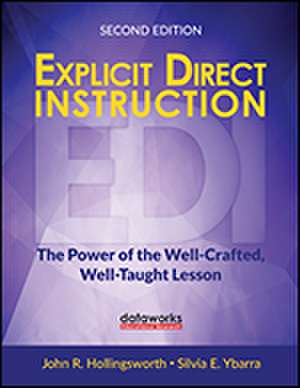
Explicit Direct Instruction (EDI)
Autor John R. Hollingsworth, Silvia E. Ybarraen Limba Engleză Paperback – 29 sep 2017
Adresat cadrelor didactice, proiectanților de curriculum și cercetătorilor în educație, acest volum oferă o metodologie riguroasă pentru optimizarea procesului de predare la clasă. Explicit Direct Instruction (EDI) se fundamentează pe o bază de date masivă, incluzând analiza a peste 2 milioane de teme de la 48.000 de profesori, transformând cercetarea academică într-un instrument de lucru pragmatic. Considerăm că forța acestei lucrări rezidă în capacitatea de a demonta mitul conform căruia instruirea directă este un proces rigid sau bazat pe dictare, propunând în schimb un model dinamic de interacțiune. Structura celei de-a doua ediții este concepută pentru a ghida cititorul de la fundamentul teoretic — cercetări asupra creierului și teorii educaționale — către aplicabilitatea imediată. Putem observa în cuprins o progresie logică: de la definirea obiectivelor lecției și activarea cunoștințelor anterioare, până la dezvoltarea conceptelor și practica ghidată. Cititorii familiarizați cu Direct Instruction: A practitioner's handbook de Kurt Engelmann vor aprecia în acest volum accentul pus pe designul specific al lecției și pe utilizarea datelor empirice recente pentru a valida succesul la clasă. În contextul operei autorilor, lucrarea extinde viziunea începută în Multiple Measures, unde John R. Hollingsworth analiza datele de ieșire (scorurile la teste). Aici, accentul se mută pe datele de intrare: practicile pedagogice concrete care permit fiecărui elev să stăpânească materia de nivelul clasei în fiecare zi. Tonul este unul direct și aplicat, oferind soluții pentru sălile de clasă diverse și incluzive, fără a recurge la un limbaj excesiv de abstract.
Preț: 199.52 lei
Carte disponibilă
Livrare economică 29 octombrie-12 noiembrie
Livrare express 14-20 octombrie pentru 127.41 lei
Specificații
ISBN-10: 1506337511
Pagini: 250
Dimensiuni: 216 x 280 x 14 mm
Greutate: 0.7 kg
Ediția:2. Auflage
Editura: Corwin
Locul publicării:Thousand Oaks, United States
V-ar putea interesa
-
 The Parallel Curriculum in the Classroom, Book 1Carol Ann TomlinsonPreț: 313.03 lei
 -
 Navigating the National Board Certification ProcessMartha H. HopkinsPreț: 250.94 lei
 -
 Multiple MeasuresJoan ArdovinoPreț: 174.83 lei
 -
 When a Crisis HitsRobert H. DeckerPreț: 286.41 lei
 -
 The Process-Centered SchoolArthur L. CostaPreț: 320.63 lei
 -
 Teaching With Heart: Making Healthy Connections With StudentsJudith A. DeiroPreț: 257.31 lei
 -
 Practical School SecurityKenneth S. TrumpPreț: 174.83 lei
 -
 LEARNING FOR LIFERonald J. AregladoPreț: 225.59 lei
 -
 The Power of StorytellingHarriet MasonPreț: 193.34 lei
 -
 Preț: 90.00 lei
 -
 -18%Preț: 1259.74 lei1536.27 lei
 -
 -15%Preț: 625.83 lei736.26 lei
 -
 Preț: 256.14 lei
 -
 Working With Parents of Bullies and VictimsJr. Walter B. RobertsPreț: 233.03 lei
 -
 Explicit Direct Instruction for English LearnersJohn R. HollingsworthPreț: 277.97 lei
 -
 -25%Preț: 177.96 lei238.16 lei
 -
 Brainball: Teaching Inquiry Theater as a Team SportMickey Kolis-26%Preț: 176.91 lei237.48 lei
 -
 Preț: 116.58 lei
 -
 Intertwining ChoicesCleresse SpraguePreț: 62.75 lei
 -
 Mr. Clark's Big BandMeredith O'BrienPreț: 102.70 lei
 -
 As A LeaderDennis BrennanPreț: 67.12 lei
 -
 Preț: 80.64 lei
 -
 Educación y capacidades : hacia un nuevo enfoque del desarrollo humanoJosé Antonio . . . [et al. Ibáñez-Martín MelladoPreț: 285.33 lei
De ce să citești această carte
Această carte este esențială pentru practicienii care doresc să treacă de la intuiție la o pedagogie bazată pe dovezi. Cititorul câștigă un set clar de pași pentru a construi lecții eficiente, asigurându-se că niciun elev nu rămâne în urmă. Este o resursă valoroasă deoarece oferă modele de lecții gata de utilizat, validate de milioane de puncte de date, facilitând succesul academic în orice context educațional.
Despre autor
John R. Hollingsworth este președintele DataWORKS Educational Research, o organizație dedicată îmbunătățirii rezultatelor elevilor prin analiza riguroasă a datelor. De-a lungul carierei sale, acesta a făcut tranziția de la analiza statistică a scorurilor la teste către cercetarea practicilor pedagogice din sala de clasă. Este un cercetător activ și formator care petrece o mare parte din timp instruind profesori în teren. Împreună cu Silvia E. Ybarra, a dezvoltat modelul EDI, aplicând principii din neuroștiințe și teoria învățării pentru a crea ghiduri practice de predare, publicând numeroase articole de specialitate în domeniul educației.
Descriere scurtă
Recenzii
"Before EDI, our school was a ship adrift at sea with everyone rowing in different directions. EDI has provided us with a framework for instruction and a common language that allowed us to all row in the same direction. By doing so, we exited program improvement within the first two years of implementation, after having been in sanctions for the previous ten years. Additionally, using the framework and common language of EDI we were named a 2015 honor roll school by the Educational Results Partnership."
"Gansevoort was one of the first schools in our district to get off the focus list. I attribute a lot of that to the EDI strategies."
“Once teachers experienced EDI, they saw the value. Many teachers have told me they can’t remember how they taught before.”
“EDI makes students accountable. They see now that school is a place to work and learn and play, and they love it. Because even though it is hard, they are doing well.”
“Fast-paced, interactive, and highly useful! Thanks!”
“This was so practical, informative, and inspiring! I loved the modeling and being able to see how to do this kind of teaching. So much to love!”
“Thank you for giving us real strategies that I can take to my classroom and use right away!”
“EDI keeps students engaged throughout the lesson! It gives students the opportunity to speak and listen to each other during the lesson. Students discuss vocabulary and read aloud during EDI which gives them practice in Reading, Speaking, Listening, and Writing. Students do all the work during a lesson! Pair-Share is a great strategy to help English Learners with speaking and practicing the vocabulary!”
“EDI training has helped our teachers develop lessons that are more rigorous and engaging for our English Language Learners.”
“One of our specialties is research on instruction and training. In both K-12 education and in higher education, we find that the features of the DataWORKS program fit all of the research that we think is the best evidence right now. You owe it to yourself and to your students to at least give it a try.”
"I would like all teachers in our district to be exposed to DataWORKS. Only then will there be systemic change for our students."
“Students in an EDI classroom share the teaching responsibilities. They eagerly participate during Pair-Share and remind the teacher if s/he has forgotten "their time." It is a very non-threatening environment and students are prepared for success.”
“EDI totally transformed my teaching of both children and adults. It is research-based, easy to use, and rewarding for both the teacher and the students. Most importantly, it works!"
“EDI is a difference maker for all students. High achievers are given the opportunity to explore the curriculum in depth and at the highest level. Challenged students are provided scaffolds and support so they can access what is being taught.”
“EDI and the DataWORKS model of school improvement made a dramatic impact on classroom instruction in the schools of South Carolina. The delivery of instruction using this program provided clarity and a focus in addressing state standards and the learning environment in classrooms.”
“What is the best way to teach students? The answer is Explicit Direct Instruction. I am a retired principal, director, and adjunct professor in California. I have been using the model of EDI published by DataWORKS for the past 10 years. I have taught it to teachers and future administrators. I have also used it in teaching my own adult students.”
Cuprins
Acknowledgments
About the Authors
Chapter 1. Students Say, “I Can Do It!”
The Day I Saw the Breakthrough in Classroom Instruction
Where Our Research Began: Student Achievement
Where Our Research Led: Classroom Instruction
Chapter 2. Are Some Approaches Better Than Others? What Is Effective Instruction?
Why Are Children Sent to School? Talent Discovery Versus Talent Development
The Teaching/Learning Dilemma: Speed Up or Slow Down
Criteria for an Instructional Approach
Two Philosophies About Education
High-Stakes Testing
What to Do?
EDI Is Not Lecturing
EDI Is Not Scripted
Research Supports Direct Instruction
When to Use Group Work
Chapter 3. Good Instruction Is Always Good Instruction: An Explicit Direct Instruction Overview
What Is Explicit Direct Instruction?
Explicit Direct Instruction Lesson Design
Explicit Direct Instruction Lesson Delivery
How to Use EDI in Your Classroom
Chapter 4. Creating Engaged Students: Use Engagement Norms!
Student Engagement Is Created When You Ask Your Students to Do Something
History of Student Engagement Norms
Student Engagement Norm 1: Pronounce With Me
Student Engagement Norm 2: Track With Me
Student Engagement Norm 3: Read With Me
Student Engagement Norm 4: Gesture With Me
Student Engagement Norm 5: Pair-Share
Student Engagement Norm 6: Attention Signal
Student Engagement Norm 7: Whiteboards
Student Engagement Norm 8: Use Complete Sentences (Public Voice, Academic Vocabulary)
Training Students in the Engagement Norms
Summary
Chapter 5. Is Everyone Learning? Checking for Understanding
What Is Checking for Understanding?
TAPPLE—Checking for Understanding the EDI Way!
Teach First
Ask a Specific Question
Pair-Share
Pick a Non-Volunteer
Listen Carefully to the Response
Effective Feedback
Summary
Chapter 6. Everyone Learns: Corrective Feedback and Whiteboards
Listen Carefully to the Response
Effective Feedback
Whiteboards, the Best Way to CFU!
Summary
Chapter 7. Establishing What Is Going to Be Taught: Learning Objective
Part I: Well-Designed Learning Objectives
Part II: Writing Standards-Based Learning Objectives
Part III: The Learning Objective Must Be Presented to the Students
Summary
Chapter 8. Connecting to What Students Already Know: Activating Prior Knowledge
Part I: What Does It Mean to Activate Prior Knowledge?
Part II: How to Activate Prior Knowledge
Summary
Chapter 9. These Are the Big Ideas: Concept Development
Part I: Concept Development Design
Part II: Concept Development Delivery
Summary
Chapter 10. I’ll Work a Problem First: Rule of Two— Skill Development and Guided Practice
Skill Development (Teacher)
Guided Practice (Students)
How to Design Skill Development and Guided Practice
How to Teach Skill Development/Guided Practice
Summary
Chapter 11. This Is Important to Learn: Relevance
Relevance
When Do You Teach Lesson Relevance?
How Do You Provide Lesson Relevance?
How to Design Lesson Relevance
How to Teach Lesson Relevance
Summary
Chapter 12. Making One Final Check: Closing the Lesson
Closing the Lesson
How to Provide Lesson Closure
When Closure Is Complete, Initiate Independent Practice
Chapter 13. Planning for Success: Differentiation and Scaffolding
Differentiating and Scaffolding to Increase Student Success
In-Class Interventions and Out-of-Class Interventions
Response to Intervention (RTI) and EDI
Summary
Chapter 14. Having Students Work by Themselves: Independent Practice and Periodic Review
Starting With the End in Mind: The Independent Practice Must Match the Lesson
Periodic Review
Summary
Chapter 15. Creating Well-Crafted Lessons: Putting It All Together
Creating EDI Lessons From a Textbook
Creating Your Own EDI Lessons
DataWORKS Enters the Classroom to Teach
Chapter 16. Looking at All the Components: Analyzing a Sample Lesson
Use educeri.com for EDI Lessons
EDI Lesson Layout
Summary
Resources: What the Research Says
References
Index