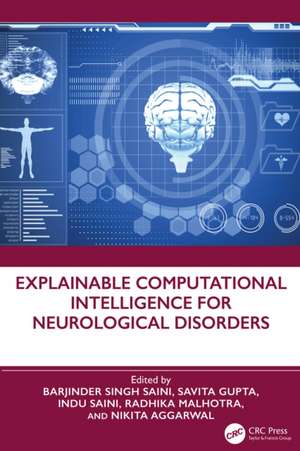
Explainable Computational Intelligence for Neurological Disorders
Editat de Barjinder Singh Saini, Savita Gupta, Indu Saini, Radhika Malhotra, Nikita Aggarwalen Limba Engleză Hardback – 22 ian 2027
This book:
- Offers a detailed perspective on explainable AI-based systems for neurological diagnosis, and clinical decision support.
- Discusses key physiological and neural biomarkers, including heart rate variability, skin conductance, entropy analytics, ECG, and EEG signals.
- Includes recent AI model designs from wearable sensor analytics and brain connectivity for assistive systems.
- Includes machine learning approaches for conditions such as Alzheimer’s, epilepsy (seizure prediction and surgery outcomes), and other neurological disorders.
- Explores translational technologies and therapies, for different neuro disorders, along with multi-modal AI insights for early tumor detection.
Preț: 929.17 lei
Preț vechi: 1213.07 lei
-23% Precomandă
Puncte Express: 1394
Carte nepublicată încă
Livrare prin curier în România Precomanda se expediază când titlul devine disponibil.
Transport gratuit pentru acest produs Plată online sau ramburs, în funcție de opțiunile comenzii.
Retur gratuit în 14 zile Comandă securizată și suport în română.
Doresc să fiu notificat când acest titlu va fi disponibil:
Se trimite...
Specificații
ISBN-13: 9781041074236
ISBN-10: 1041074239
Pagini: 328
Ilustrații: 136
Dimensiuni: 156 x 234 mm
Ediția:1
Editura: CRC Press
Colecția CRC Press
ISBN-10: 1041074239
Pagini: 328
Ilustrații: 136
Dimensiuni: 156 x 234 mm
Ediția:1
Editura: CRC Press
Colecția CRC Press
Public țintă
Academic, Postgraduate, and Undergraduate AdvancedCuprins
1. Artificial Intelligence in Medical-based Systems for Neurological Disorders. 2. A Review on Autonomic Biomarkers in Health and Neurological Disorders: Heart Rate Variability, Skin Conductance, and Entropy-Based Analysis. 3. Advanced Computational Techniques for Neurological Disorder Screening through Wearable Sensor-Based Human Activity Recognition. 4. Sleep Apnea Disorder Detection using Wearable Sensors. 5. An Integrated Study of Biomarkers, Diagnostics and Therapeutic Approaches for Alzheimer’s Disease. 6. Designing Hybrid Models for Neuro-Disease Classification. 7. Interpretability and Explainability of Machine Learning and Deep Learning Models in ECG Disease Detection. 8. Advanced Computational Analysis of Brain Connectivity Using EEG data. 9. Feature Engineering and Machine Learning Approaches for EEG Based Imagined Speech Recognition. 10. Machine Learning Based Huntington’s Disease Detection. 11. Clinically Meaningful Epileptic Seizure Prediction Using iEEG Features and Random Forest. 12. Intracranial EEG analysis for predicting Surgery Outcomes of Drug-Resistant Epilepsy subjects using Machine Learning. 13. Explainable Hybrid CNN–Transformer Framework for Dynamic Word-Level Indian Sign Language Recognition in Neurological Disorder Communication Assistance Systems. 14. Framework for Design and Evaluation of Virtual Reality based Interventions for Improving Vocational Skills in Individuals with Autism Spectrum Disorder. 15. Stem Cells in Neurology: Advancing Regenerative Therapies for Neurodegenerative Disorders. 16. Integrating Multi-Modal Biomarkers for the Early Detection of Pancreatic Ductal Adenocarcinoma: A Comprehensive Review.
Notă biografică
Barjinder Singh Saini is a professor in the Electronics and Communication department at Dr B. R. Ambedkar National Institute of Technology, Jalandhar, India, with 24 years of academic experience. He received his M.Tech. degree in the Department of Electronics and Communication Engineering from REC, Kurukshetra, and a Ph.D. in Electronics and Communication Engineering from Dr B. R. Ambedkar National Institute of Technology, Jalandhar. His research interests include Signal and Image processing, Medical Image Analysis, Microprocessors, and Microcontrollers. He has contributed more than 100 research papers in reputed journals, and more than 200 conference articles are there to his credit.
Savita Gupta is a Professor in the Department of Computer Science and Engineering, University Institute of Engineering and Technology (UIET), Panjab University. She received her M.E. degree from Thapar University and a Ph.D. in Computer Science and Engineering from Punjab Technical University, Jalandhar. She passionately performs her research activities in Signal and Image Processing, Medical Image Analysis, Wavelets Signal and Image processing, Artificial Intelligence, and Cognitive neuroscience. Her contributions to speckle noise reduction in ultrasound images are widely acknowledged in biomedical engineering. She has contributed more than 200 research papers in reputed journals, and more than 400 conference articles are there to her credit.
Indu Saini received her Bachelor of Technology degree in Electronics and Communication Engineering from Guru Nanak Dev University Amritsar and her master’s in technology and PhD from NIT Jalandhar. She works as an Associate Professor in the Department of Electronics and Communication Engineering at NIT Jalandhar. She has received sponsored projects from MeitY and MHRD, New Delhi. She was also awarded the Distinguished Woman in Engineering award from the Centre for Advanced Research and Design (CARD) of Venus International Foundation and the Bharat Excellence Award by FFI, India, in 2019. She has been credited with 02 granted and 02 filed patents. Her research interests include Biomedical Signal and Image Processing, Machine Learning Algorithms, and VLSI Design. She is also a Co-founder of a Start-Up named INS Technology Private Limited.
Radhika Malhotra is currently associated with the Department of Electronics and Communication Engineering at Punjab Engineering College, Chandigarh, India. She did her Bachelor of Technology degree in Electronics and Communication Engineering and Master of Technology in Microelectronics and VLSI Design. She has one and a half years of research experience and worked as a Research Associate at IIT Ropar. Her research interests include biomedical image processing, artificial intelligence, classification, prognosis, and survival prediction of neurodevelopmental disorders.
Nikita Aggarwal works in the Biomedical Lab of the Department of Electronics and Communication Engineering at Dr B R Ambedkar National Institute of Technology, Jalandhar, India. In 2012, she received a Bachelor of Technology degree in Electronics and Communication Engineering from Punjab Technical University, Jalandhar, and completed her master’s in engineering from the National Institute of Technical Teachers Training & Research (NITTTR), Panjab University, Chandigarh. She has more than five years of experience in teaching and research. Her research interests include biomedical image processing, artificial intelligence, Remote sensing, and early diagnosis of neurodevelopmental disorders.
Karan Veer received his Ph.D. in Electrical and Instrumentation Engineering from Thapar University, Patiala, India, in 2015. He was awarded the Dr. D. S. Kothari Postdoctoral Fellowship (UGC) in 2016 and a Research Associateship (ICMR) in 2018. He has over ten years of teaching and research experience in biomedical instrumentation and has published more than 90 SCI-indexed research articles, along with two research books and six book chapters. He has been recognized among the top 2% scientists worldwide by Stanford University and Elsevier for 2023–2024 and 2024–2025. Currently, he is an Assistant Professor in the Department of Instrumentation and Control Engineering at Dr. B. R. Ambedkar National Institute of Technology (NIT), Jalandhar, India. His research interests include biomedical instrumentation, healthcare analytics, rehabilitation engineering, and Ayurveda-based biomedical applications.
Savita Gupta is a Professor in the Department of Computer Science and Engineering, University Institute of Engineering and Technology (UIET), Panjab University. She received her M.E. degree from Thapar University and a Ph.D. in Computer Science and Engineering from Punjab Technical University, Jalandhar. She passionately performs her research activities in Signal and Image Processing, Medical Image Analysis, Wavelets Signal and Image processing, Artificial Intelligence, and Cognitive neuroscience. Her contributions to speckle noise reduction in ultrasound images are widely acknowledged in biomedical engineering. She has contributed more than 200 research papers in reputed journals, and more than 400 conference articles are there to her credit.
Indu Saini received her Bachelor of Technology degree in Electronics and Communication Engineering from Guru Nanak Dev University Amritsar and her master’s in technology and PhD from NIT Jalandhar. She works as an Associate Professor in the Department of Electronics and Communication Engineering at NIT Jalandhar. She has received sponsored projects from MeitY and MHRD, New Delhi. She was also awarded the Distinguished Woman in Engineering award from the Centre for Advanced Research and Design (CARD) of Venus International Foundation and the Bharat Excellence Award by FFI, India, in 2019. She has been credited with 02 granted and 02 filed patents. Her research interests include Biomedical Signal and Image Processing, Machine Learning Algorithms, and VLSI Design. She is also a Co-founder of a Start-Up named INS Technology Private Limited.
Radhika Malhotra is currently associated with the Department of Electronics and Communication Engineering at Punjab Engineering College, Chandigarh, India. She did her Bachelor of Technology degree in Electronics and Communication Engineering and Master of Technology in Microelectronics and VLSI Design. She has one and a half years of research experience and worked as a Research Associate at IIT Ropar. Her research interests include biomedical image processing, artificial intelligence, classification, prognosis, and survival prediction of neurodevelopmental disorders.
Nikita Aggarwal works in the Biomedical Lab of the Department of Electronics and Communication Engineering at Dr B R Ambedkar National Institute of Technology, Jalandhar, India. In 2012, she received a Bachelor of Technology degree in Electronics and Communication Engineering from Punjab Technical University, Jalandhar, and completed her master’s in engineering from the National Institute of Technical Teachers Training & Research (NITTTR), Panjab University, Chandigarh. She has more than five years of experience in teaching and research. Her research interests include biomedical image processing, artificial intelligence, Remote sensing, and early diagnosis of neurodevelopmental disorders.
Karan Veer received his Ph.D. in Electrical and Instrumentation Engineering from Thapar University, Patiala, India, in 2015. He was awarded the Dr. D. S. Kothari Postdoctoral Fellowship (UGC) in 2016 and a Research Associateship (ICMR) in 2018. He has over ten years of teaching and research experience in biomedical instrumentation and has published more than 90 SCI-indexed research articles, along with two research books and six book chapters. He has been recognized among the top 2% scientists worldwide by Stanford University and Elsevier for 2023–2024 and 2024–2025. Currently, he is an Assistant Professor in the Department of Instrumentation and Control Engineering at Dr. B. R. Ambedkar National Institute of Technology (NIT), Jalandhar, India. His research interests include biomedical instrumentation, healthcare analytics, rehabilitation engineering, and Ayurveda-based biomedical applications.
Descriere
This book brings together recent advances in neuro-focused AI systems, biomedical signal interpretation, multi-modal analytics and explainable AI.