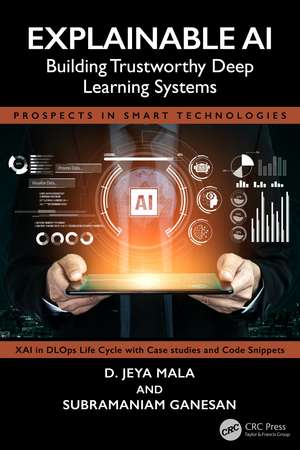
Explainable AI: Building Trustworthy Deep Learning Systems: Prospects in Smart Technologies
Autor D. Jeya Mala, Subramaniam Ganesanen Limba Engleză Hardback – 28 oct 2026
Explainable AI: Building Trustworthy Deep Learning Systems focuses on how to incorporate XAI methods, tools, and techniques to clarify Machine Learning decisions. It explores applications in fields such as healthcare, defense, human activity recognition, and object identification. The book offers practical advice on embedding XAI tools throughout the lifecycle of Deep Learning systems, covering topics such as Explainability and Interpretability, Deep Learning Operations (DLOps), and Machine Learning Operations (MLOps). It also includes real-world examples, challenges, and solutions.
Researchers working in the area of Trustworthy AI, Responsible AI, and Explainable AI can use this book as a primary source as it contains code implementations with metrics calculations in detail. Moreover, professionals in IT indsutries applying AI in software development such as DevOps and Deep Learning architecture development with XAI integrations in systems engineering and industrial engineering will find it a highly valuable development guide.
For those adopting the textbook for courses PowerPoint slides are available.



Preț: 819.99 lei
Preț vechi: 999.99 lei
-18% Precomandă
Puncte Express: 1230
Carte nepublicată încă
Livrare prin curier în România Precomanda se expediază când titlul devine disponibil.
Transport gratuit pentru acest produs Plată online sau ramburs, în funcție de opțiunile comenzii.
Retur gratuit în 14 zile Comandă securizată și suport în română.
Doresc să fiu notificat când acest titlu va fi disponibil:
Se trimite...
Specificații
ISBN-13: 9781041046875
ISBN-10: 1041046871
Pagini: 200
Ilustrații: 148
Dimensiuni: 156 x 234 mm
Greutate: 0.53 kg
Ediția:1
Editura: CRC Press
Colecția CRC Press
Seria Prospects in Smart Technologies
ISBN-10: 1041046871
Pagini: 200
Ilustrații: 148
Dimensiuni: 156 x 234 mm
Greutate: 0.53 kg
Ediția:1
Editura: CRC Press
Colecția CRC Press
Seria Prospects in Smart Technologies
Public țintă
Professional Training and Undergraduate AdvancedCuprins
Part I: Foundations on XAI. 1. Introduction to XAI Taxonomy, Ethics and Policy. 2. XAI Techniques and Models. 3. Intrinsically Interpretable Models. 4. Posthoc Explainability Part II: Integration of XAI into DLOps. 5. DLOps: Introduction to XAI in DL Model Development. 6. XAI in Model Training. 7. XAI in Model Validation. 8. XAI Integration in CI/CD. 9. XAI in DL Model Deployment, Monitoring Part III: Emerging Trends in XAI. 10. Integrating XAI in Agentic AI Architecture. 11. Interplay of XAI withGenAI.
Notă biografică
Dr. D. Jeya Mala is currently a professor in the School of Computer Science and Engineering (SCOPE), Vellore
Institute of Technology, Chennai, Tamil Nadu, India. She has more than 24 years of teaching and research
experience and 4 years of industrial experience. As a member of the “National Work Group on Quantum
Computing” formed by the Telecommunications Department, Government of India, she contributed to
India’s proposal on Quantum Computing for Future Networks at the Geneva Meet, Switzerland. She served
as an expert evaluation committee member of AICTENEAT, Government of India, and MoE’s Innovation
Council, Government of India. To her research credit, she has one granted design patent, three published utility patents from IP, Government of India, one completed funded research project, 4 books, and more than 65 papers published in reputed refereed SCI- and Scopus-indexed journals, conferences, and book chapters. She is
currently working on a funded quantum-based collaborative research project with Deakin University, Australia. She is a listee of Who’s Who list of SEBASE repository of University College London, UK, for her research work in the area of searchbased software engineering and a proud recipient of several laurels and awards, and member of IEEE, ACM, etc. Her research interests include artificial intelligence, quantum computing, DL and ML, XAI, healthcare analytics, software engineering, cybersecurity, and blockchain.
Dr. Subramaniam Ganesan, a professor in the Department of Electrical & Computer Engineering (ECE), Oakland University, Rochester, Michigan, USA. He is a senior member of IEEE, former IEEE Computer
Society Distinguished Visiting Speaker, IEEE Region for 4 Technical Activities member, and fellow of ISPE.
He has received the Lifetime Achievement Award from ISAM, the Lloyd L. Withrow Distinguished Speaker
Award from SAE, the Best Paper Award from ISAM, the Best Teacher Award from ASEE, and similar accolades from Oakland University. He is the editor-in-chief of the International Journal of Embedded Systems & Computer Engineering, as well as the International Journal of Sensors & Applications. He has been the session organizer of the “Systems Engineering” panel at the SAE World Congress for the past 15 years. More details can be viewed on the home page at: www.secs.oakland.edu/~ganesan. His research interests are in real-time systems, parallel architectures, mobile computing, automotive embedded systems, and signal processing. He holds several patents in embedded systems.
systems.Computing, Automotive Embedded Systems, and Signal Processing.
Institute of Technology, Chennai, Tamil Nadu, India. She has more than 24 years of teaching and research
experience and 4 years of industrial experience. As a member of the “National Work Group on Quantum
Computing” formed by the Telecommunications Department, Government of India, she contributed to
India’s proposal on Quantum Computing for Future Networks at the Geneva Meet, Switzerland. She served
as an expert evaluation committee member of AICTENEAT, Government of India, and MoE’s Innovation
Council, Government of India. To her research credit, she has one granted design patent, three published utility patents from IP, Government of India, one completed funded research project, 4 books, and more than 65 papers published in reputed refereed SCI- and Scopus-indexed journals, conferences, and book chapters. She is
currently working on a funded quantum-based collaborative research project with Deakin University, Australia. She is a listee of Who’s Who list of SEBASE repository of University College London, UK, for her research work in the area of searchbased software engineering and a proud recipient of several laurels and awards, and member of IEEE, ACM, etc. Her research interests include artificial intelligence, quantum computing, DL and ML, XAI, healthcare analytics, software engineering, cybersecurity, and blockchain.
Dr. Subramaniam Ganesan, a professor in the Department of Electrical & Computer Engineering (ECE), Oakland University, Rochester, Michigan, USA. He is a senior member of IEEE, former IEEE Computer
Society Distinguished Visiting Speaker, IEEE Region for 4 Technical Activities member, and fellow of ISPE.
He has received the Lifetime Achievement Award from ISAM, the Lloyd L. Withrow Distinguished Speaker
Award from SAE, the Best Paper Award from ISAM, the Best Teacher Award from ASEE, and similar accolades from Oakland University. He is the editor-in-chief of the International Journal of Embedded Systems & Computer Engineering, as well as the International Journal of Sensors & Applications. He has been the session organizer of the “Systems Engineering” panel at the SAE World Congress for the past 15 years. More details can be viewed on the home page at: www.secs.oakland.edu/~ganesan. His research interests are in real-time systems, parallel architectures, mobile computing, automotive embedded systems, and signal processing. He holds several patents in embedded systems.
systems.Computing, Automotive Embedded Systems, and Signal Processing.
Descriere
With the increasing use of deep learning systems across various industries, there is a need to make their decision-making processes more understandable and transparent. The textbook addresses these needs by providing a detailed guide on integrating XAI into the DLOps pipeline, so organizations can implement CI and CD practices effectively.